

For anyone asking, "Can you practice law without a law degree?", the short answer is almost always no. State bars strictly regulate who may practice law, and earning a law degree remains the primary way to qualify for a license to practice.
However, a related question has a more nuanced answer: "Do you have to go to law school to take the bar?" In a handful of states, very limited alternative paths exist. They do not eliminate the requirement for bar admission and are not practical for most people.
Bar Admission Requires a License, Not Just Knowledge
Practicing law is defined by specific activities protected by state bar associations such as giving legal advice, representing clients, preparing legal documents, and appearing in court. Simply knowing the law is not enough. You must be licensed. Unauthorized practice of law (UPL) carries severe penalties.
As a result, while exceptions exist, they apply only in specific jurisdictions and should not be viewed as a general alternative to attending law school.
States That Allow Bar Eligibility Without Law School
Only 4 states (CA, VT, VA, WA) allow individuals to pursue bar eligibility without attending an accredited law school. These states offer a Law Office Study or legal apprenticeship pathway, which requires studying under the direct supervision of a licensed attorney or judge while completing structured legal work over several years.
This option is highly regulated, state-specific, and not transferable. Requirements vary by jurisdiction, and participation does not guarantee passing the bar or long-term career mobility. It is not a shortcut to becoming an attorney, only a limited alternative recognized in a few states.
Because eligibility is limited and outcomes vary widely, this path is appropriate only for a small number of candidates willing to accept higher risk and reduced portability.
How Legal Apprenticeship and Law Office Study Programs Work
Legal apprenticeship programs require candidates to study under the supervision of a licensed attorney or judge for several years. This typically involves full-time or near full-time legal work, structured study schedules, regular progress reports to the state bar, and strict documentation requirements. Unlike law school, these programs lack standardized curricula and institutional academic support, placing greater responsibility on the apprentice.
The Law Office Study Program vs. Traditional Law School
The law office study program and traditional law school differ in structure, risk, and long-term career outcomes. Although both may lead to bar eligibility in limited cases, they are not treated equally by state bars or legal employers.
It is also important not to confuse law office study programs with unaccredited law schools. Attending an unaccredited institution may limit—or completely eliminate—bar eligibility, depending on the state, and can significantly reduce long-term career options.
Why Most Aspiring Attorneys Still Choose Law School
Because nontraditional paths to bar eligibility are limited, state-specific, and often restrict long-term mobility, most aspiring attorneys continue to choose law school as the most predictable and widely accepted route to licensure.
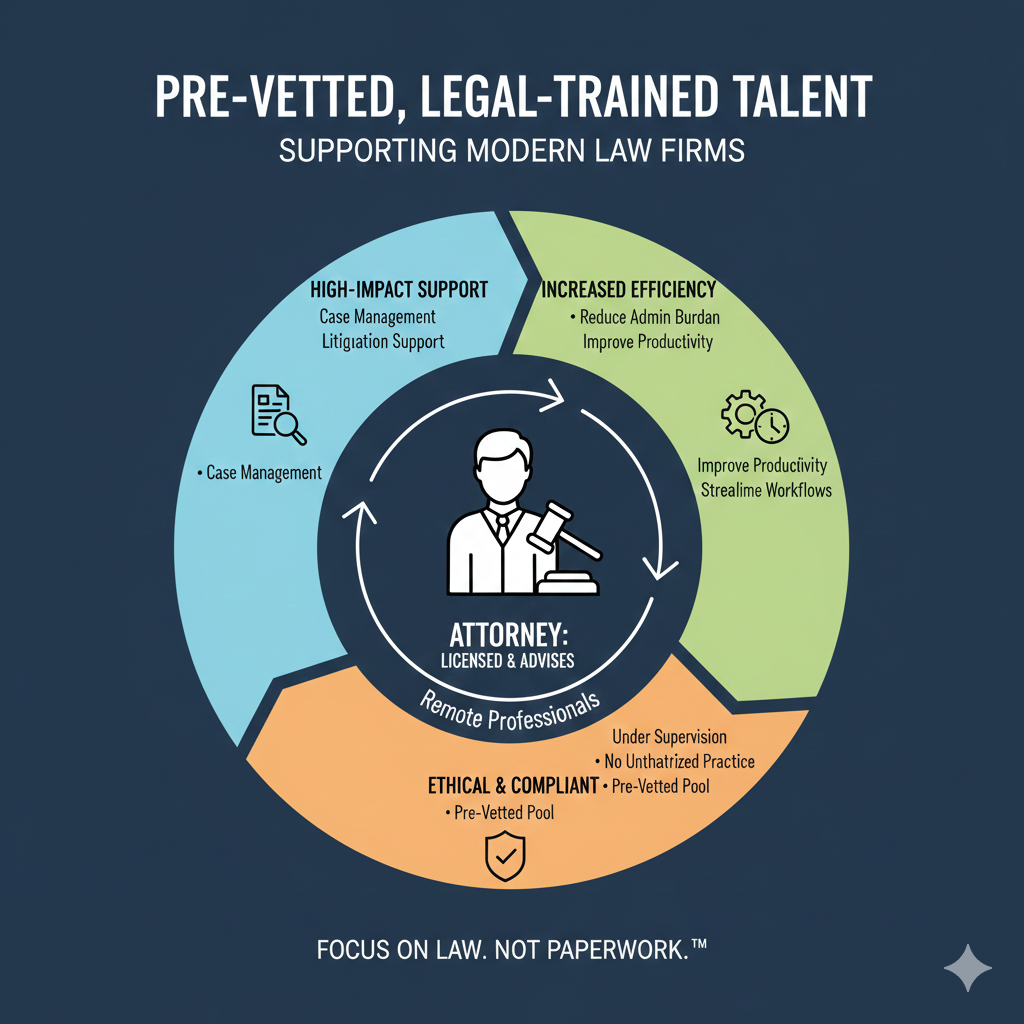
Pre-Vetted, Legal-Trained Talent Supporting Modern Law Firms
While practicing law requires bar licensure, modern law firms depend on legal-trained professionals to support attorneys in compliant, high-impact ways. These professionals work under attorney supervision, helping firms manage cases efficiently without engaging in the unauthorized practice of law.
Remote Attorneys connect firms with a pre-vetted pool of U.S. law–experienced legal professionals skilled in case management, litigation support, document review, and legal operations. By integrating qualified support talent, firms can reduce administrative burden, improve productivity, and keep attorneys focused on higher-value legal work—while maintaining strict ethical and regulatory compliance.
Why Firms Prioritize Pre-Vetted, Legal-Trained Talent
Reduce Risk While Maintaining Compliance
Law firms prioritize pre-vetted, legal-trained professionals because they provide dependable support without increasing compliance risk. These professionals work under attorney supervision, understand the limits of their role, and fit easily into existing firm workflows.
Skills That Support Attorneys, Not Replace Them
Firms value remote legal talent with a strong understanding of U.S. legal procedures, clear communication skills, and the ability to follow direction and escalation protocols. Experience with legal research, drafting support, and common legal technology allows remote professionals to contribute quickly with minimal onboarding.
Increase Efficiency Without Adding Overhead
By partnering with pre-vetted legal professionals who meet these standards, firms reduce administrative workload, improve efficiency, and allow licensed attorneys to focus on higher-value legal work—while maintaining ethical and regulatory compliance.
FAQ's
Can you practice law without a law degree in the United States?
No. Practicing law in the U.S. requires bar admission, and a law degree is the standard requirement to qualify for a bar license.
Do you have to go to law school to take the bar exam?
In most states, yes. Law school graduation is required for bar exam eligibility, though a few states allow limited alternatives like legal apprenticeships.
Can anyone take the bar exam without a law degree?
No. Bar exam eligibility depends on state rules. Only a few states allow non–law school paths, and strict education and supervision requirements apply.
Is a law office study program easier than law school?
Not usually. Law office study programs require years of supervised legal work, have lower bar pass rates, and often limit career mobility.
What legal jobs can you do without a law degree?
Many law firms hire legal-trained professionals for roles like case management, litigation support, and document review without practicing law.