

You built your solo practice for freedom. But as caseloads grow, that freedom starts to shrink.
Most solo practitioners face the same wall: more clients mean more work, but hiring a full-time associate means fixed costs, management overhead, and risk. It feels like growth and sustainability can't coexist.
That's where a contract attorney for solo practitioners changes everything. A contract attorney gives you dedicated, full-time legal support billed monthly on a flexible month-to-month basis without adding permanent headcount to your payroll.
This guide explains how a contract attorney for solo practitioners works, when to bring one in, and how to do it without adding fixed overhead.
Key Takeaways
- A solo practitioner is a licensed attorney who runs their own law firm with no partners, associates, or built-in support staff.
- Contract attorneys provide dedicated, full-time legal support billed monthly on a flexible month-to-month basis giving you consistent capacity without long-term employment contracts or in-house overhead.
- The most common trigger points for hiring contract support: case surge, overflow litigation work, contract disputes, and specialized practice areas.
- A business contract attorney handles commercial agreements, NDAs, vendor contracts, and partnership disputes that solo practitioners increasingly face from business clients.
- Integration takes 5 steps: define scope, brief the attorney, set communication protocols, supervise outputs, and scale as needed.
What Is a Solo Practitioner and Why Scaling Feels Impossible
A solo practitioner is a licensed attorney who operates an independent law firm no partners, no associates, no built-in support staff. According to the American Bar Association, nearly 49% of lawyers in private practice work solo. That's a massive portion of the legal market operating without institutional backup.
Unlike BigLaw or mid-size firms, solo practitioners carry full autonomy but they also absorb 100% of the operational weight. According to Attorney at Work, many solo lawyers operate with no support staff at all meaning client calls, filing deadlines, and late-night briefs all land on one desk with no one to share the load.
The growth paradox is real. You want more clients. But more clients means more work and hiring full-time staff means locking in costs even when the caseload dips. This is precisely why the contract attorney model was built for solo practitioners.
Solo practice challenges at a glance:
- No support staff to delegate research or drafting
- Risk of turning down cases due to capacity limits
- High fixed costs if you hire full-time
- Burnout from wearing too many hats at once
What Does a Contract Attorney for Solo Practitioners Actually Do?
A contract attorney is a trained legal professional who provides dedicated support to your firm working full-time under your direction, billed monthly. They bring deep experience across U.S. law firm workflows without the overhead of a traditional in-house hire.
The solo practitioner retains full control of client relationships. The contract attorney works behind the scenes executing tasks, not managing the practice.
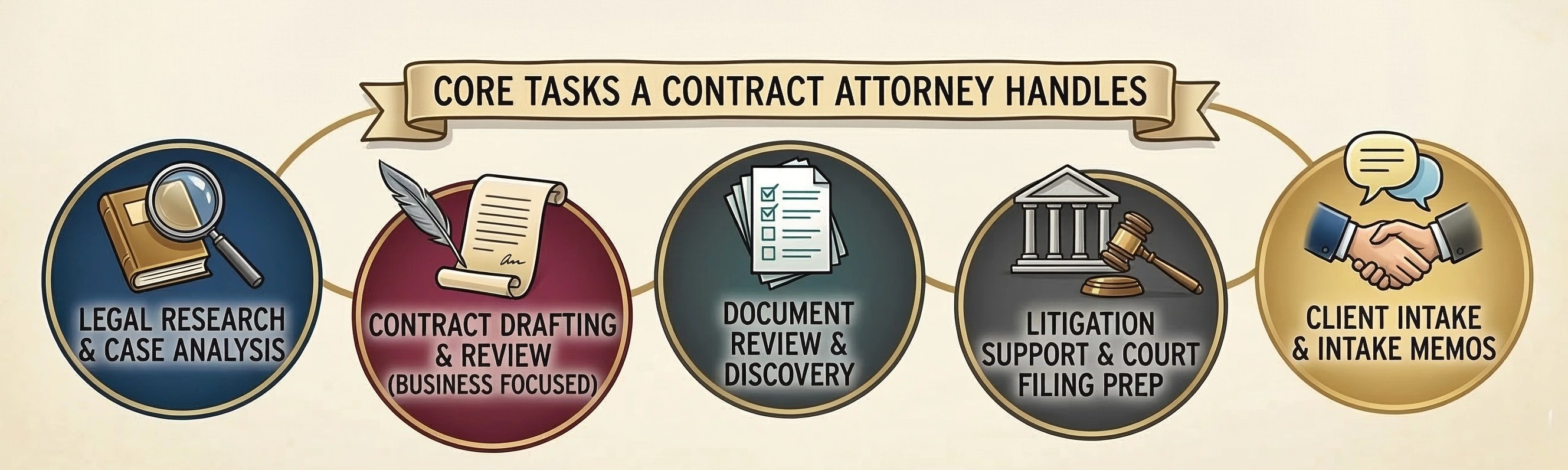
Core Tasks a Contract Attorney Handles for Solo Practitioners
- Legal research and case analysis
- Contract drafting and review (as a business contract attorney)
- Document review and discovery
- Litigation support and court filing preparation
- Client intake and intake memos
What Is a Business Contract Attorney?
A business contract attorney specializes in commercial agreements NDAs, service contracts, vendor agreements, partnership terms, and employment contracts. If your solo practice is growing to serve business clients, this is the contract support you'll need most.
Handling Breach of Contract and Contract Disputes Without Burning Out
Contract disputes are among the most time-consuming matters a solo practitioner handles. A breach of contract case whether your client is the plaintiff or the defendant demands deep document review, research, and drafting. Done alone, it consumes your entire week.
A breach of contract attorney brought in on a contract basis can take that load off your plate. They can analyze the contract terms, research prior case law, draft demand letters, and prepare litigation support while you stay client-facing and strategic.
Contract Dispute Attorney: When Specialization Matters
Not all contract disputes are created equal. A contract dispute attorney brings subject-matter depth whether the dispute involves a commercial lease, a construction agreement, an employment contract, or a services agreement gone wrong.
For solo practitioners, this is where the contract model truly shines. Instead of turning down a complex dispute case, you bring in a contract dispute attorney for that specific matter keeping the client and delivering high-quality work without overextending yourself.
For example, imagine a solo family law attorney whose long-time business client comes to them with a vendor contract dispute involving a $200,000 services agreement. The attorney doesn't practice commercial litigation — but doesn't want to lose the client.
By bringing in a contract dispute attorney experienced in commercial agreements, the solo practitioner can oversee the matter strategically while the contract attorney handles the heavy lifting: document analysis, demand letter drafting, and case law research. The client stays, the work gets done, and the solo doesn't burn 40+ hours learning a new practice area from scratch.
5 Signs You Need a Contract Attorney Right Now
Knowing when to bring in contract support is as important as knowing how. Here are five clear indicators:
- You're turning down cases because you're at capacity. Every "no" is revenue lost.
- A client brings a complex matter outside your core focus area you want to keep the client but need specialized depth.
- You're spending evenings on research and drafting instead of business development or rest.
- You have a case surge seasonal, referral-driven, or campaign-related and need temporary capacity.
- A contract dispute or breach of contract matter demands research depth and document volume beyond what one attorney can handle solo.
Contract Attorney Cost vs. Full-Time Hire: A Realistic Comparison
Solo practitioners often hesitate because they assume contract support is expensive. But when you compare the full cost of a full-time in-house associate salary, benefits, training, management overhead against dedicated contract attorney support billed monthly, the math favors flexibility.
Bottom line: A contract attorney gives you the capacity of an associate without the financial exposure. You get dedicated, full-time support billed monthly with the flexibility to scale as your practice demands.
For solo practitioners looking to test this model at low risk, Remote Attorneys connects law firms with pre-vetted, experienced contract attorneys trained by U.S. attorneys in U.S. law firm workflows starting at just $20/hr on a flexible month-to-month basis.
How to Integrate a Contract Attorney Into Your Solo Practice
Integration doesn't have to be complicated. Use this 5-step process:
- Define the scope. Identify the specific task or matter you want delegated brief, research memo, contract review, or case support.
- Brief the attorney. Share case background, relevant documents, deadlines, and your preferred format for deliverables.
- Set communication protocols. Establish how and when you'll check in daily emails, Loom updates, or milestone-based reviews.
- Review and supervise outputs. You remain the supervising attorney. Review all work product before it goes to clients or courts.
- Scale as needed. Once you see the model works, expand contract support to additional practice areas or recurring matter types.
Note on supervision: Under the ABA Model Rules of Professional Conduct, the supervising attorney must maintain responsibility for all contract attorney work product.
This is not a barrier it's built into the model. You review and approve; the contract attorney executes. For detailed guidance on ethical obligations, see ABA Formal Opinion 88-356, which specifically addresses the use of contract/temporary attorneys.
Frequently Asked Questions
Can a solo practitioner hire a contract attorney ethically?
Yes. Under ABA Formal Opinion 88-356, law firms are permitted to engage contract attorneys provided the supervising attorney reviews all work products and maintains ultimate responsibility. Disclosure to the client may be required depending on the level of independence given to the contract attorney and your jurisdiction's specific rules.
Does a solo practitioner need a business contract attorney?
Yes, if your clients include small businesses, startups, or contractors. A business contract attorney handles NDAs, vendor agreements, and commercial terms that fall outside general practice scope but are increasingly common client needs.
How do I supervise a contract attorney's work to stay compliant?
Treat contract attorney oversight the same way you would supervise any team member working on your cases. Review all work product before it reaches clients or courts. Set clear deliverable standards, communication checkpoints, and deadlines. Under ABA Model Rule 5.1, the supervising attorney bears responsibility for ensuring the work meets professional conduct standards.
What's the difference between a contract attorney and a freelance lawyer?
The terms are often used interchangeably. Both refer to legal professionals working on a flexible basis. "Contract attorney" typically implies working within another firm's matters under the supervising attorney's direction, while "freelance lawyer" may also serve end-clients directly.
Can I use a contract attorney for ongoing support, not just one case?
Absolutely. While contract attorneys can be engaged for a specific matter, many solo practitioners use them as full-time, dedicated support on a month-to-month basis. Remote Attorneys provides exactly this — a dedicated attorney who integrates into your workflow and supports your firm continuously, with the flexibility to scale as your caseload changes.
How do I find a reliable contract attorney for my solo practice?
Use a vetted legal staffing platform like Remote Attorneys, which pre-screens experienced attorneys trained by U.S. attorneys in U.S. law firm workflows. Avoid generic freelance marketplaces that lack legal-specific vetting.
What tasks should I delegate to a contract attorney first?
Start with time-intensive but well-defined tasks: legal research memos, contract drafting and review, document review for discovery, and litigation support such as motion drafts or court filing preparation. These are high-effort tasks that don't require ongoing client relationship management — making them ideal for delegation.
Ready to Scale Your Solo Practice Without the Overhead?
Solo practitioners don't have to choose between growth and sustainability. A dedicated contract attorney gives you the capacity to take on more cases, handle complex contract disputes, and serve business clients — without the financial risk of a full-time in-house hire.
You built your practice for independence. Contract attorneys let you scale it on your own terms.
Whether you need help managing a sudden case surge, handling a complex breach of contract matter, or adding business contract review capacity — a dedicated, experienced contract attorney can integrate into your workflow within days, not months.