

Medical malpractice attorneys handle some of the most technically demanding cases in civil litigation. They sit at the intersection of law and medicine, where a missed deadline or a weak expert witness can end a case before it begins. This guide is written for law firm owners and managers who run or are considering expanding into medical malpractice practice areas.
Whether you are staffing your first malpractice team or looking to scale an existing one, what follows covers everything you need to know: the role, the case types, the legal standards, the operational challenges, and how forward-thinking firms are building leaner, faster teams today.
Key Takeaways
- Medical malpractice cases require expert witnesses in nearly every file, making case prep expensive and time-intensive
- Over 96% of medical malpractice claims are resolved through settlement, not trial — but trial-readiness still determines leverage
- The average payout per claim sits between $350,000 and $400,000, according to data from the National Practitioner Data Bank (NPDB)
- Remote legal professionals are now handling record review, intake, and demand letter drafting for malpractice firms at a fraction of in-house staffing costs
What Does a Medical Malpractice Attorney Do?
A medical malpractice attorney often called a medical lawyer represents patients who were harmed by a healthcare provider's failure to meet the accepted standard of care. This includes reviewing medical records, retaining expert witnesses, building a negligence argument, negotiating with defense insurance teams, and litigating when settlement fails.
This is not general personal injury work. Medical liability cases require clinical literacy. Your attorneys need to understand what a standard of care violation actually looks like in a surgery suite, a labor and delivery unit, or a radiology reading room.
Types of Cases a Medical Malpractice Attorney Handles
Medical liability claims arise across a wide range of clinical settings. Knowing which case types your firm will focus on shapes every staffing and intake decision you make.
- Surgical errors
Are among the most litigated. Wrong-site surgery, retained instruments, anesthesia mistakes, and post-operative negligence all fall here. According to Knapp and Roberts, surgical errors rated 6% of "Never Events" in 2022, with failure to follow protocol as the leading cause.
- Misdiagnosis and delayed diagnosis
Represent the largest category in nationally reported verdicts. Diagnostic failure cases alone accounted for over $220 million in reported damages across 41 nationally tracked cases, with an average award of $20 million per case.
- Medication errors
Are the second most-reported claim type after surgical errors. Insulin and morphine are the two most commonly cited drugs in these claims.
- Birth injuries
Consistently produce the largest verdicts. A March 2024 jury awarded $120 million in a delayed C-section case against Henry Ford Health System, where fetal distress went unaddressed for two hours.
- Hospital negligence
Covers systemic failures: understaffing, inadequate credentialing, faulty equipment, and flawed protocols. Hospitals can face direct liability even when the treating physician is an independent contractor.
- Failure to obtain informed consent
Is relevant when a patient was not told of material risks before a procedure and would have refused had they known.
The 4 Legal Elements Your Team Must Prove
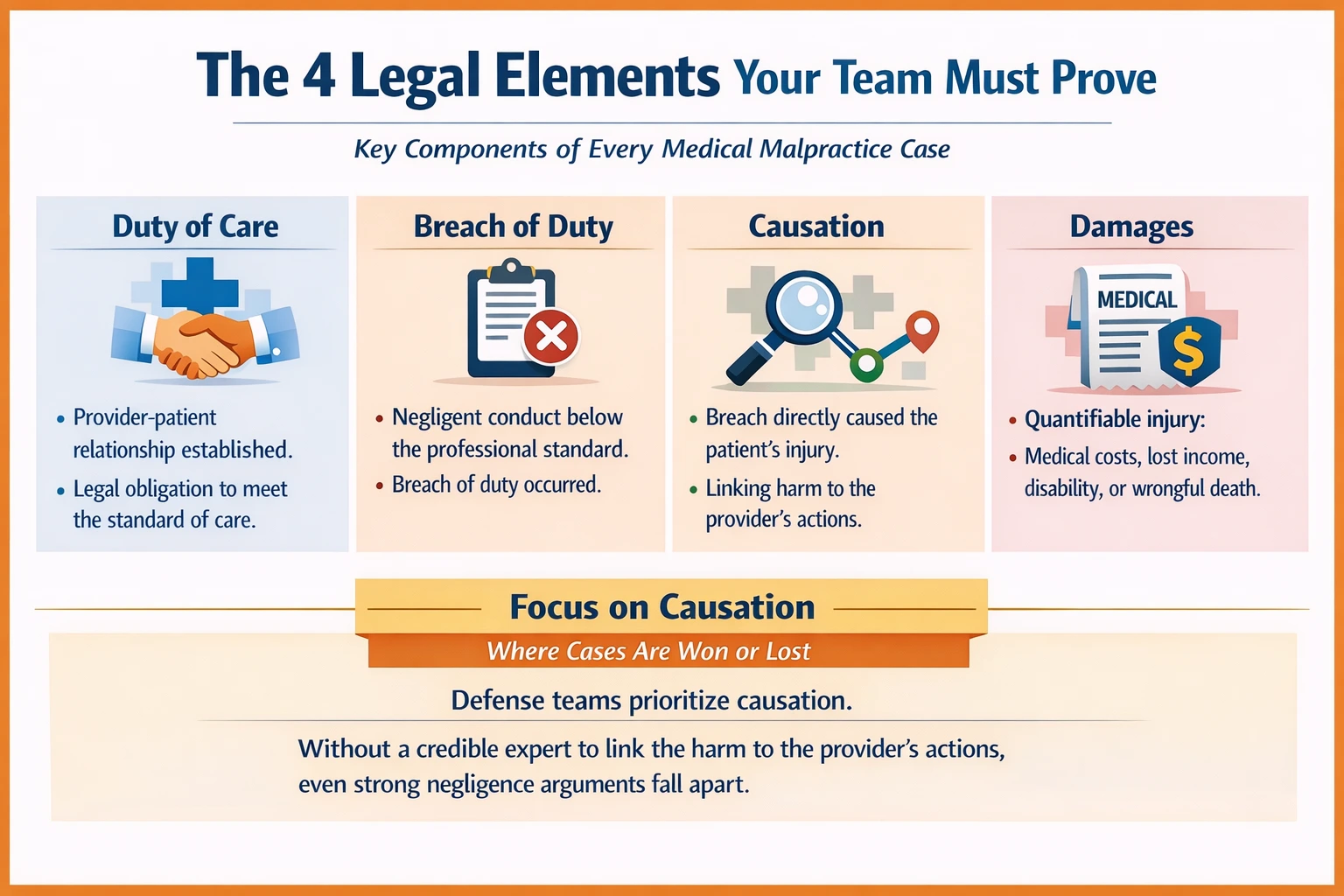
Every medical malpractice case rests on four elements. Your attorneys and paralegals need to approach each file with these as the organizing framework from intake forward.
- Duty of care — A provider-patient relationship was established, creating a legal obligation to meet the standard of care.
- Breach of duty — The provider's conduct fell below what a competent professional in the same specialty would have done. This is the negligence element.
- Causation — The breach directly caused the patient's injury. This is where most cases are won or lost, and where expert witness credibility matters most.
- Damages — The plaintiff suffered a quantifiable injury: medical expenses, lost income, disability, or wrongful death.
Causation is where defense teams focus their resources. Without a credible expert who can clearly trace the harm to the provider's specific actions, even strong negligence arguments fall apart.
Why Medical Malpractice Cases Are Operationally Demanding
Medical malpractice is not a high-volume, fast-turnover practice area. The firms that run it well understand the operational weight before they build their team.
Here is what the workload actually looks like:
- Long case cycles.
Most files run 12 to 36 months from intake to resolution. Your team carries those cases and the overhead the whole time.
- Front-loaded costs.
Firms handling contingency cases often pay expert witness fees, medical record retrieval costs, and litigation expenses before seeing any recovery. For surgical error and birth injury cases, those costs can reach six figures.
- Medical record review volume.
A single hospitalization can generate thousands of pages of records. Staff need either clinical training or enough medical familiarity to spot what matters.
- State-by-state complexity.
Statutes of limitations, damage caps, certificate of merit requirements, and expert witness rules vary by state. Missing a procedural deadline ends the case.
- Well-resourced defense.
Hospital systems and their insurers have experienced defense teams, medical experts, and deep litigation budgets. Your preparation needs to match that.
According to Miller and Zois, nearly 20,000 medical malpractice lawsuits are filed in the United States annually, and 2023 claims resulted in $4.8 billion in settlement payouts. The volume and value are both significant. But so is the cost of running these files.
How Law Firms Staff Medical Malpractice Cases
The staffing model for a malpractice practice differs from most other personal injury work. Here is how most firms structure it, and where the pressure points are.
Core Team Structure
Most malpractice firms use a core team of licensed attorneys and experienced paralegals, supported by contract professionals for high-volume work. A typical structure looks like this:
- Lead attorney handles expert witness strategy, depositions, and trial or settlement
- Associate or contract attorney manages record review, legal research, motion drafting, and expert coordination
- Litigation paralegal manages case timelines, filing deadlines, and document organization
- Intake specialist handles the first call from a potential client, gathers facts, and moves qualified leads into the intake pipeline
The intake role is where most firms quietly lose cases before they begin. A potential client who does not get a response the same day they call will move on. A busy intake line that goes to voicemail at 5 PM means lost contingency fees.
Where Remote Staffing Fits
Hiring a full-time associate attorney in 2024 costs a firm close to $300,000 annually when salary, benefits, malpractice insurance, and overhead are factored in, according to LAWCLERK's 2024 hiring outlook. For firms that want to grow intake volume or handle more files without that fixed cost, contract and remote attorneys are filling the gap.
Remote legal professionals now handle:
- Medical record retrieval and initial review
- Demand letter drafting
- Legal research on standard of care and jurisdiction-specific rules
- Client intake documentation and follow-up
- Expert witness scheduling and coordination support
For a deeper look at how law firms delegate these tasks, see Top Legal Tasks You Can Delegate to Remote Attorneys.
What to Look for When Hiring a Medical Malpractice Attorney
Whether you are bringing on an in-house associate or a remote attorney to support your malpractice practice, the evaluation criteria are different from general litigation hiring.
Use this as a practical checklist:
- Clinical literacy. Can they read a discharge summary and identify what is missing? Do they know what "standard of care" means in a specific specialty, not just in the abstract?
- Expert witness experience. Have they retained, prepped, and defended expert witnesses before? Do they know the difference between a treating physician and a retained expert in terms of disclosure rules?
- State-specific knowledge. Are they familiar with your state's statute of limitations for malpractice claims? Do they understand your state's certificate of merit or affidavit requirements?
- Settlement vs. trial orientation. Most malpractice cases settle. But your attorney's trial readiness determines how much the defense offers. Hire attorneys who prepare for trial even when settlement is likely.
- Client communication skills. Malpractice clients are often in grief or in crisis. How an attorney handles those conversations reflects directly on your firm's reputation.

How Remote Attorneys Support Medical Malpractice Firms
This is the one section where we speak directly to what Remote Attorneys provides, because it is directly relevant to the staffing decisions you are making.
Remote Attorneys connects law firms with pre-vetted legal professionals who support medical malpractice practices across the full case lifecycle. Our network includes attorneys trained in personal injury and medical liability work, available starting at $19 per hour with no long-term commitment required.
Here is what remote attorneys actually do for malpractice firms:
- Intake support. Calls are answered promptly, leads are qualified, and follow-up is handled so no case falls through the cracks. See our personal injury attorney support page for specifics.
- Medical record review. Remote attorneys process and organize records, flag relevant entries, and summarize findings for the lead attorney.
- Demand letters and pre-litigation drafting. Contract attorneys draft demand letters and pre-litigation correspondence to your firm's standards.
- Legal research. Standard of care research, jurisdiction-specific statute of limitations analysis, and expert witness background research.
- Paralegal support. Remote paralegals handle deadline tracking, filing coordination, and case file organization.
Firms that add remote support during intake surges or high case-volume periods avoid the cost of a full-time hire while keeping throughput consistent.
Frequently Asked Questions
What is the difference between a medical malpractice attorney and a medical lawyer?
Both terms refer to the same type of attorney. "Medical lawyer" is used casually; "medical malpractice attorney" is the formal professional title used in practice.
How long does a medical malpractice case typically take to resolve?
Most cases settle or reach verdict within 2 to 4 years. Complex surgical error and birth injury cases can run longer depending on jurisdiction and the number of defendants.
What are the biggest staffing challenges for medical malpractice law firms?
Managing long case timelines, maintaining intake responsiveness, covering front-loaded litigation costs on contingency files, and retaining staff experienced with emotionally difficult clients.
Can a remote attorney handle medical malpractice casework?
Yes. Record review, legal research, intake documentation, demand letters, and expert coordination are all tasks remote attorneys handle effectively. In-court appearances and jurisdiction-specific filings still require licensed, in-state counsel.
What is the average settlement in a medical malpractice case?
The national average falls between $350,000 and $400,000. Birth injury and surgical error cases routinely produce multi-million dollar recoveries. Settlement value depends on injury severity, jurisdiction, and whether the case is trial-ready.
Build the Team Before the Caseload Demands It
Medical malpractice is a high-stakes, high-investment practice area. The firms that run it well do not scramble for support when a surge of cases comes in. They build their intake infrastructure, their record review process, and their staffing model in advance.
The combination of a strong lead attorney, experienced litigation paralegals, and remote legal support for high-volume tasks gives mid-size firms a real structural advantage over competitors still relying entirely on full-time in-house staff.
If you are evaluating how to staff or scale your medical malpractice practice, read our guide on outsourced legal back office support for law firms and explore what virtual legal assistants can do for your team day to day.
The caseload is there. The question is whether your team is ready to take it.