
Pro bono legal programs are professionally expected, ethically encouraged, and publicly visible. But most law firms treat them as an informal expectation rather than a planned operational commitment, and the numbers show it.
According to the 2025 Law Firm Pro Bono Challenge Report, pro bono hours represented approximately 3.71% of total client billable hours in 2024, down from 3.76% in 2023. That gap may look small on paper, but across 114 reporting firms contributing nearly 4.93 million hours, even a fraction of a percentage point reflects real capacity being lost. That loss is not about willingness. It reflects a lack of operational infrastructure.
This post covers the five operational friction points law firm managers face most often when running pro bono programs, and what practical steps address each one.
Key Takeaways
- Pro bono lawyers are not paid by clients. Compensation comes through firm salary, billable hour credits, grants, or court-awarded fees in qualifying cases.
- ABA Model Rule 6.1 sets 50 hours per attorney per year as the aspirational standard. The Law Firm Pro Bono Challenge raises that to 3-5% of total firm billable hours.
- The five biggest operational barriers are billable pressure, malpractice exposure, case funding, geographic gaps, and conflict screening.
- Without a designated coordinator and written policies, pro bono participation stays fragile and shrinks the moment billing pressure rises.
What Pro Bono Means for a Law Firm
"Pro bono" comes from the Latin pro bono publico, meaning "for the public good." In practice, it refers to free legal services provided to individuals or organizations that cannot afford representation.
For a law firm, this is not optional charity. ABA Model Rule 6.1 establishes that every licensed attorney has a professional responsibility to provide legal services to those unable to pay. The rule sets an aspirational goal of 50 hours per attorney per year.
That distinction matters for firm managers. Pro bono is a professional obligation built into the Rules of Professional Conduct, not a discretionary program.
How Do Pro Bono Lawyers Get Paid?
Pro bono lawyers are not paid by their clients. Their compensation runs through four channels that firm managers need to understand when budgeting and tracking program costs.
Firm Salary
The attorney receives their regular salary while the firm absorbs the cost of their pro bono time. This is the most common model. The firm treats pro bono as part of its professional responsibility commitment.
Billable Hour Credit
Many firms give attorneys billable credit for pro bono hours, counting them toward the annual target. Firms with 150 or more lawyers gave an average of 85 billable-credit hours for pro bono work in 2024. This directly reduces the financial friction attorneys feel when taking on non-paying cases.
Grants and Legal Aid Funding
Legal aid organizations receive grants from the Legal Services Corporation, private foundations, and state bar programs. A portion of that funding can offset attorney compensation or cover program administrative costs.
Court-Awarded Fees
In civil rights and consumer protection cases, federal and state fee-shifting statutes allow a judge to order the losing party to pay the prevailing party's attorney fees. This reimburses the firm for time spent on qualifying pro bono matters.
Firms that offer contract attorney support for pro bono intake and case prep reduce internal capacity pressure without committing full-time staff to every matter.
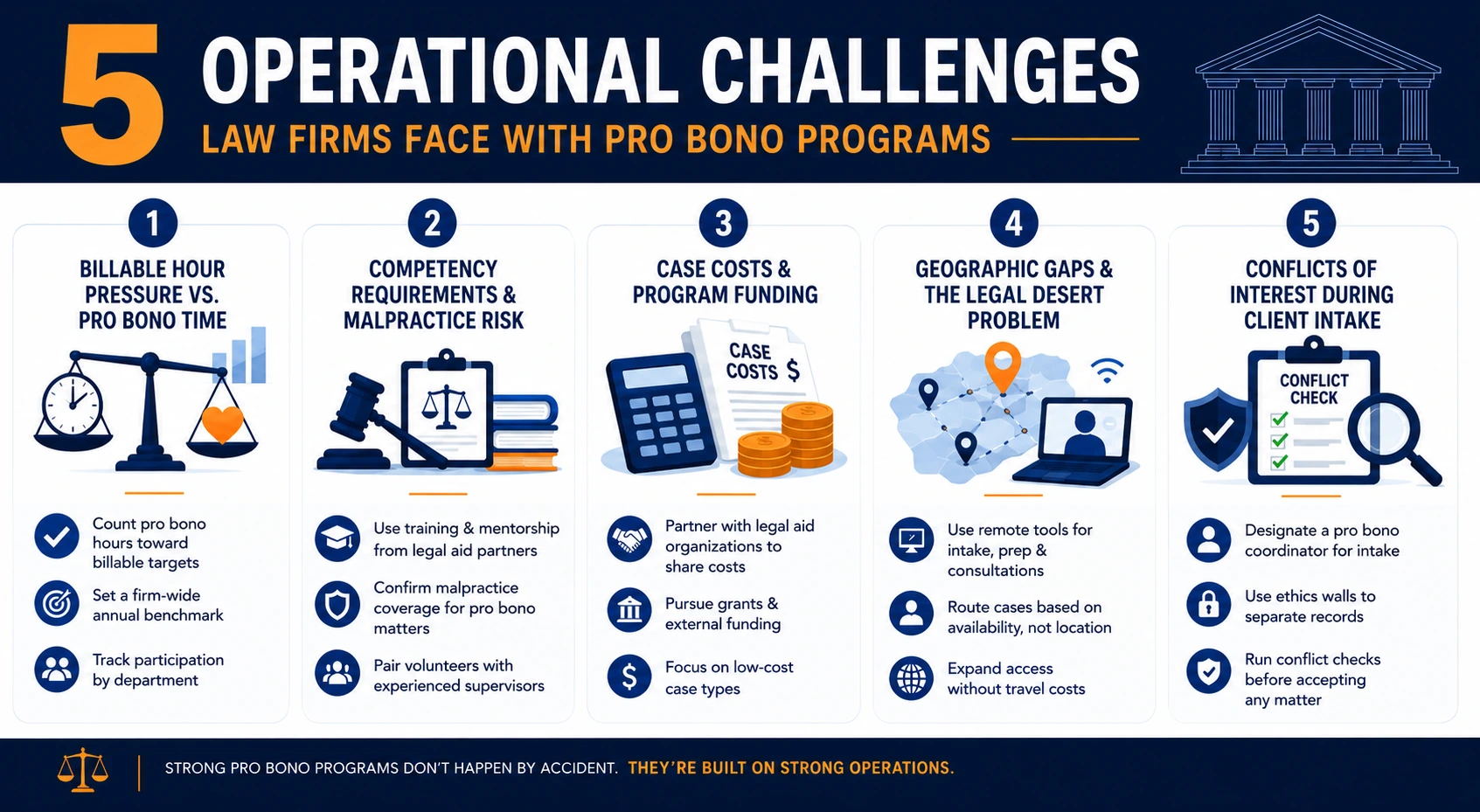
5 Operational Challenges Law Firms Face With Pro Bono Programs
1. Billable Hour Pressure vs. Pro Bono Time
Associates under annual billing targets have very little room to absorb unpaid hours without firm-level support. When pro bono depends entirely on individual initiative, it is the first thing cut when workloads increase.
The solution is institutional commitment rather than individual pressure. The Law Firm Pro Bono Challenge ties pro bono targets to the firm's total billable output instead of per-attorney quotas. This distributes the obligation across the firm and removes the dynamic where attorneys feel they cannot afford the hours.
What managers can do:
- Count pro bono hours toward billable targets
- Set a firm-wide annual benchmark in writing
- Track participation rates by department, not just total hours
Accurate time tracking is critical here. Pro bono hours that go untracked cannot be evaluated, reported, or credited toward the firm's benchmark goals.
2. Competency Requirements and Malpractice Exposure
ABA Rule 1.1 requires competent representation on every matter, pro bono included. Many attorneys hesitate to volunteer because pro bono cases often fall outside their regular practice area. That hesitation is legitimate.
A 2024 New Jersey lawsuit, still unresolved as of this writing, raised this argument directly. A senior associate specializing in labor law challenged their mandatory assignment on the grounds that handling cases outside their expertise exposes them to malpractice claims and ethics grievances under the Rules of Professional Conduct.
How firms address this:
- Partner with legal aid organizations that provide targeted CLE training and mentorship for volunteers
- Confirm the firm's malpractice policy covers pro bono matters (many standard policies exclude them)
- Use the Pro Bono Institute's Clinic in a Box® program, a registered half-day clinic model that gives attorneys a structured onboarding framework for case types outside their usual practice
Pairing volunteers with experienced supervisors in the relevant area increases participation and reduces dropped matters.
3. Case Costs and Program Funding
Pro bono clients cannot cover standard litigation expenses: filing fees, expert witnesses, depositions, or translation. For small and mid-size firms, those costs come directly out of pocket when no external support structure exists.
This is one of the most overlooked operational barriers. It is also one of the most common reasons solo practitioners and boutique firms decline pro bono matters entirely.
Practical approaches:
- Build referral relationships with local legal aid organizations that already cover intake and litigation costs
- Apply for Legal Services Corporation grants if the firm operates in underserved areas
- Limit early pro bono participation to case types that do not require significant out-of-pocket litigation expenses
Partnering with established legal services organizations also removes the intake and screening burden from internal staff.
4. Geographic Gaps and the Legal Desert Problem
Rural regions with too few practicing attorneys to meet basic legal need, commonly called legal deserts, face the sharpest access gaps. In some of these jurisdictions, courts assign mandatory pro bono cases to local attorneys regardless of their experience or capacity.
The practical fix is hybrid service delivery. Organizations like Lawyers for Good Government make all volunteer pro bono opportunities remote-eligible, with virtual training and supervision. This allows firms in major metros to serve clients in underserved areas without travel costs.
This is where a firm's remote legal infrastructure directly affects its pro bono capacity. Law firms that already use remote paralegals and attorneys can redirect that infrastructure toward pro bono matters without disrupting their billing workflow.
Firms with remote workflows can:
- Assign intake and case prep to remote staff without pulling billing attorneys off client matters
- Conduct client consultations virtually for rural or transportation-limited clients
- Route cases based on attorney availability rather than office location
5. Conflicts of Interest During Client Intake
Large firms and in-house legal departments carry extensive client rosters. A pro bono client's matter may conflict with an existing corporate relationship. The intake process can surface that conflict before the firm has a system in place to handle it cleanly.
This is especially acute for in-house counsel, where corporate client conflicts are broad and sometimes not immediately obvious.
Standard operational controls:
- Designate a dedicated pro bono coordinator to manage all intake screening. Having a designated coordinator is one of the first indicators evaluators use to assess a firm's real operational commitment to pro bono.
- Implement ethics walls that separate pro bono intake records from the firm's private client database
- Use standardized conflict-check procedures before accepting any matter, even for one-time clinic representation
Legal services agencies that supply pro bono referrals typically run their own conflict screening. Partnering with those organizations adds a second layer before a case ever reaches the firm.
What Declining Pro Bono Hours Signal for Firm Leaders
Pro bono participation across U.S. law firms dropped in 2024. Fewer lawyers and fewer firms met the profession's minimum hourly goals, driven by billing pressure, political headwinds in high-visibility case areas, and a lack of formalized program infrastructure.
Many firms still do not have written pro bono policies or designated coordinators. Without those structures, pro bono participation stays fragile. It grows when attorneys have bandwidth and shrinks when they do not.
Firms sustaining pro bono performance year over year treat it as an operational program with the same accountability as any other practice area: written policies, tracked hours, designated ownership, and visible partner support.
How Remote Legal Capacity Helps Firms Run Pro Bono Programs
The core challenge for most firms is not willingness. It is capacity. When billing attorneys are at maximum, pro bono gets cut first.
A firm using remote paralegals for intake screening, research, and drafting can redirect the equivalent of 10 to 15 attorney hours per month toward pro bono without changing billing targets or adding headcount. That is enough to handle two to three pro bono matters monthly — meeting the ABA's 50-hour annual goal across a small team without restructuring how the firm operates.
Firms that use remote legal support staff to absorb that routine work free up attorney hours that can be directed toward pro bono. The capacity already exists. It is a matter of directing it.
If your firm is managing this kind of capacity challenge, book a demo with Remote Attorneys to see how a remote-ready legal team works in practice.
For more on building this kind of team, read how to delegate legal tasks effectively to remote staff and how virtual workflows are reshaping law firm operations.
Frequently Asked Questions
What is pro bono in law?
Pro bono is free legal representation for people who cannot afford it. It comes from the Latin pro bono publico, meaning "for the public good," and is encouraged under ABA Model Rule 6.1.
How do pro bono lawyers get paid?
They are not paid by clients. Compensation comes through firm salary, billable hour credits, legal aid grants, or court-awarded fees under fee-shifting statutes in qualifying civil cases.
Are law firms required to do pro bono work?
It is not federally mandatory, but ABA Model Rule 6.1 sets 50 hours per attorney as the aspirational standard. Some states like New Jersey have mandatory programs.
What types of cases do pro bono lawyers handle?
Common areas include housing, immigration, family law, civil rights, consumer protection, veterans' benefits, and nonprofit formation, depending on the firm's capacity and legal aid partnerships.
What is a legal desert?
A legal desert is a rural or underserved area with very few practicing attorneys. Residents face the sharpest access-to-justice gap, often with no realistic options for legal representation.
Building a Pro Bono Program That Holds Up Operationally
The five challenges covered here cover where pro bono programs most often break down: billing pressure, competency exposure, case costs, geographic gaps, and conflict screening. None are unsolvable. All of them require intentional planning.
Firms that sustain pro bono commitments year over year treat them the same way they treat any other part of the practice: with infrastructure, accountability, and enough capacity to do the work without burning out the team.
Remote Attorneys works with law firms to build that kind of capacity, with flexible remote legal staff that supports both billable and pro bono work without the overhead of traditional hiring.