
The New Standard of Legal Operations in 2026
The debate around hybrid vs. remote is over. In 2026, the real divide in the legal industry is efficiency vs. obsolescence.
Law firms are no longer competing on prestige, office size, or even billable rates. They are competing on how fast, how transparent, and how predictably they can deliver legal outcomes. Clients expect Amazon-level visibility into their matters, real-time updates, and fewer surprises on cost a shift documented in Thomson Reuters' 2026 State of the Legal Market Report." Firms that cannot deliver this experience are not seen as traditional they are seen as inefficient.
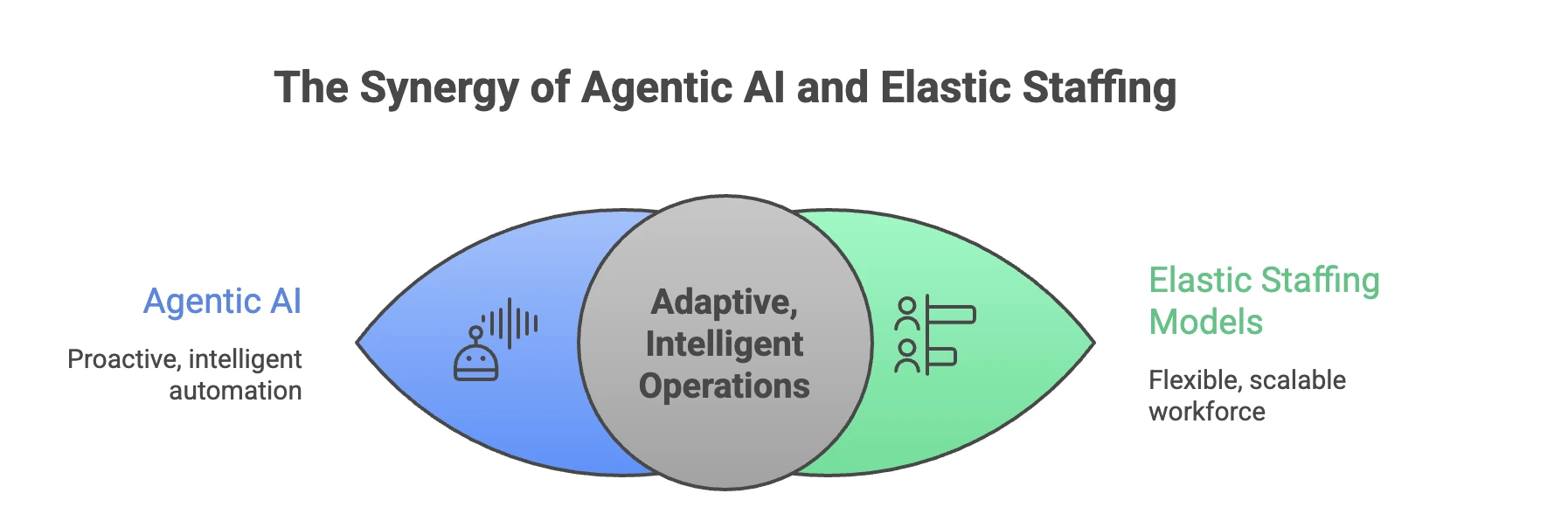
Legal operations in 2026 are no longer about administrative support or back-office optimization. It is about building a virtual legal workflow where technology, human expertise, and staffing elasticity operate as a single system.
At the center of this shift are two structural changes:
- Agentic AI replacing passive tools
- Elastic staffing models replacing fixed, overhead-heavy teams
The thesis is simple:
Firms that build a seamless virtual workflow will win on margins, speed, and client trust. Firms that don’t will slowly price themselves out of relevance.
Key Takeaways
- Legal operations in 2026 is driven by integrated workflows, not manual coordination.
- Agentic AI is becoming part of everyday legal execution, especially in research, drafting, and administration.
- Elastic staffing models help firms manage workload spikes without increasing fixed overhead.
- Clients expect real-time visibility into matter progress and performance metrics.
- Operational efficiency is now a competitive advantage, not just a cost-saving initiative.
Anatomy of Virtual Legal Workflow Automation in 2026
Moving Beyond “Point Solutions”
Historically, legal tech vendors talked about productivity in isolation. A faster research tool here. A better document manager there. However, leading platforms are now embedding AI directly into unified workflows, with 78% of legal professionals expecting Gen AI to become central to their operations.
But Legal Operations 2026 is not about tools. It is about ecosystem integration.
A modern virtual workflow is not a stack of disconnected platforms. It is a continuous system where data, tasks, and accountability move without friction from intake to resolution.
The Modern Tech Stack
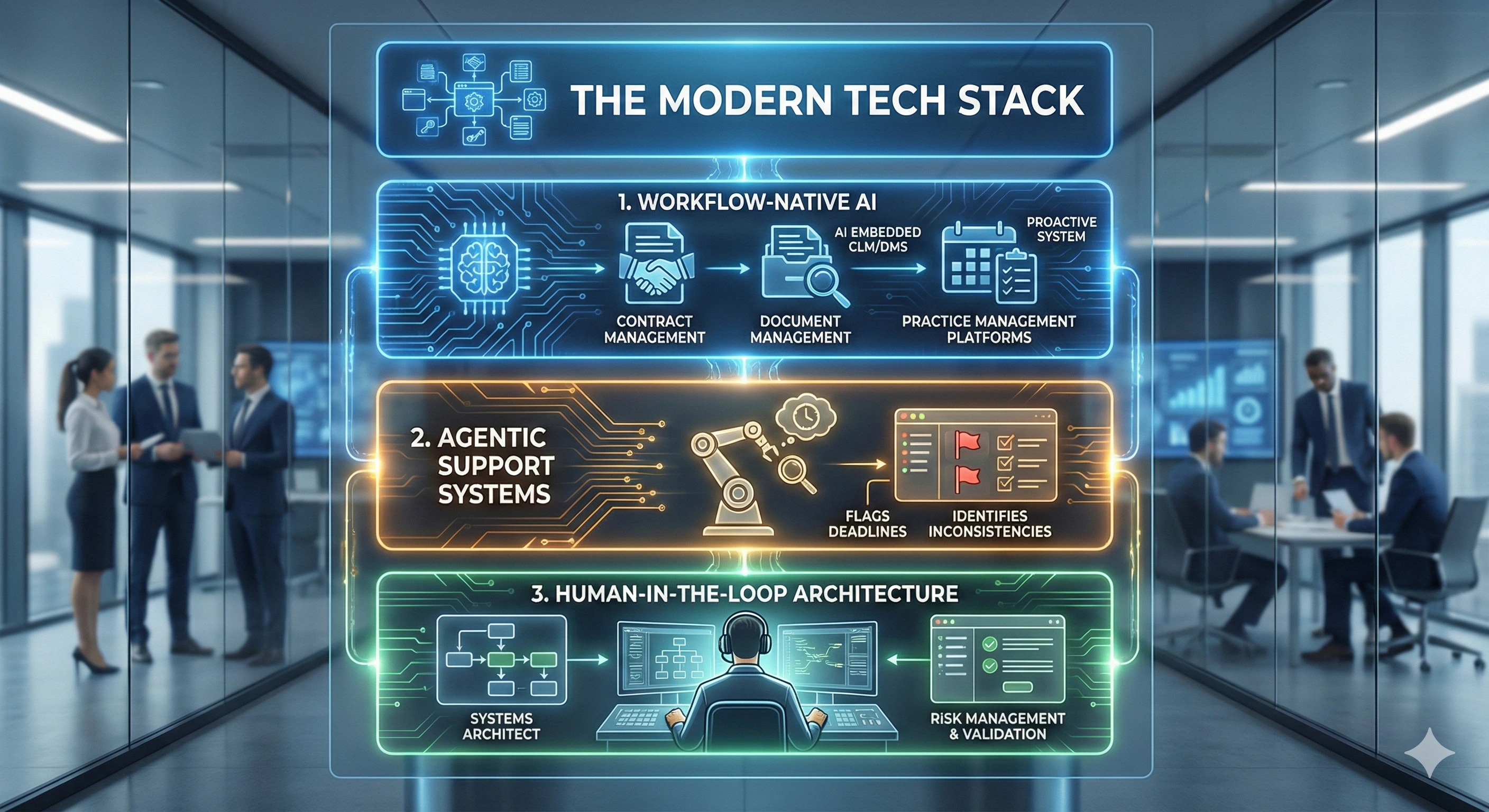
A 2026-ready workflow is built on three layers:
1. Workflow-Native AI
AI is no longer a chatbot on the side. It is embedded directly inside:
- Contract lifecycle management (CLM)
- Document management systems (DMS)
- Practice management platforms
These systems don’t wait for prompts. They act.
2. Agentic Support Systems
Agentic AI does not just answer questions. It:
- Flags missing discovery documents
- Surfaces approaching deadlines
- Identifies inconsistencies across filings
- Suggests task reassignment when bottlenecks appear
This is a fundamental shift from reactive oversight to proactive execution.
3. Human-in-the-Loop Architecture
Contrary to fear narratives, humans are not removed. Their role changes.
The law firm manager in 2026 is no longer a taskmaster chasing updates. They are a systems architect—designing workflows, validating outputs, and managing risk at the system level.
Automated Legal Administration & Intake
The Frictionless Start
Client intake remains one of the most common breakdown points in law firm workflows, where incomplete information, manual forms, and delayed routing slow matter progression. Recent research shows automated legal intake tools are helping firms capture, qualify, and convert clients faster by collecting case details in real time and routing matters automatically.
Automated intake systems are increasingly replacing paper forms and manual processes, enabling firms to respond instantly, gather structured information, and schedule consultations without administrative delays.
Modern firms use adaptive, AI-driven intake workflows that:
- Change questions dynamically based on client responses
- Pre-classify matters by complexity and urgency
- Route cases automatically to the right workflow and talent pool
Auto-Conflict Checks Without Silos
Conflict-check accuracy depends heavily on structured intake data and centralized matter records. The American Bar Association (2025) emphasizes that conflict analysis requires identifying client information, legal issues, and matter relationships at intake to ensure ethical compliance.
Modern conflict-check software now integrates directly with intake and practice-management systems, automating searches across current, former, and prospective client records while maintaining audit trails for compliance.
Virtual workflows integrate intake data across:
- CRM
- Practice management systems
- Document repositories
- Historical matter databases
The result: real-time, automated conflict detection without manual review cycles.
The Operational Payoff
According to Clio's 2025 Legal Trends Report, the average lawyer utilization rate is just 38%, meaning approximately 62% of their day is spent on non-billable administrative work
Automated intake and administration do not just save time—they reclaim revenue capacity.
The Hidden Cost of Manual Processes
Poor contract management costs companies an average of 9% of annual revenue, according to research by the International Association for Contract & Commercial Management. For a $50M firm, that's $4.5M lost annually to inefficient processes, delayed negotiations, and missed obligations.
Automated intake and administration don't just save time—they directly protect revenue by eliminating these costly inefficiencies.
Source: IACCM via ACC Legal Operations 101, page 9
The Remote Attorney Advantage: Elastic, Specialized Legal Capacity
As legal workflows become more data-driven and demand fluctuates across matters, law firms need staffing models that provide flexibility without sacrificing quality or control. Remote attorneys allow firms to expand legal capacity on demand while maintaining consistent workflow standards. Instead of hiring for peak workload, firms can integrate specialized legal talent directly into their operational systems.
RemoteAttorneys.com provides vetted remote attorneys who integrate into existing firm workflows as an extension of the legal team.
Advantages of Remote Attorney Integration
Elastic Capacity
Scale legal talent up or down based on real workload demand without increasing fixed overhead.
Specialized Legal Talent
Access attorneys trained in specific practice areas and jurisdictional rules—not generalists.
Workflow Integration
Remote attorneys integrate directly into drafting pipelines, legal research queues, case management systems, and litigation support workflows.
Operational Efficiency
Offload labor-heavy, process-driven work while maintaining quality control and institutional knowledge.
Cost Predictability
Avoid underutilization, ramp-up delays, and overhead associated with full-time associate hiring.
Real-World Example
A mid-sized litigation firm adopted a Core + Variable model:
- Core team: partners and senior associates
- Variable layer: remote attorneys for discovery, drafting, and research
Result:
- Litigation spikes handled without emergency hiring
- Faster turnaround times
- Improved realization rates
Data-Driven Performance and Client Visibility
The 2026 Client Expectation
Clients no longer accept monthly summaries.
They expect:
- Real-time matter dashboards
- Clear task ownership
- Transparent timelines
Virtual workflows make this standard—not premium.
KPIs That Actually Matter
In a virtual legal workflow, visibility into performance determines whether efficiency improvements actually translate into profitability. Tracking the right operational metrics helps law firms measure workflow speed, resource utilization, and output quality. Without these indicators, legal operations improvements remain assumptions rather than measurable gains.
Cycle Time
How fast does work move from intake to completion?
Realization Rates
How much remote attorney output is actually billed?
Throughput Per Matter
How many tasks move without human intervention?
These metrics define profitability in 2026.

Ethics, Auditability, and Compliance
With increased automation comes increased scrutiny.
ABA Formal Opinion 512 from American Bar Association clarifies ethical responsibilities around generative AI use, including:
- Duty of competence
- Client confidentiality
- Human oversight
Similarly, the EU AI Act introduces accountability requirements for AI-assisted workflows.
Virtual legal operations improve auditability by design. Every action is logged. Every output is traceable.
Read more; https://www.remoteattorneys.com/blog/do-lawyers-have-assistants
Overcoming Virtual Bottlenecks
The Human Element Most Guides Ignore
Technology is rarely the real barrier. Adoption is.
Veteran partners often resist virtual workflows due to:
- Perceived loss of control
- Distrust in remote output
- Habitual reliance on physical presence
Change management in 2026 requires:
- Clear workflow ownership
- Pilot matters, not full rollouts
- Visibility into performance metrics
Cybersecurity as a Competitive Feature
Ironically, virtual workflows are often more secure than paper-heavy offices.
Centralized access control, encrypted systems, and audit trails reduce:
- Lost documents
- Unauthorized access
- Informal data handling
Security is no longer an IT concern—it is a client-facing value proposition.
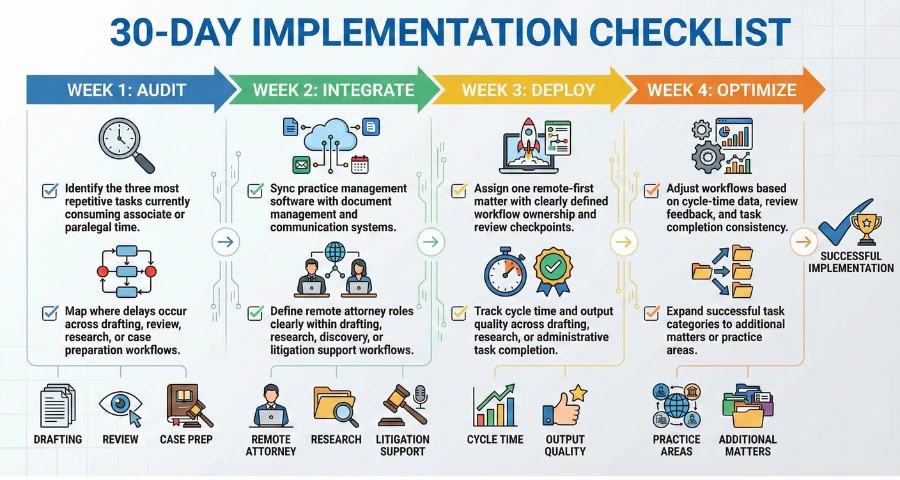
30-Day Implementation Checklist
Week 1: Audit
- Identify the three most repetitive tasks currently consuming associate or paralegal time
- Map where delays occur across drafting, review, research, or case preparation workflows
Week 2: Integrate
- Sync practice management software with document management and communication systems
- Define remote attorney roles clearly within drafting, research, discovery, or litigation support workflows
Week 3: Deploy
- Assign one remote-first matter with clearly defined workflow ownership and review checkpoints
- Track cycle time and output quality across drafting, research, or administrative task completion
Week 4: Optimize
- Adjust workflows based on cycle-time data, review feedback, and task completion consistency
- Expand successful task categories to additional matters or practice areas
The Future Belongs to the Agile
Legal Operations 2026 is not about working remotely. It is about working intelligently.
Firms that embrace virtual workflows gain:
- Higher margins
- Faster delivery
- Happier clients
- Scalable growth without linear hiring
Legal services are now valued for outputs, not hours. The firms that understand this shift will lead the next decade of legal practice.
FAQ’s
1. Is using remote attorneys ethically compliant for law firms?
Yes. Firms remain responsible for supervision, confidentiality, and competence. Clear workflows and review controls ensure compliance with ABA Opinion 512.
2. How does agentic AI differ from traditional legal automation?
Agentic AI initiates actions like flagging risks or delays, while traditional automation only responds to commands. Lawyers still review and approve outputs.
3. What legal work is best suited for remote attorneys?
Drafting, research, discovery review, case prep, and recurring legal tasks work best when integrated into structured workflows with defined oversight.
4. Will virtual workflows reduce billable hours revenue?
No. They reduce non-billable work and increase realization rates. Firms earn more by delivering faster outcomes with fewer internal inefficiencies.
5. How quickly can a law firm transition to a virtual workflow?
Most firms can pilot a virtual workflow within 30 days by automating intake, integrating tools, and deploying remote attorneys on defined matters.