

IP law firms outsource patent docketing to reduce administrative burden, control costs, and free attorneys for substantive work. The question most managing partners ask before making that move is whether an outside team can maintain the same accuracy as an in-house specialist.
The short answer is yes, when the engagement is structured correctly. Patent docketing is the process of recording, tracking, and calendarizing every deadline and document tied to a patent's lifecycle, helping patent lawyers manage filings from application through expiration. Done well, outsourcing this work adds a layer of process redundancy that most in-house setups do not have.
Key Takeaways
- Administrative errors including missed deadlines account for nearly 23% of all malpractice claims, per the ABA Profile of Legal Malpractice Claims 2020-2023
- Missing a single filing deadline can permanently abandon a patent with no path to recovery
- Outsourced docketing specialists use dual-entry verification and SLA-backed processes that many in-house teams lack
- The right outsourcing partner works inside your existing IP docketing software; no migration required
What Is Patent Docketing?
Patent docketing is the systematic recording, tracking, and calendarization of deadlines and documents across the entire patent lifecycle. It covers everything from the initial filing date to post-grant maintenance fees, covering every office action, IDS submission, and PCT deadline in between.
Docketing is not just data entry. It requires specific knowledge of USPTO rules, international patent office procedures, statutory response periods, and fee schedules across jurisdictions. That is why IP law firms rely on trained docketing specialists or paralegals rather than general administrative staff.
The stakes are concrete. The ABA Standing Committee on Lawyers' Professional Liability tracks malpractice claims across all practice areas every four years. Its most recent Profile of Legal Malpractice Claims (2020-2023) identifies administrative errors, including failure to calendar and missed deadlines, as accounting for nearly 23% of all claims filed. That is a specific and preventable category of risk.
Patent Docketing Services Law Firms Can Outsource
Most IP firms think of docketing as one job. In practice, it covers several distinct service categories, each with its own workflow, deadlines, and risk profile. Here is what law firms typically hand off to an outsourced provider.
Office Action Tracking and Response Docketing
This is the most time-sensitive category. A docketing specialist logs incoming office actions from the USPTO or foreign patent offices, calculates the response deadline, and routes the action to the responsible attorney with the correct due date. The specialist also tracks extension requests and confirms that responses are filed and acknowledged.
Maintenance Fee and Annuity Management
Patents require ongoing fee payments to stay in force. An outsourced docketing team tracks payment windows across U.S. and international portfolios, sends advance reminders at firm-defined intervals, and confirms payment processing. This is especially valuable for firms managing large portfolios across multiple jurisdictions with different annuity schedules.
IDS and Disclosure Tracking
Information Disclosure Statements (IDS) are required filings that notify the USPTO of relevant prior art during prosecution. A docketing specialist tracks disclosure obligations, flags new prior art that may trigger a filing requirement, and logs submission confirmations. Gaps here affect enforceability after the patent is granted.
PCT and Foreign Filing Coordination
International patent applications filed through the Patent Cooperation Treaty (PCT) involve multiple overlapping deadlines across different patent offices. Outsourced docketing covers national phase entry windows, regional validation deadlines, and foreign associate correspondence tracking. Specialists coordinate with foreign counsel to confirm filings and update the docket accordingly.
Docket Audits and Compliance Reporting
Beyond day-to-day tracking, outsourced providers can conduct periodic docket audits to verify that all entries are accurate, no deadlines have been miscalculated, and the portfolio reflects current prosecution status. Audit reports serve as documentation in the event of a malpractice inquiry and are recommended at least quarterly.
Where In-House Docketing Breaks Down
In-house docketing works well at low volume. The problems appear when portfolio size grows, staff turns over, or prosecution timelines run across multiple jurisdictions.
Four common failure points:
- Staff turnover : When a docketing specialist leaves, institutional knowledge leaves with them. Deadline calculations, priority dates, and correspondence logs all depend on the person who built them. Without a documented handoff process, a replacement starting from scratch creates a coverage gap at exactly the wrong time.
- Volume spikes : Seasonal surges in prosecution activity create docket backlogs that one in-house person cannot clear within statutory windows. Even a two-day delay in entering an office action can shift a calculated deadline past the actual due date.
- Multi-jurisdictional complexity : U.S. prosecution alone is complex. Add EPO validations, WIPO filings, and national phase entries across different countries and the margin for manual error multiplies quickly.
- Software gaps : Even the best IP docketing software, including AppColl, Alt Legal, and Anaqua, still requires skilled human input to interpret legal nuances and handle edge cases. Automation catches routine correspondence; it does not catch judgment errors.
The downstream cost of these failures is well documented. According to LAWPRO's 2025 IP claims analysis, time management errors account for 27% of all IP malpractice claims, while clerical and delegation errors account for another 26%.
The average IP claim in Ontario costs approximately $45,000, and some arise as late as 14 years after the original work. In one documented case, a firm failed to docket the due date for a Canadian national phase application. The deadline passed with no available fix, resulting in permanent loss of patent rights and a large settlement payout.
These failures are not caused by negligence. They are caused by under-resourced systems that were never designed to scale.
What "Accuracy" Actually Means in Patent Docketing
When law firm managers worry about losing accuracy through outsourcing, they are usually thinking about data entry errors. Accuracy in docketing goes deeper than that.
The assumption that outsourcing reduces accuracy usually comes from bad handoff processes, not from outsourcing itself. Well-structured outsourced docketing teams use dual-entry verification and QC checkpoints, the same standard malpractice insurance carriers recommend. Firms that implement rules-based docketing systems can see malpractice insurance premium reductions of 5 to 10%, with some carriers now requiring such systems as a condition of coverage.
For law firms managing IP portfolios, this means accuracy is a structural question, not a staffing question. The right process produces accurate results whether it runs in-house or through a vetted external team.
In-House vs. Outsourced Patent Docketing: How They Compare
Both models can work. The difference comes down to portfolio size, staff stability, and how much risk a firm is willing to absorb from a single point of failure.
Where in-house works well:
A dedicated in-house docketer is a strong fit for smaller firms with stable portfolios, a single jurisdiction, and low staff turnover. When the same person handles the same applications over time, they build context that is hard to replicate quickly.
Where outsourced pulls ahead:
Outsourced docketing becomes the more reliable option when portfolio volume grows, prosecution spans multiple jurisdictions, or the firm cannot afford a gap if the in-house specialist leaves. A remote IP paralegal working inside your existing software provides the same day-to-day continuity without the single-point-of-failure risk.
The comparison is not about quality of work. It is about which structure holds up when volume, complexity, or staffing pressure increases.
How to Evaluate Patent Docketing Services
Not all outsourced patent docketing services are built the same way. These are the questions that separate vendors who patch a problem from those who prevent one.
Evaluation checklist for law firm managers:
- Do they work inside your existing IP docketing software, or do they require data migration?
- What is their SLA turnaround for routine docketing items? (Industry benchmark: 24 hours)
- Is there a dedicated specialist assigned to your portfolio, or does staff rotate?
- Is attorney oversight applied to docketing actions, or is it purely administrative?
- How do they handle multi-jurisdictional filings, including EPO, PCT, and national phase entries?
- Do they have a quality check process where a second person reviews deadline entries before they are finalized?
- Can they provide docket audit reports on request?
- What is their escalation protocol for urgent or high-risk deadlines?
The best outsourcing arrangements do not replace your existing process. They run inside it, adding a layer of specialist coverage that in-house staffing alone cannot sustain cost-effectively. A contract paralegal trained in IP prosecution can fill this role without requiring a full-time hire or a long-term staffing commitment.
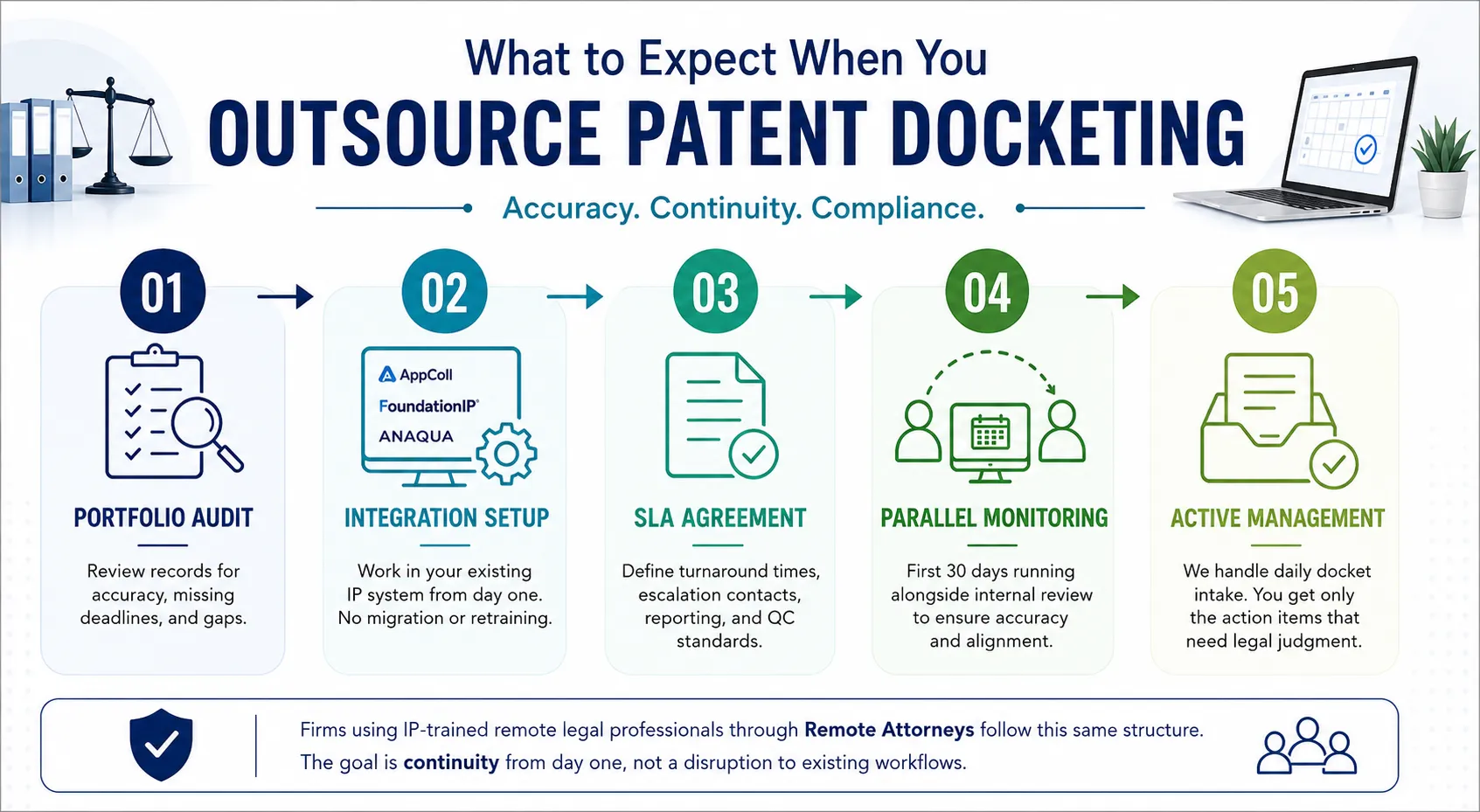
What to Expect When You Outsource Patent Docketing
A smooth transition follows a predictable sequence. Here is what that looks like in practice:
Step 1: Portfolio audit. The outsourced team reviews existing docket entries for accuracy, missing deadlines, and jurisdictional gaps before taking on active management.
Step 2: Integration setup. Good providers work within your existing system from day one. Whether your firm uses AppColl, Foundation IP, or Anaqua, no migration or retraining is required.
Step 3: SLA agreement. Turnaround times, escalation contacts, reporting frequency, and QC standards are documented before work begins.
Step 4: Parallel monitoring. During the first 30 days, the outsourced team runs alongside internal review. This catches calibration issues before they affect live deadlines.
Step 5: Active management. The specialist handles daily docket intake. Attorneys receive only the action items that require legal judgment. Administrative tracking moves off the attorney's desk entirely.
Firms using IP-trained remote legal professionals through Remote Attorneys follow this same structure. The goal is continuity from day one, not a disruption to existing workflows.
How Remote Attorneys Supports IP Firms With Patent Docketing
Remote Attorneys places IP-trained paralegals and legal professionals with law firms across the country. Trusted by more than 1,000 law firms, their specialists are trained by U.S.-based attorneys and work inside your existing systems from the start.
IP firms use Remote Attorneys to handle patent docket intake, office action tracking, IDS management, and deadline monitoring. Paralegals start at $17 per hour, with no long-term commitment and month-to-month flexibility. Firms scale up during prosecution surges and scale back when volume drops.
If your firm is managing more than 50 active patent applications and your docket is handled by one in-house person, the risk exposure is real. A conversation with Remote Attorneys takes 30 minutes. Book a free consultation to see what an IP-trained remote paralegal can manage for your practice.
Frequently Asked Questions About Patent Docketing
What is patent docketing?
Patent docketing is the process of tracking every deadline, filing, and procedural event in a patent's lifecycle, from application through post-grant maintenance, to prevent missed dates and patent abandonment.
What happens if a patent docketing deadline is missed?
A missed deadline can permanently abandon a patent application or expire a granted patent. Some deadlines, like PCT national phase windows, have no reinstatement path, making docketing errors potentially irreversible.
Can an outsourced team maintain the same accuracy as an in-house specialist?
Yes, when the provider uses a structured process with deadline verification, dedicated specialists, and documented turnaround standards. Accuracy depends on the system, not the physical location of the person doing the work.
What software do outsourced patent docketing services use?
Most providers work inside your existing platform, including AppColl, Alt Legal, Anaqua, Foundation IP, or CPA Global. A good provider requires no software migration or system changes on your end.
How often should a law firm audit its patent docket?
Best practice is quarterly. Audits verify deadline calculations, catch overlooked items, and confirm that records are current across all active jurisdictions and prosecution stages.
Accuracy Comes From Systems, Not Just Staff
Patent docketing errors do not happen because attorneys are careless. They happen because the systems behind the work were not built for the volume, the staff transitions, or the jurisdictional complexity that growing IP practices face.
Outsourcing does not introduce inaccuracy. A poorly structured handoff does. When a provider uses dual-entry QC, works inside your existing software, and operates under a documented SLA, the accuracy layer is stronger than what most single in-house docketers can sustain across a large portfolio.
The core question is not location of the work. It is whether the process behind the work has enough redundancy to catch errors before they become permanent. That applies equally to in-house teams and outsourced ones.
Firms that answer that question honestly, and then build or source accordingly, are the ones that do not lose patents to preventable deadline errors.