
Law firms lose billable hours every time a contract sits in an inbox waiting for a signature or a renewal date slips past unnoticed. Contract lifecycle management (CLM) software fixes that by centralizing drafting, redlining, approval routing, and renewal tracking in one system.
This guide compares the best CLM platforms for law firms in 2026, breaks down the features that matter most, and shows where the software reaches its limit. Even the strongest CLM platform still needs an attorney's judgment to draft precise terms and catch risk that automation misses.
Key Takeaways
- CLM software centralizes contract drafting, redlining, e-signature, and renewal tracking in one searchable system.
- Poor contract management costs organizations close to 9.2% of annual revenue on average, according to World Commerce & Contracting research.
- Software handles storage and workflow. Drafting language and judging risk still call for attorney review.
- Solo and small firms need different features than large firms, so contract volume should drive the software choice, not the longest feature list.
What Is Contract Lifecycle Management Software?
Contract lifecycle management software is a platform that manages a contract from request through drafting, negotiation, approval, signature, storage, and renewal. It replaces email chains and shared drives with one searchable record.
Contract lifecycle management software automates how a firm creates, negotiates, executes, stores, and renews agreements from a single system. For law firms, that covers two contract types: client-facing documents like engagement letters, and operational agreements like vendor contracts, leases, and outside counsel arrangements.
The difference between contract management and CLM comes down to scope. Contract management often just means storing signed documents. CLM covers the entire process, from the first draft to the final renewal decision.
Why Law Firms Need Contract Management Software
Manual contract handling costs real money. Deloitte and Docusign's 2024 agreement management study found that poor agreement processes drain nearly $2 trillion in global economic value every year. World Commerce & Contracting's August 2025 whitepaper puts the average revenue loss from contract mismanagement at close to 9.2% annually, mostly from missed renewals and overlooked obligations.
Law firms carry an added cost. Every hour spent chasing a signature or reformatting a template is an hour not billed to a client. The Clio Legal Trends Report 2024 found that up to 74% of a law firm's billable administrative work could be automated, much of it tied to document handling and data entry. Some of that overlap is exactly what a virtual legal assistant already handles for firms that outsource the administrative layer.
Beyond time savings, CLM software gives firms:
- A searchable record of every contract and its current status
- Automatic alerts before renewal or expiration dates
- Consistent clause language across engagement letters and vendor agreements
- An audit trail for e-signatures and version history
Key Features to Look for in CLM Software
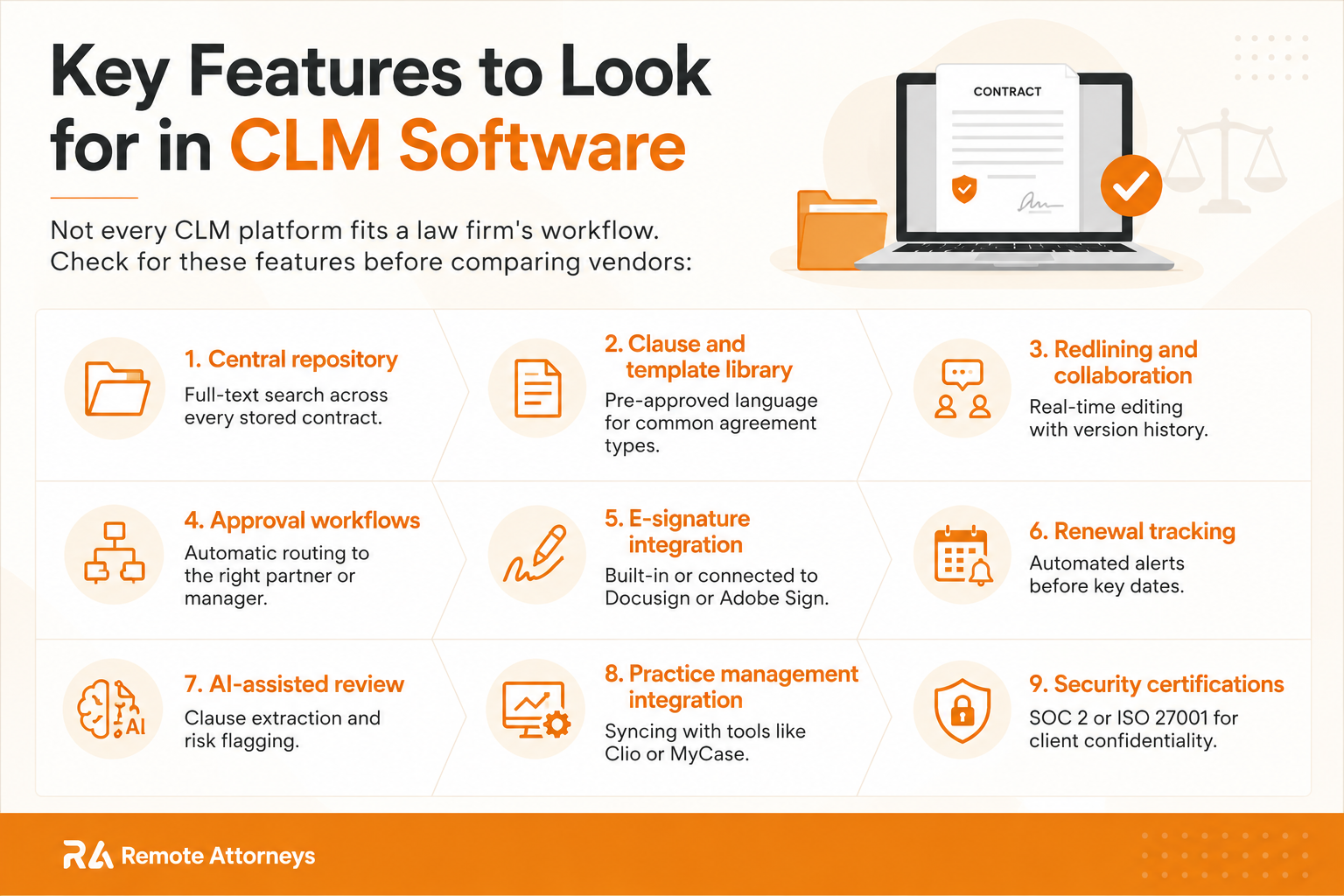
Not every CLM platform fits a law firm's workflow. Check for these features before comparing vendors:
- Central repository: full-text search across every stored contract
- Clause and template library: pre-approved language for common agreement types
- Redlining and collaboration: real-time editing with version history
- Approval workflows: automatic routing to the right partner or manager
- E-signature integration: built-in or connected to Docusign or Adobe Sign
- Renewal tracking: automated alerts before key dates
- AI-assisted review: clause extraction and risk flagging
- Practice management integration: syncing with tools like Clio or MyCase
- Security certifications: SOC 2 or ISO 27001 for client confidentiality
Firms handling client-sensitive contracts should treat security certification as a requirement, not a bonus feature. A platform that scores well on drafting tools but skips SOC 2 certification is not a safe fit for firms bound by client confidentiality obligations.
Best Contract Lifecycle Management Software for Law Firms
This list weighs law firm fit first: how well each platform handles engagement letters, vendor contracts, and outside counsel agreements, not just generic enterprise procurement. Pricing, integration options, and ease of deployment are the other factors behind each ranking.

Ironclad
AI-powered CLM built for high-volume, complex contracting. No-code workflows, native e-signature, and deep Salesforce integration replace scattered email chains. Best for high-volume firms with layered approval chains and enterprise budget.
Clio Draft
Document automation built into the Clio ecosystem. Turns Word templates into fillable, AI-assisted contracts, engagement letters, and court forms. Best for solo and small firms already running Clio Manage.
Agiloft
No-code CLM built for complex, non-standard workflows. Configurable approval chains and obligation tracking suit heavily regulated practices. Best for firms that need deep configuration and can absorb a longer rollout.

LawVu
A legal workspace bundling CLM with matter intake, spend management, and outside counsel collaboration. AI drafting lives inside Microsoft Word. Best for firms serving corporate clients who want CLM plus broader legal ops tools.
SpotDraft
AI-native CLM built for mid-market legal teams. Published pricing, native e-signature, and playbook-based AI clause review. Best for budget-conscious mid-size firms that want structured workflows without enterprise overhead.
Which One Fits Your Firm
Solo and small firms usually do best starting with Clio Draft or Juro, since both deploy fast and cost less upfront. Mid-size firms handling a steady stream of vendor and client contracts often choose SpotDraft or LawVu for the added automation. Enterprise firms tend to need Ironclad or Agiloft for deeper configuration and compliance controls.
Pricing for most platforms is quote-based, so request a demo and compare total cost against actual contract volume before committing. If your firm's real bottleneck is a backlog of contracts waiting for review rather than a lack of software, a document review attorney can clear that queue inside your existing CLM workflow.
Where CLM Software Stops and an Attorney's Judgment Begins
CLM software manages the process. It does not draft precise indemnification language, catch a one-sided limitation of liability clause, or negotiate better terms with opposing counsel. Those are judgment calls that require legal training, not automation.
Most firms do not lack a place to store contracts. They lack the attorney hours to draft, review, and negotiate everything flowing through the system. Only 32% of legal departments expect attorney headcount increases this year, according to CLOC's 2026 State of the Industry Report, which means most firms need to get more from the attorneys they already have rather than hire their way out of the backlog.
Remote Attorneys' contract drafting and writing services pair with any CLM platform your firm already runs, giving your team dedicated attorney support for the drafting and redlining work software cannot do on its own.
How to Choose the Right CLM Software for Your Firm
Match the platform to your firm's size and workflow, not the vendor with the longest feature list.
- Contract volume: firms handling under 50 contracts a month rarely need enterprise-tier pricing.
- Integration needs: confirm compatibility with your existing practice management software.
- Compliance requirements: verify SOC 2 or equivalent certification for client data.
- Support for the human side: pair the software with a contract paralegal or a virtual paralegal to manage intake and routing, so attorneys are not stuck on data entry.
The software handles the system. The people running it determine whether that system actually saves time.
Frequently Asked Questions
What is the best contract lifecycle management software for law firms?
There is no universal best option. Clio Draft suits solo and small firms, while Ironclad and Agiloft fit larger firms with high contract volume and compliance needs.
What does contract management software do?
It centralizes contract drafting, redlining, approval routing, e-signature, and renewal tracking in one searchable system instead of email threads and shared drives.
What is the difference between contract management and CLM?
Contract management usually means storing signed documents. Contract lifecycle management covers the full process, from the first draft through negotiation and renewal.
How much does CLM software cost for a law firm?
Most platforms use custom, quote-based pricing tied to contract volume and user count. Expect to request a demo before getting an actual price quote for your firm.
Can CLM software replace a contract attorney?
No. Software manages storage and workflow, but drafting precise language, judging risk, and negotiating terms with opposing counsel still require an attorney's legal training.
Picking the CLM Platform That Actually Fits Your Firm
The right CLM platform depends on firm size, contract volume, and how much of the process you plan to automate versus keep in attorney hands.
Start by comparing two or three platforms against your actual contract volume, not a vendor's full feature list. Request a demo, check integration with your existing practice management software, and confirm the security certifications your clients expect.
Software solves the storage and workflow half of the problem. The drafting, review, and negotiation half still needs a trained legal professional. Firms that pair the right CLM platform with the right attorney support close both gaps at once.
Ready to close that gap? Book a consultation with Remote Attorneys to pair the right attorney support with the CLM platform your firm already runs.