
.webp)
KEY TAKEAWAYS
- A business formation lawyer’s role goes beyond entity registration—it includes building protective legal infrastructure from Day 1.
- Each of the four business formation types carries a different non-solicitation risk profile that affects how agreements should be drafted.
- With non-competes under increasing state and federal scrutiny in 2025, non-solicitation agreements are now the most enforceable form of employee restriction.
- Agreements signed at the time of employment have stronger legal standing than those introduced mid-tenure.
- Remote and multi-state businesses face greater legal exposure—state-aware drafting is essential.
You worked with a business entity formation lawyer to structure the perfect LLC. You filed the right documents, set up a solid operating agreement, and launched your business. Six months later, your top salesperson walks out — and takes three major clients and two junior employees with them.
No lawsuit was filed. No law was broken. Why? Because there was no non-solicitation agreement in place.
This is one of the most costly gaps in business formation — and one of the most preventable. A complete business formation engagement doesn't end at the filing stage. It includes the operational and employment safeguards that protect everything you built.
This guide explains why every business formation lawyer should have non-solicitation agreements built into your company's foundational legal structure — and what happens when they don't.
What a Business Formation Lawyer Actually Does
Most business owners think of a business formation lawyer as someone who handles the paperwork — the LLC registration, the articles of incorporation, the EIN application. That's a narrow view of a broad role.
A business entity formation lawyer is responsible for structuring how your company operates, not just how it's registered. That includes:
- Choosing the right entity type and jurisdiction
- Drafting operating agreements, bylaws, and shareholder agreements
- Establishing governance and decision-making frameworks
- Defining ownership rights, profit-sharing, and equity structures
- Building employment and contractor frameworks — including restrictive covenants
That last point is where most formation engagements fall short. The employment framework isn't just HR policy — it's a legal asset. When a business entity formation lawyer structures your company without addressing non-solicitation, you have an incomplete foundation.
For remote and multi-state businesses, the exposure is even greater. Employees working across state lines are subject to different laws, different thresholds, and different enforceability standards. A single-state template won't protect a distributed team.
What Are the 4 Types of Business Formations? (And Why Each One Needs Different Protections)
The type of business entity you choose directly affects how vulnerable your business is to employee-driven losses — and how your non-solicitation agreement should be structured.
The formation type you choose shapes the design of the agreement — not just whether one is needed. A business entity formation lawyer who understands this distinction builds entity-specific protections, not one-size-fits-all templates.
Non-Solicitation Agreements Are the New Standard.
The legal landscape for employee restrictions has shifted significantly.
In April 2024, a Texas federal court blocked the FTC from enforcing its final rule banning non-compete agreements nationwide. You can review the 2025 state-by-state restrictive covenant roundup to understand the current patchwork of state laws. States didn't wait — they moved fast with their own restrictions.
What this means in practice:
- California, Minnesota, Oklahoma, and North Dakota generally ban non-competes outright
- Colorado's 2025 non-solicitation threshold is now $76,254.60 — updated annually
- Florida's CHOICE Act (effective July 2025) creates new employer-favorable presumptions for non-competes, but only in specific contexts
- States like Illinois and Washington continue tightening wage thresholds for enforceability
According to Frost Brown Todd's 2025 mid-year update, non-compete restrictions remain one of the most fluid areas of employment law in the country.
Non-solicitation agreements, however, are surviving judicial scrutiny. Courts view them as narrower and more targeted. They protect legitimate business interests without broadly restricting where someone can work.
What Every Business Formation Lawyer Looks for in an Enforceable Non-Solicitation Agreement
Not all non-solicitation agreements hold up in court. Courts frequently strike down agreements that are too broad, lack adequate consideration, or fail to account for state-specific rules.
A Massachusetts jury awarded $452 million in a trade secret misappropriation case in 2024 — underscoring what's at stake when companies fail to protect client relationships and proprietary information from the start.
Here is what a qualified business entity formation lawyer will build into a robust agreement:
- Defined Scope — Which clients, employees, and vendor relationships are covered. Blanket restrictions get struck down; specificity survives.
- Reasonable Duration — Courts typically accept 6 months to 2 years. Agreements outside this range face enforceability challenges.
- Geographic Limitations — Less common in non-solicitation than non-competes, but required in states with specific geographic scope requirements.
- Adequate Consideration — The agreement must be signed at onboarding. Post-hire agreements require new consideration (promotion, raise, equity) to be valid in most states.
- Relationship Specificity — Courts require agreements to protect actual business interests, not theoretical ones. Name the client categories, the employee relationships, the accounts.
- State-Law Compliance Layer — What is enforceable in Florida may be void in California. Multi-state agreements require choice-of-law provisions and state-specific drafting.

Client Non-Solicitation vs. Employee Non-Solicitation — You Need Both
Many business owners assume a single non-solicitation clause covers everything. It doesn't. There are two distinct types, and most businesses — especially service-driven and remote-first firms — need both.
Timing Is Everything — Why Business Formation Is the Optimal Window
The question isn't just whether to have a non-solicitation agreement — it's when it's put in place.
Courts consistently give greater weight to agreements signed at the beginning of employment. The legal logic is straightforward: the job offer itself is the consideration. An employee receives employment in exchange for agreeing to the restrictions.
When agreements are introduced mid-tenure, they require new consideration — a raise, a promotion, additional equity — to be enforceable in most states. Miss that requirement and the agreement may be void from inception.
The business formation stage is the cleanest, most defensible moment to build these agreements. Your business entity formation lawyer is already drafting your operational documents. Adding non-solicitation language at this stage costs a fraction of what it costs to litigate a violation later.
For context: ContractsCounsel data shows the average cost to draft a non-solicitation agreement is $380. The average cost of a trade secrets lawsuit starts in the hundreds of thousands.
You cannot retroactively protect what you didn't secure at the start. The business formation window is the lowest-cost, highest-protection moment for these agreements.
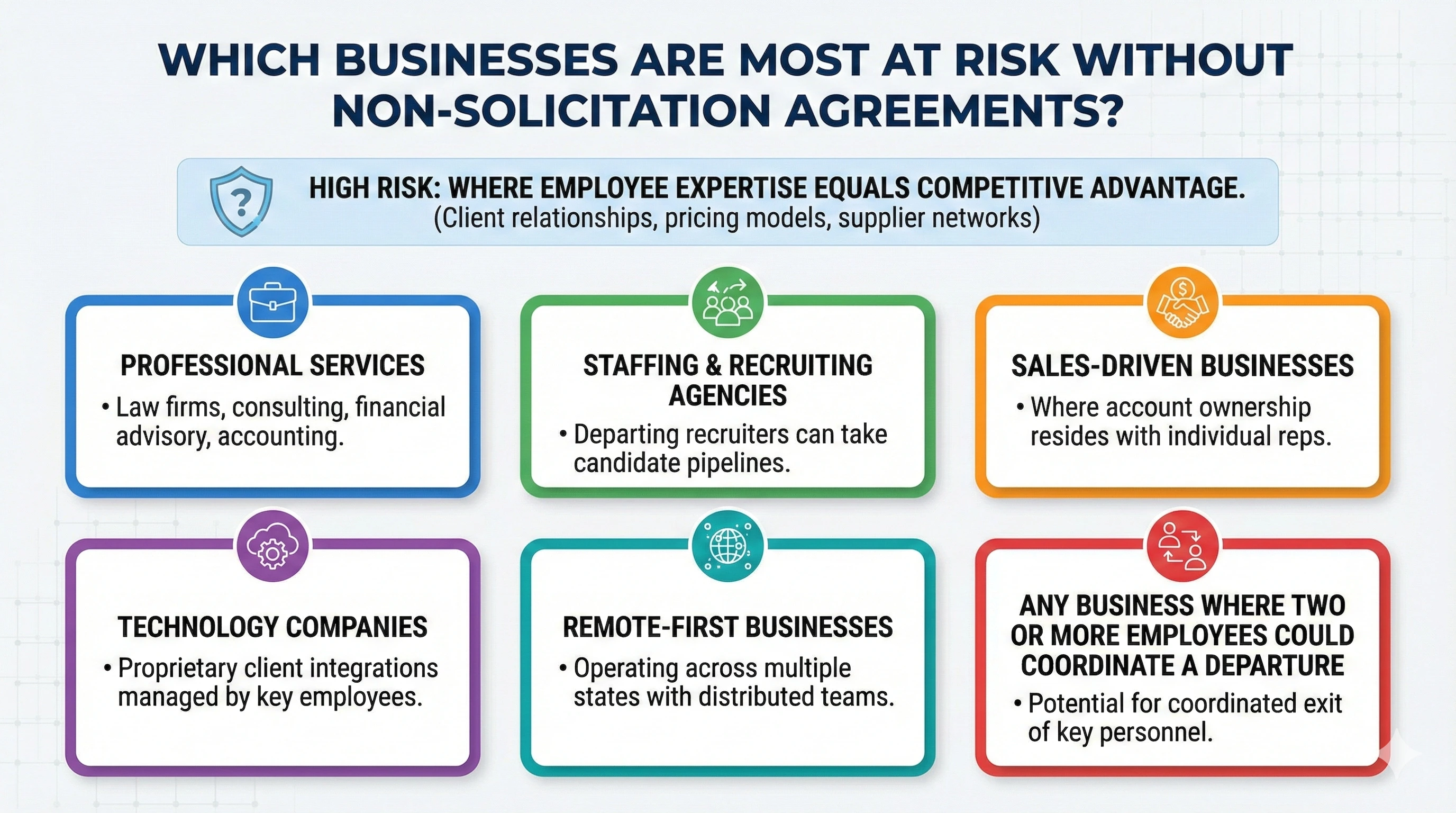
Which Businesses Are Most at Risk Without Non-Solicitation Agreements?
Non-solicitation risk is highest wherever employee expertise directly equals competitive advantage. If your team owns the client relationships, knows your pricing models, or manages your supplier network — you have exposure.
- Professional services (law firms, consulting, financial advisory, accounting)
- Staffing and recruiting agencies — departing recruiters can take candidate pipelines
- Sales-driven businesses where account ownership resides with individual reps
- Technology companies with proprietary client integrations managed by key employees
- Remote-first businesses operating across multiple states with distributed teams
- Any business where two or more employees could coordinate a departure
Law firms are particularly exposed. A departing associate or partner who solicits clients or laterals staff to a competing firm represents a direct revenue threat — one that a well-drafted non-solicitation agreement, built into the firm's employment framework from the start, could prevent or litigate against.
Need help matching your firm with a qualified remote attorney who handles business formation and employment contracts? Visit RemoteAttorneys.com/services to explore our legal staffing options.
Build Your Business Right — Formation Is More Than a Filing
A non-solicitation agreement isn't a formality. It's a business asset.
When a business entity formation lawyer structures your entity, they're building the legal infrastructure your company will operate within for years. That infrastructure must include employment protections — because the people who enter your business also hold the keys to your most valuable relationships.
As non-competes face growing legal headwinds in 2025, non-solicitation agreements have become the primary enforceable tool for protecting client pipelines, team stability, and competitive positioning. And the most defensible time to put them in place is when you form the entity.
Whether you're forming an LLC, structuring a partnership, or incorporating a new corporation — your formation documents should include non-solicitation protections from Day 1.
Continue Reading on RemoteAttorneys.com
Related service pages: Virtual Freelance Lawyers | Remote Legal Staffing Agency | How It Works
Related blog posts: Hiring In-House vs. Remote Attorney for Law Firms | 8 Ways Remote Attorneys Improve Law Firm Productivity
FAQ
How much does it cost to hire a lawyer to start a business?
Business formation lawyer fees range from $500 to $5,000+ depending on entity type, jurisdiction, and complexity. Remote legal services can significantly reduce these costs — RemoteAttorneys.com offers qualified attorneys starting at $19/hour.
Do I need a lawyer to establish an LLC?
You are not legally required to use a lawyer to form an LLC, but it's strongly advisable. A business entity formation lawyer ensures your operating agreement, membership structure, and employment protections are legally sound and enforceable — not just filed.
Should I get a lawyer to set up my LLC?
Yes — especially if you have co-founders, employees, or clients. An attorney ensures your LLC operating agreement addresses ownership rights, buyout provisions, and non-solicitation clauses from the start. DIY filings often miss these critical protections.
Are non-solicitation agreements enforceable in every state?
No. Enforceability varies significantly by state. California, Minnesota, and North Dakota restrict them heavily. States like Florida and Texas are more employer-friendly. A business formation lawyer must draft state-specific agreements — generic templates often fail in court.
Is there demand for remote paralegals?
Yes — demand for remote paralegals is growing rapidly. Law firms increasingly use virtual paralegal support to reduce overhead, scale capacity, and manage peak caseloads. RemoteAttorneys.com offers experienced freelance paralegals starting at $19/hour with no long-term commitment required.