

Key Takeaways
- Responsiveness is Revenue: Faster communication directly impacts retention and referrals.
- Service Is Operational, Not Personal: Client experience must be system-driven—not dependent on one attorney.
- Remote Talent Increases Capacity: Strategic delegation improves turnaround time and output quality.
- Structure Protects Growth: Corporate structure and non-solicitation agreements protect firm goodwill.
- Scalable Service Defines Your Ceiling: Firms that build infrastructure outperform firms that rely on effort alone.
In the legal industry, the question “What does customer service mean to you?” is often met with a blank stare or a reference to a friendly receptionist. But for high-performing firms, customer service is not hospitality—it is operational precision.
It is the speed of a filing.
It is the clarity of a contract.
It is the reliability of communication.
It is the consistency of follow-up.
For managing partners, this is not a soft concept — it is a measurable performance variable that directly affects firm stability and growth.
When responsiveness declines, intake conversion weakens.
When communication becomes inconsistent, retention erodes.
When execution slows, attorney capacity tightens and revenue per lawyer compresses.
Customer service in a modern law firm is not about surface-level experience. It is about operational reliability — structured systems that protect client trust, preserve margin, and sustain scalable growth.
Redefining Service: The “Product” of the Modern Law Firm
Most firms believe they sell legal expertise. In reality, they sell experience, certainty, and responsiveness.
Beyond the Billable Hour
Clients do not pay for time. They pay for outcomes. Time is simply the internal mechanism firms use to price work, but it is not how clients measure value. From the client’s perspective, hours are invisible. What they experience is speed, clarity, accuracy, and certainty.
When those elements are strong, the service feels premium — regardless of how long the work took. When they are weak, even a technically correct result feels unsatisfactory.
- Results
- Predictability
- Speed
- Clear communication
- Reduced risk
A client does not evaluate your firm by how many hours were logged. They evaluate:
- How quickly their email was answered
- Whether deadlines were met
- Whether documents were error-free
- Whether they felt informed throughout the process
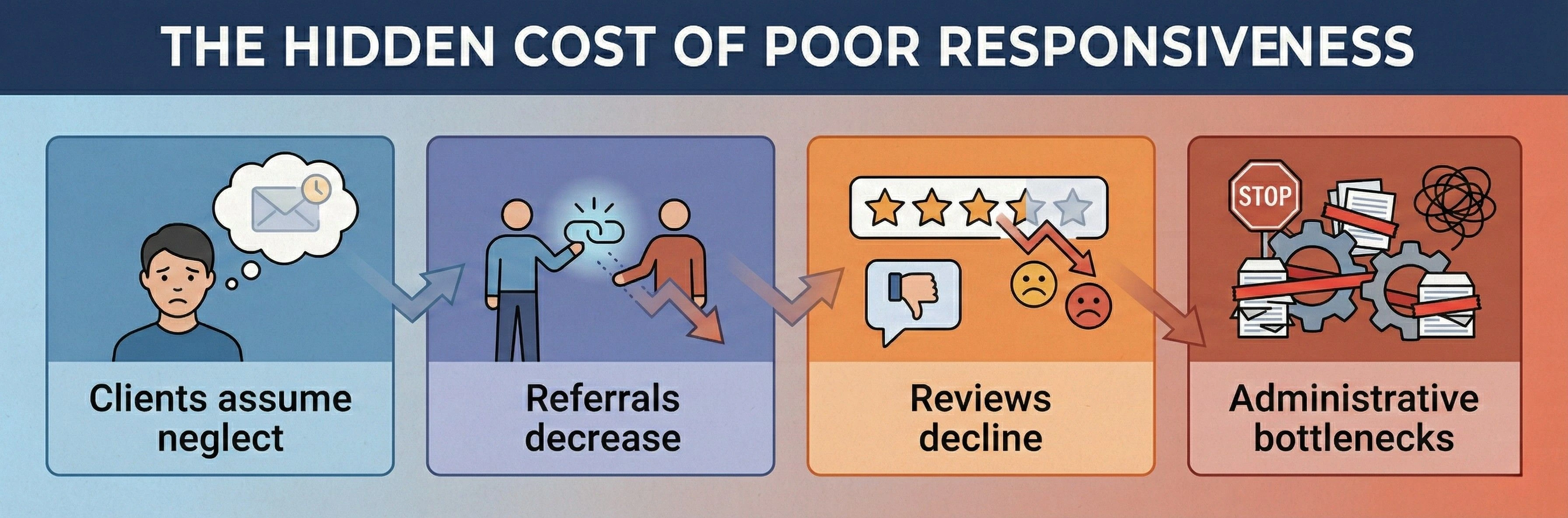
The Hidden Cost of Poor Responsiveness
When communication slows down, the damage to a firm’s bottom line is measurable. According to the 2026 Report on the State of the US Legal Market, deteriorating buyer sentiment has led corporate general counsel to move "mobile demand" away from expensive, unresponsive firms toward lower-cost, midsize alternatives.
- Clients assume neglect: Trust is the foundation of the attorney-client relationship; when it erodes, churn increases.
- Referrals decrease: According to the Clio Legal Trends Report, responsiveness is the #1 factor clients use to determine lawyer quality, with 79% of clients expecting a response within 24 hours.
- Reviews decline: Negative sentiment regarding "lack of communication" is the most frequent driver of one-star reviews.
- Administrative bottlenecks: Even highly skilled attorneys lose revenue when they are buried in the "execution" of tasks rather than strategy.
Customer service in law is not emotional warmth—it is operational reliability. By utilizing specialized support through remote paralegals, firms materially reduce response times, eliminate communication bottlenecks, and ensure that no lead or active client feels overlooked.
Scaling Responsiveness with Remote Talent
The number one complaint across practice areas is consistent:
“My lawyer won’t call me back.”
Why does this happen?
- Partners are overloaded.
- Associates are billing-heavy.
- Intake staff are overwhelmed.
- Drafting tasks consume strategic time.
This is not a professionalism issue—it is a capacity issue.
Where Remote Paralegals Improve Service
Remote paralegals and legal support staff can:
- Manage intake follow-ups
- Send case status updates
- Prepare draft pleadings
- Organize discovery
- Track deadlines
- Coordinate with courts
- Prepare client documentation packages
When structured properly, response time becomes a system—not a personality trait.
Structural Excellence: Risk-Protected Scalability
Customer service cannot scale without infrastructure. Capacity expansion alone is insufficient. When firms grow without reinforcing legal and operational structure, service reliability eventually degrades.
Scaling responsiveness requires both staffing design and structural protection.
Corporate Structure as a Service Foundation
As firms expand—particularly when engaging remote legal professionals—corporate structure becomes a stability requirement, not an administrative formality.
A business formation lawyer helps ensure:
- Proper entity selection (PLLC, PC, LLP)
- Liability insulation
- Multi-state compliance
- Clear operating agreements
- Defined management authority
- Workforce classification compliance
This matters because service reliability collapses under legal instability. If your structure cannot securely and compliantly support distributed professionals, scalability becomes fragile.
Operational growth must be legally insulated to remain sustainable.
Efficiency as a Service Standard
High-performing firms divide roles with precision:
- Lead attorneys → Strategy, court appearances, client-facing leadership
- Remote legal professionals → Drafting, research, documentation, backend execution
This is not cost-cutting. It is value optimization.
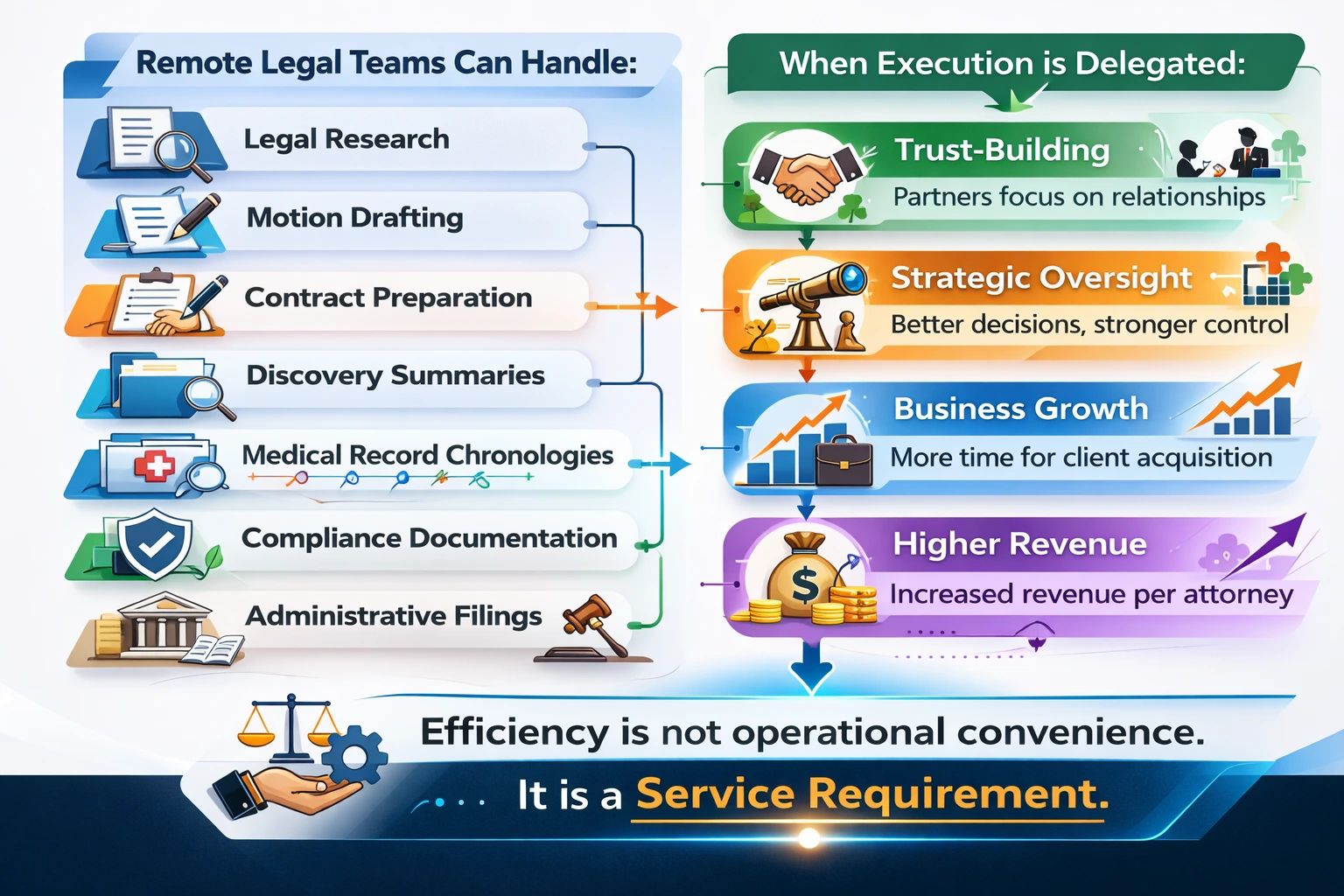
Remote legal teams can handle:
- Legal research
- Motion drafting
- Contract preparation
- Discovery summaries
- Medical record chronologies
- Compliance documentation
- Administrative filings
When execution is delegated:
- Partners focus on trust-building
- Strategic oversight improves
- Business development expands
- Revenue per attorney increases
Efficiency is not operational convenience. It is a service requirement.
Protecting Goodwill Through Structured Agreements
Scaling service also requires safeguarding the firm’s institutional value.
When working with remote professionals, protective mechanisms such as non-solicitation agreements preserve:
- Client ownership
- Referral relationships
- Brand control
- Institutional goodwill
True customer service means the client relationship belongs to the firm — not to an individual contributor.
Without protection, growth introduces exposure.With structure, growth becomes durable.
The Financial Reality: Turning Service Into a Growth Multiplier
Customer service improvements must translate into measurable ROI.
Let’s look at practical implications.
Remote staffing allows:
- Scaling during case spikes
- Reducing idle payroll during slow periods
- Increasing output without increasing office footprint
- Improving margin control
When turnaround improves, firms can:
- Accept more cases
- Improve retention
- Increase referral rates
- Enhance review ratings
- Strengthen brand perception
Customer service becomes revenue expansion—not overhead.
The Strategic Question
Ask yourself:
- Is my service dependent on my availability?
- Can my firm respond within 24 hours consistently?
- Can we increase case volume without decreasing quality?
- Are systems documented and repeatable?
- Is client communication structured?
If the answer is no, your service model is personality-driven.
Personality-driven firms plateau.
System-driven firms scale.
Read More: https://www.remoteattorneys.com/blog/legal-operations-2026-virtual-workflow
The Infrastructure That Defines Your Firm’s Ceiling
Ultimately, your answer to “What does customer service mean to you?” defines your firm’s ceiling.
If it means:
“I answer every call myself.”
Growth is capped.
If it means:
“My firm delivers fast, structured, professional results through a vetted team.”
Your potential becomes unlimited.
Modern law firms cannot rely solely on effort. They must rely on infrastructure.
FAQ
What does customer service mean in a law firm?
Customer service in a law firm means delivering timely communication, accurate work, proactive updates, and reliable execution through structured systems.
Why is responsiveness critical for law firms?
Responsiveness builds trust, improves retention, increases referrals, and protects revenue. Delays in communication often reduce conversion and damage reputation.
How does poor customer service affect a law firm’s growth?
Slow responses and inconsistent follow-up reduce client satisfaction, increase churn, limit referrals, and cap firm scalability.
How can law firms improve customer service at scale?
Firms improve service by documenting workflows, delegating backend work, setting response standards, and using remote legal support.
Does customer service impact law firm profitability?
Yes. Strong service increases retention, strengthens referrals, improves reviews, and allows firms to scale without reducing quality.