
.webp)
Most law firms don't need to pick the best legal research platform. They need the one that fits how their team actually works. Lexis Advance and Westlaw have both been the backbone of legal research for decades. Both cover case law, statutes, and regulations. Both now offer AI research tools. The real question is which one earns its cost at your firm. That answer depends on your practice area, your team's experience, and how you run research day to day.
This comparison breaks down both platforms feature by feature, including their AI tools, citation systems, pricing, and secondary sources, so you can make a clear decision without reading a product brochure.
Key Takeaways
- Lexis Advance (now Lexis+) is more intuitive for new researchers and works well for firms that rely on Shepard's for citation validation.
- Westlaw leads on litigation analytics, giving litigators data on judges, motion outcomes, and damages awards that Lexis+ does not match.
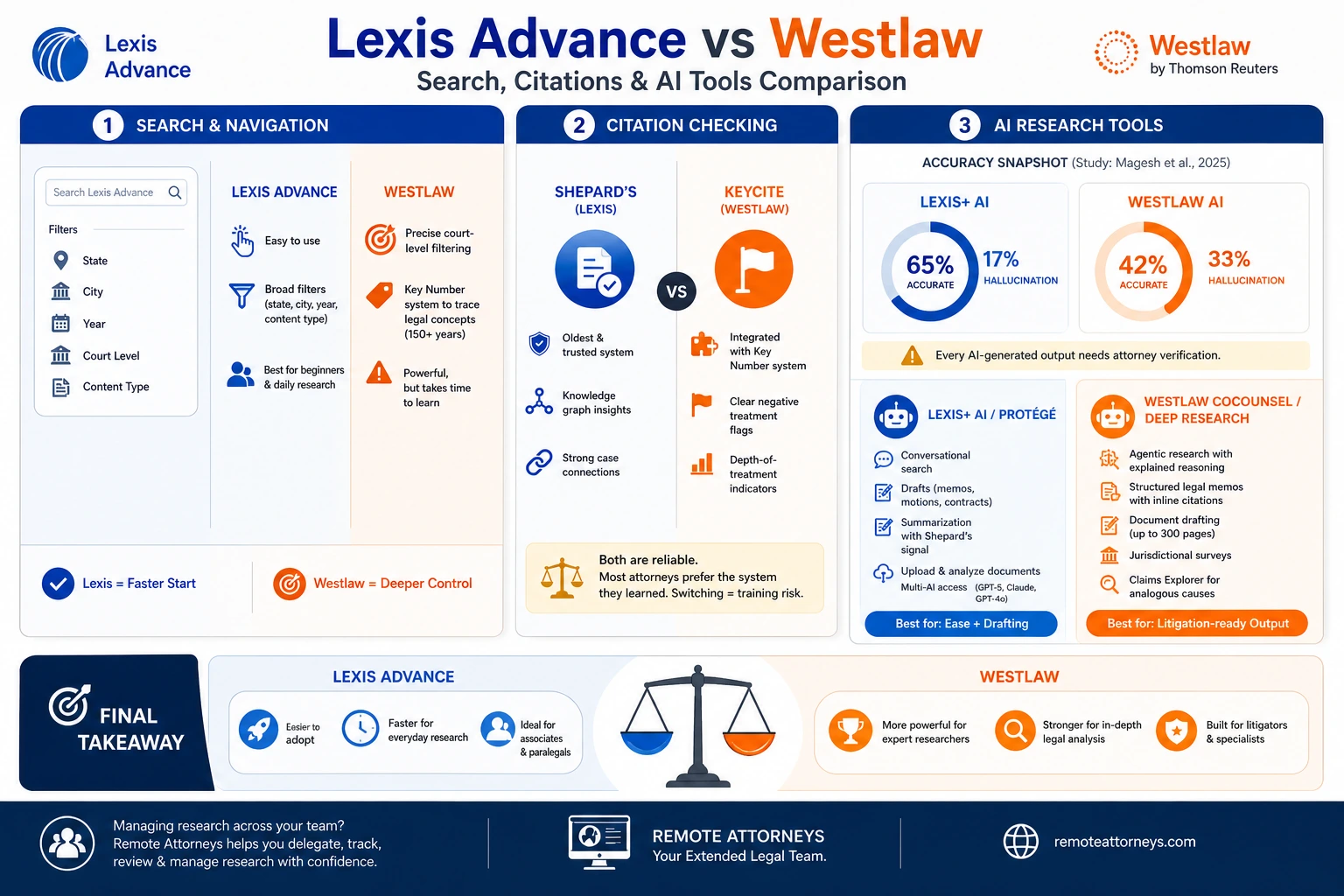
- Both AI tools still hallucinate. A 2025 Stanford study found Westlaw's AI at 33% and Lexis+ AI at 17%, so attorney review remains non-negotiable.
- Neither platform publishes pricing. Both require a custom quote, and both will negotiate at renewal, especially if you have a competing offer.
What Is Lexis Advance?
Lexis Advance is LexisNexis's core legal research platform, covering case law, statutes, regulations, and secondary sources across more than 60,000 legal and news sources.
LexisNexis has been migrating all Lexis Advance users to the upgraded Lexis+ platform. The transition is automatic. All user logins, files, folders, alerts, and account settings from Lexis Advance carry over to Lexis+ with no interruption to service. In practice, Lexis Advance and Lexis+ refer to the same platform at different stages.
For this comparison, "Lexis Advance" and "Lexis+" are used interchangeably. If you're doing a lexis advance sign in today, you're most likely already on Lexis+.
What Is Westlaw?
Westlaw is Thomson Reuters' flagship legal research platform and the most widely used legal research tool in the United States.
Westlaw holds approximately 31% market share in the legal research category. In 2023, Thomson Reuters acquired Casetext for $650 million, integrating its CoCounsel AI assistant into Westlaw. In August 2025, Thomson Reuters launched CoCounsel Legal with "Deep Research," an agentic AI capability that generates research plans, explains its reasoning, and delivers structured reports using AI agents drawing on KeyCite, Key Numbers, and statute annotations.
Westlaw's current premium tier is called Westlaw Advantage, with CoCounsel Legal as its AI layer.
Search and Navigation: Which Is Easier to Use?
For most firms, this is where the day-to-day difference shows up most.
Lexis Advance is widely regarded as more user-friendly for general exploration, particularly for newer researchers and smaller firms. It allows filtering by state, city, year, journal, court level, or content type, making case comparisons straightforward.
Westlaw allows filtering for a specific court (for example, the Ohio Eighth District). Lexis Advance filters only by court level. Users can add segment search terms in Lexis Advance to narrow results further.
Westlaw's WestSearch algorithm and Key Number system give experienced researchers a structured way to trace legal concepts across 150+ years of case law. That's powerful, but it takes time to learn.
Bottom line: Lexis Advance is the better starting point for associates and paralegals doing daily lexis advance research. Westlaw rewards researchers who already know exactly what they're looking for.
If you delegate legal research to a remote team, this usability gap matters. Explore how Remote Attorneys integrates into your firm's research workflow with professionals already trained on both platforms.
Citation Checking: Shepard's vs. KeyCite
Citation checking is where the stakes are highest, especially for litigators.
Lexis Advance uses Shepard's Citations Service, the oldest citation system in U.S. legal research. The Shepard's Knowledge Graph allows users to precisely identify relevant data, verify case connections and legal concepts, receive answers grounded in validated citations, and reduce research time through measurably better quality results.
Westlaw uses KeyCite, which integrates tightly with its Key Number system and flags negative treatment with depth-of-treatment indicators.
Both are reliable. Most attorneys have a strong preference based on where they trained. If your team learned Shepard's in law school, switching to KeyCite mid-case introduces real risk.
Practical note for firm managers: Factor this into any platform switch. Retraining attorneys on a new citator during active litigation is a cost most firms don't budget for.
AI Research Tools: Lexis+ AI vs. Westlaw CoCounsel
This is the section most legal operations managers want to read first in 2025 and 2026.
Both platforms made major AI upgrades. Both are genuinely useful. Neither is ready to replace attorney judgment.
The Hallucination Problem
According to the peer-reviewed study "Hallucination-Free?" published in the Journal of Empirical Legal Studies (Magesh et al., 2025), Lexis+ AI answered accurately on 65% of queries while Westlaw's AI-Assisted Research was accurate only 42% of the time. Westlaw hallucinated at nearly twice the rate of Lexis+ AI, 33% versus 17%. Both vendors had marketed their retrieval-augmented generation (RAG) architectures as preventing hallucinations, but the study found those claims "overstated."
One in six queries from Lexis+ AI may return fabricated information. One in three from Westlaw. Every AI-generated output needs attorney verification before it goes into a brief, motion, or client memo.
Lexis+ AI / Protégé
Lexis+ AI supports conversational search, document drafting, summarization, and analysis, and promises citation-linked responses grounded in Shepard's-validated sources. It is designed to be user-friendly, even for those new to AI tools.
In August 2025, LexisNexis added Protégé General AI, providing secure access to multiple general-purpose AI models, including GPT-5, Claude Sonnet 4, and GPT-4o, all within the secure legal research environment.
Key capabilities:
- Conversational legal research with follow-up questions
- First-draft document generation (motions, memos, contracts)
- Case summarization with Shepard's signal included
- Upload and analyze documents up to 10 files per session
- Protégé Vault for storing thousands of documents for AI analysis
Westlaw CoCounsel / Deep Research
Users report that Westlaw's AI-assisted research feels more reliable in everyday practice because every AI-generated point links directly to the underlying cases, making citation verification straightforward.
CoCounsel Deep Research functions as an agentic AI tool. Rather than returning a list of cases, it reasons through the legal question, builds a research plan, and delivers a structured memo grounded in Westlaw and Practical Law content.
Key capabilities:
- Multi-step agentic research with explained reasoning
- Structured legal memos with inline citations
- Document drafting up to 300 pages
- Jurisdictional surveys across state and federal law
- Claims Explorer for identifying analogous causes of action
Bottom line: Lexis+ AI is easier to adopt and better for conversational drafting. CoCounsel Deep Research produces more structured, memo-ready output for litigators. Neither replaces verification.
For law firms managing research output from multiple team members, the Remote Attorneys platform gives you tools to track, review, and manage research tasks alongside AI-generated drafts.
Litigation Analytics: A Clear Advantage for Westlaw
This section matters most to trial attorneys and litigation-focused firms.
Westlaw's Litigation Analytics module tracks data on judges, courts, attorneys, firms, damages, and case types. Attorneys can see how often a judge grants certain motions compared to the court average and review damages awards by case type and jurisdiction.
Lexis+ offers some analytics through its Context tool, but the depth of judge-specific and motion-outcome data trails Westlaw by a significant margin.
If your firm prepares cases with specific judges in mind, or if knowing a court's typical damages range helps you advise clients on settlement, Westlaw's analytics alone may justify its cost.
Verdict: Westlaw wins this category outright.
Secondary Sources and Practical Guidance
Both platforms offer broad secondary source libraries. The differences come down to depth and focus.
Westlaw structures its secondary material tightly around practice needs, with in-depth commentary in many treatises. Lexis provides a comparable range, including Matthew Bender treatises, law reviews, restatements, and step-by-step practice guides, though some users note the analysis stays at a more basic level.
Lexis+ Practical Guidance covers 25+ practice areas with annotated forms, checklists, and drafting tools, useful for transactional attorneys who need a fast starting point.
Westlaw's Practical Law (a separate product integrated into Westlaw) is widely considered the gold standard for transactional practice notes, particularly in M&A, finance, and corporate work.
Verdict: Transactional firms often prefer Westlaw's Practical Law. Appellate and academic researchers tend to find Lexis's secondary content more accessible and easier to filter.
Pricing: What Law Firms Actually Pay
Both platforms avoid publishing standard pricing. Here is what is publicly known.
Both LexisNexis and Thomson Reuters price their platforms per named user or per concurrent user, with additional charges for premium content sets, analytics modules, and integrations. Neither publishes standard list pricing; both require direct sales engagement for a custom quote.
Firms pay a flat rate for whatever content package they purchase, with unlimited use of in-plan materials during the contract period. Documents outside the firm's plan trigger additional per-document fees.
What practitioners report paying:
- Solo practitioners: approximately $200–$270/month for Lexis basic access
- Westlaw small firm plans: comparable range, often higher for analytics add-ons
- Both platforms offer multi-year discounts and volume pricing for larger firms
Practical tip for managing partners: Get competing quotes at renewal. Both vendors negotiate, especially if you reference the other platform's offer. Leverage the migration timeline if LexisNexis is pushing you from Lexis Advance to Lexis+.
Who Should Choose Lexis Advance / Lexis+?
Lexis+ is the better fit if your firm:
- Has associates or paralegals doing most of the daily lexis advance research
- Relies heavily on Shepard's for citation validation, especially in appellate work
- Needs drafting and document summarization tools that are easy to learn
- Works across transactional matters where Practical Guidance checklists save time
- Wants a shorter onboarding curve for new team members
Your lexis advance sign in credentials carry over automatically to Lexis+. No setup required.
Who Should Choose Westlaw?
Westlaw is the better fit if your firm:
- Focuses on complex federal or appellate litigation
- Uses judge-specific and motion-outcome analytics to build case strategy
- Has experienced researchers comfortable with Key Number navigation
- Needs the deepest transactional practice notes available (Practical Law)
- Wants the most structured AI research memos with inline citations
How Remote Attorneys Fits Into Your Research Workflow
Your research platform is only as effective as the team using it.
Law firm owners subscribe to Lexis Advance or Westlaw to support their legal research. But managing that research, verifying AI output, delegating tasks, and tracking quality takes time. That's where Remote Attorneys provides direct value.
Remote Attorneys fields legal professionals already trained on both Lexis Advance and Westlaw. When your firm needs research support, document drafting, case analysis, or litigation prep, those professionals bring platform expertise your team doesn't have to build from scratch.
You can also read more on how firms delegate legal research effectively in our guide on top legal tasks you can delegate to remote attorneys.
Frequently Asked Questions
Is Lexis Advance the same as Lexis+?
Lexis Advance is the predecessor. LexisNexis migrated all users to Lexis+, which adds AI tools and an updated interface. Your existing login works on Lexis+ with no setup needed.
Is Westlaw or Lexis better for case law research?
Both cover comprehensive U.S. case law. Westlaw's Key Number system offers structured concept navigation. Lexis Advance research is comparable in depth and adds Shepard's citation signals. The gap is minimal; preference usually follows training.
Which legal AI tool is more accurate: Lexis+ AI or Westlaw CoCounsel?
A 2025 Stanford study found Lexis+ AI hallucinated 17% of the time versus Westlaw's 33%. Both still require attorney verification before any AI-generated content is used in filings or client advice.
How much does a Lexis Advance subscription cost?
LexisNexis does not publish list pricing. Solo practitioners report paying around $270/month. Firm-wide contracts are custom-quoted by user count, content modules, and contract term.
Can Lexis Advance or Westlaw be used on mobile?
Yes. Both platforms offer mobile access. Lexis+ works on any modern browser and has a dedicated mobile app. Westlaw offers similar mobile access through its Westlaw Advantage platform.
Making the Right Call for Your Firm
Lexis Advance and Westlaw are both excellent platforms. Neither is universally better. The right choice depends on what your team actually does every day.
Choose Lexis+ if usability, Shepard's reliability, and a shorter learning curve matter most. Choose Westlaw if litigation analytics and structured AI research memos are your priority.
Many firms subscribe to both and split usage by practice area: litigation teams on Westlaw, transactional teams on Lexis. If that sounds expensive, consider how much of that research load could be handled by a trained remote legal team working within your existing platform subscriptions.
For more on how law firms are building leaner, more efficient research operations, see our post on legal operations in 2026 and how remote attorneys improve law firm productivity.