A missed lease clause or zoning issue can lead to major financial loss and legal risk. Commercial real estate law is more complex than residential deals and offers no consumer protection, so all risks fall on the parties and their lawyers.
Unlike residential deals, buyers and tenants in commercial property transactions carry no consumer protection backstop. Every risk lands squarely on the parties and their counsel. That reality demands a level of legal rigor that many firms underestimate until a deal goes wrong.
This post breaks down the most critical legal risks in commercial real estate law, the due diligence frameworks that prevent them, and how law firms can build the capacity to handle high-volume CRE matters without cutting corners. Per legal industry data tracked through 2026, demand for specialized legal services continues to grow as transaction complexity increases.
KEY TAKEAWAYS
- Commercial real estate law is more complex than residential and carries higher legal risk.
- The most costly mistakes involve title defects, zoning issues, and weak due diligence.
- A strong due diligence process is the best defense against liability in CRE transactions.
- Using experienced legal professionals helps law firms reduce risk and manage CRE matters efficiently.
How It Differs from Residential Real Estate Law
Commercial real estate transactions carry higher legal risk than residential deals because fewer regulatory protections apply.
Key differences include:
- No consumer protection safeguards – Most commercial transactions lack mandatory disclosures and cooling-off periods common in residential real estate.
- Sophisticated parties assumption – Courts assume both parties understand the contract and typically enforce the agreement exactly as written.
- Greater reliance on due diligence – Buyers, tenants, and their attorneys are responsible for identifying legal, financial, and regulatory risks before closing.
- Higher consequences for mistakes – Issues such as poorly negotiated leases, missed environmental risks, or title defects can create long-term liability and significant financial losses.
Because of these factors, thorough legal review and due diligence are essential in every commercial real estate transaction.
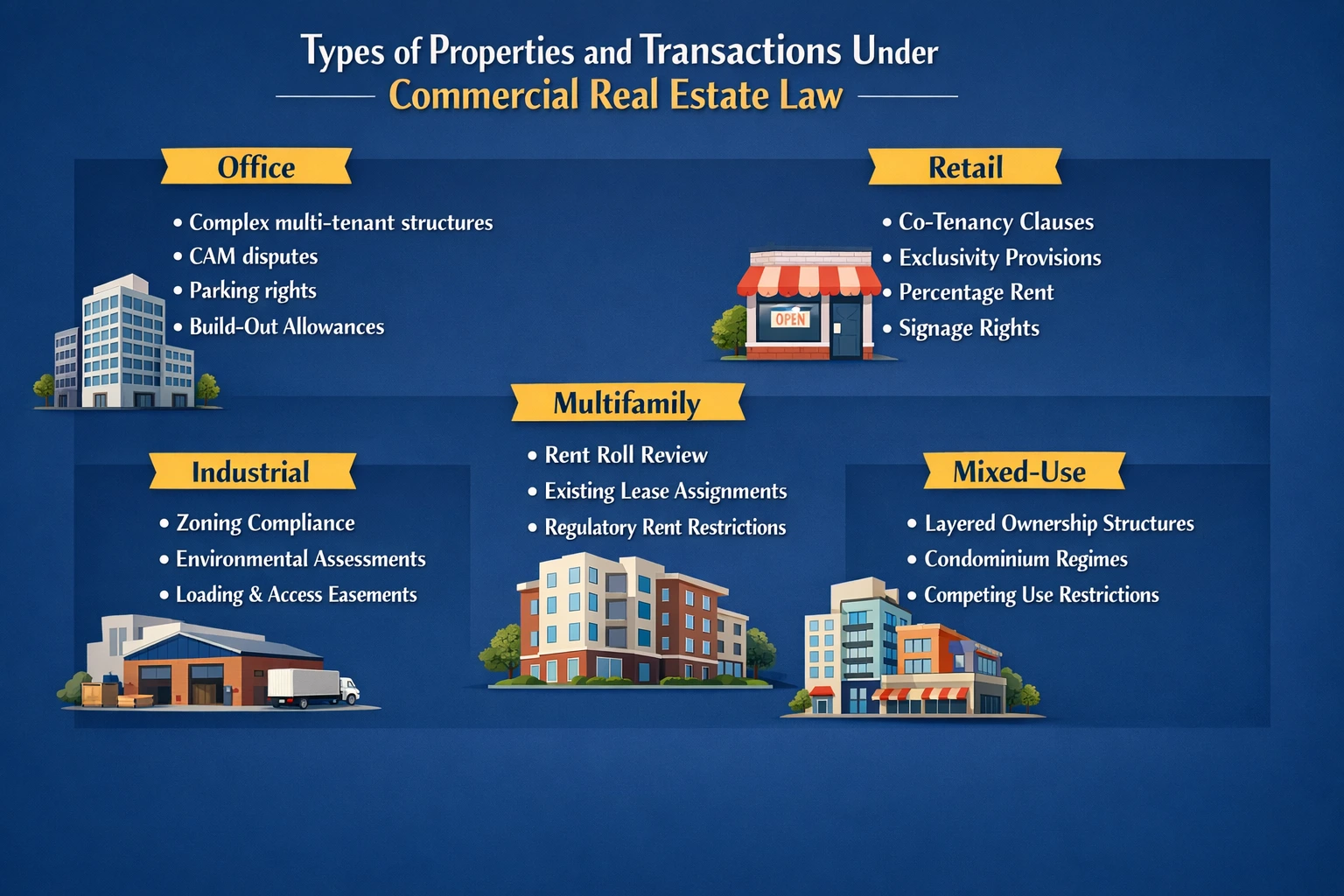
Types of Properties and Transactions Under Commercial Real Estate Law
Commercial real estate law covers a broad range of asset classes, including office buildings, retail centers, industrial warehouses, multifamily rental properties, mixed-use developments, and hotels. Each asset type carries its own regulatory context, financing structure, and lease format.
The transactions themselves span acquisition and disposition, long-term and short-term leasing, construction and development financing, sale-leasebacks, joint ventures, and portfolio transfers. Each transaction type requires a different legal review framework. What protects a client in a retail lease negotiation is not the same toolkit needed in an industrial acquisition with environmental exposure.
- Office: Complex multi-tenant structures, CAM disputes, parking rights, and build-out allowances
- Retail: Co-tenancy clauses, exclusivity provisions, percentage rent, and signage rights
- Industrial: Zoning compliance, environmental assessments, loading and access easements
- Multifamily: Rent roll review, existing lease assignments, and regulatory rent restrictions
- Mixed-use: Layered ownership structures, condominium regimes, and competing use restrictions
The Most Costly Legal Mistakes in Commercial Real Estate
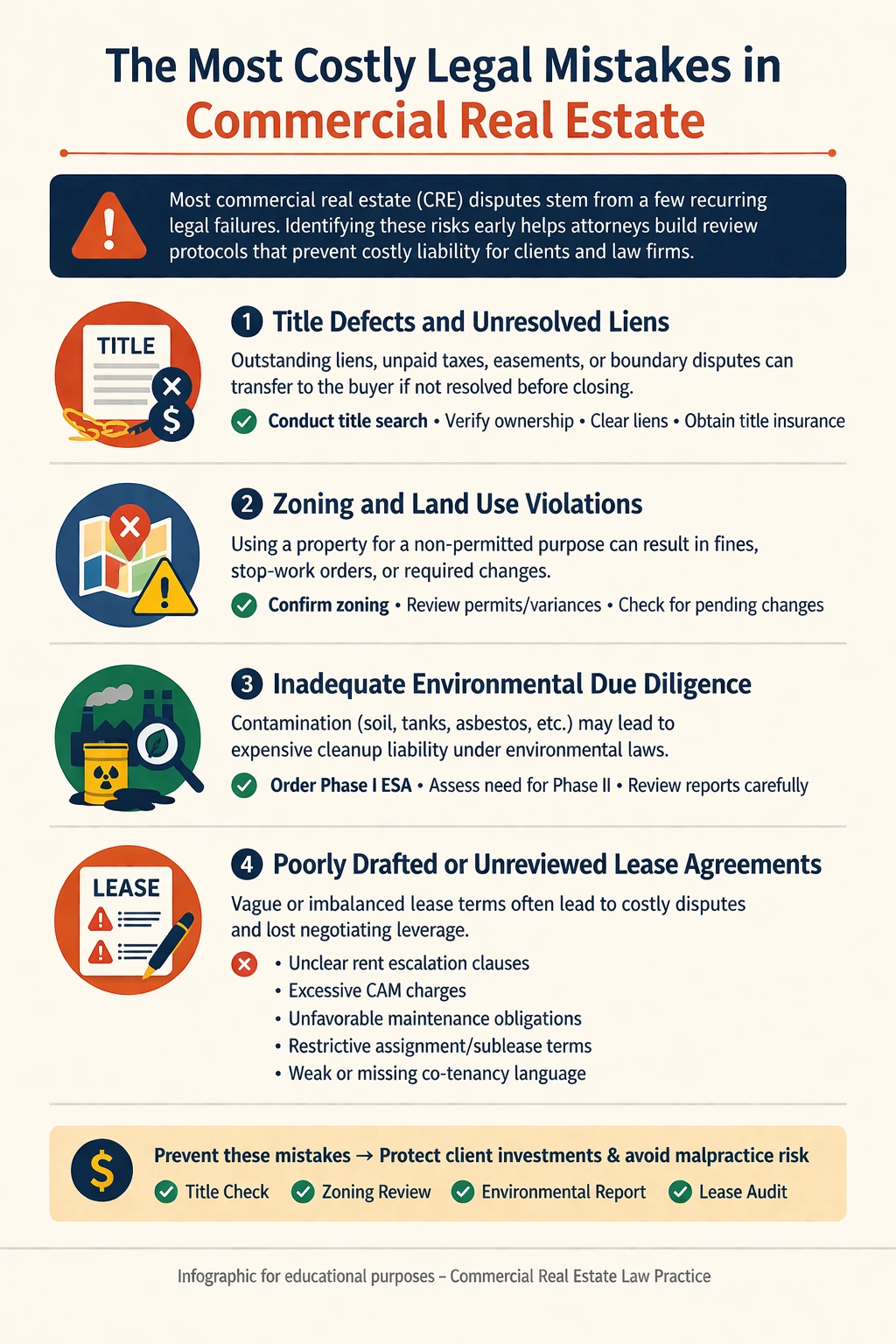
Most commercial real estate (CRE) disputes stem from a few recurring legal failures. Identifying these risks early helps attorneys build review protocols that prevent costly liability for clients and law firms.
- Title Defects and Unresolved Liens
Title defects are among the most serious risks in a commercial real estate transaction. Outstanding liens, unpaid taxes, easements, or boundary disputes can limit property use or transfer unexpected obligations to the buyer.
If these issues are missed during due diligence, the buyer inherits the liability after closing. Attorneys must conduct a thorough title search, verify ownership history, confirm liens are cleared, and secure title insurance before the transaction closes.
- Zoning and Land Use Violations
Zoning laws determine how a property can be used or developed. If a property’s intended use violates local zoning regulations, the owner may face fines, stop-work orders, or forced operational changes.
Attorneys must confirm zoning designation, verify that the intended use is permitted or legally nonconforming, review variances or conditional permits, and assess whether pending municipal zoning changes could affect the property.
- Inadequate Environmental Due Diligence
Environmental liability can significantly affect the value and usability of a commercial property. Issues such as contaminated soil, underground storage tanks, asbestos, or regulated wetlands may trigger federal or state cleanup obligations.
A Phase I environmental site assessment is the standard starting point. If potential contamination is identified, a Phase II assessment may be required. Skipping these reviews can leave buyers responsible for expensive remediation after closing.
- Poorly Drafted or Unreviewed Lease Agreements
Commercial leases are highly negotiable and largely unregulated, making careful review essential. Disputes commonly arise from rent escalation clauses, common area maintenance (CAM) charges, maintenance responsibilities, assignment restrictions, and co-tenancy provisions.
Tenant improvement allowances also require close scrutiny, as recapture provisions or hidden conditions can significantly change the economics of a lease over time.
How Due Diligence Protects Law Firms and Their Clients
Commercial real estate due diligence is the primary safeguard against hidden legal, financial, and regulatory risks. Without a structured review process, buyers can inherit liabilities that were not disclosed or discovered before closing.
Legal Due Diligence: Title, Ownership, and Compliance
Legal due diligence verifies the chain of title, recorded encumbrances, regulatory compliance, pending litigation, and contractual obligations tied to the property. The objective is to confirm the seller has the legal right to transfer ownership and that the buyer understands all obligations attached to the asset.
Attorneys must also review existing leases, confirm rent roll accuracy, verify transferable permits, and check for condemnation proceedings or use restrictions. Effective legal due diligence focuses not only on the documents provided, but also on identifying missing disclosures or unresolved risks.
Financial and Environmental Due Diligence
Financial due diligence analyzes income statements, operating expenses, rent rolls, capital expenditures, and outstanding debt obligations affecting the property.
Environmental due diligence typically requires Phase I environmental site assessments and, if needed, Phase II testing. These reviews identify contamination risks that could create significant liability after closing.
Real estate paralegals often coordinate these processes by tracking deadlines, managing documentation, and working with third-party vendors to keep due diligence on schedule.
The Role of the Commercial Real Estate Attorney in Due Diligence
In commercial real estate due diligence, the attorney is not simply reviewing documents. The attorney is making judgments about risk, materiality, and whether the identified issues require renegotiation, a price adjustment, an escrow holdback, or a decision to walk away from the deal entirely.
That judgment function cannot be delegated to a checklist. It requires an attorney with practice area experience who understands what a normal deal looks like in that asset class and can recognize when something deviates from the norm in a way that matters. Firms that try to handle high-volume CRE due diligence with under-resourced teams are the firms whose clients later have claims.
Commercial Lease Agreements: What Law Firms Must Review
A commercial lease is not a standardized document. It is a negotiated instrument that reflects the relative leverage of the parties at the time of execution. Every clause is potentially negotiable. The question is whether the attorney reviewing the lease knows which clauses to push on and what the market standard actually is.
Key Clauses That Trigger Disputes
Several commercial lease provisions frequently lead to disputes and unexpected costs if not carefully reviewed.
Rent Escalation Clauses
Rent increases tied to CPI without a cap can compound significantly over long lease terms. Attorneys should evaluate the total rent obligation over the full lease period, not just the starting base rent.
Common Area Maintenance (CAM) Charges
CAM provisions often allow landlords broad discretion to allocate expenses. Without safeguards, tenants may end up paying for management fees, capital improvements, and administrative costs.
Other High-Risk Lease Clauses
- Co-tenancy provisions that must be precisely defined to be enforceable
- Use restrictions that may limit business operations
- Personal guarantee clauses that expose owners to personal liability
- Early termination rights that include significant financial penalties
Careful lease review ensures these provisions are clearly defined and aligned with the client’s long-term financial exposure.
NNN, Gross, and Modified Gross Leases: Legal Implications
The lease structure determines the financial and legal obligations of both parties. Each structure carries its own risk profile for tenants and its own drafting requirements for counsel.
Regardless of the lease type, force majeure clauses, assignment provisions, and default cure periods require careful review in 2026. Assignments become particularly consequential in portfolio transactions where multiple leases transfer simultaneously and each must be separately analyzed for restricting language.
Financing, Closing, and Last-Mile Legal Risks
The final phase of a commercial real estate transaction is where accumulated oversights from earlier stages converge. A deal that survived a clean due diligence process can still collapse at closing if the financing documents are not aligned with the purchase agreement or if a last-minute title issue surfaces.
Lender Requirements and Loan Structuring
Commercial real estate financing requires attorneys to review lender terms as closely as the purchase agreement. Loan covenants, recourse provisions, prepayment penalties, and default triggers can vary widely between lenders.
Even favorable term sheets may include cross-default clauses, cash sweep provisions, or cash management controls that limit the borrower’s operational flexibility.
Attorneys must review the entire financing package to ensure the loan structure aligns with the ownership entity, the intended property use, and that all lender conditions can be satisfied before closing.
Common Closing Mistakes That Derail Deals
Many commercial real estate closings fail due to preventable last-minute issues, such as unresolved title exceptions, unmet lender conditions, untransferred permits, or unconfirmed wire instructions.
To avoid these problems, attorneys should verify:
- All due diligence items are complete
- Financing and lender conditions are fully satisfied
- Title insurance is issued and exceptions resolved
- Required permits and regulatory approvals are in place
- Both parties approve the final settlement statement
Tight timelines increase the risk of errors. Firms handling high CRE closing volume must maintain disciplined checklists and adequate staffing to prevent last-minute disputes
How Law Firms Build the Capacity to Handle Commercial Real Estate Work
Commercial real estate matters are document-heavy, deadline-driven, and complex. When deal volume increases, law firms that lack dedicated support staff face a higher risk of missed details, delayed reviews, and costly legal mistakes.
Hiring additional in-house staff is not always the best solution. According to Remote Attorneys’ cost analysis, full-time legal hires can cost $300–$400 per hour in loaded overhead, making them difficult to justify when CRE deal flow fluctuates.
Many firms expand capacity by working with remote attorneys and paralegals who function as trained extensions of their legal team. Remote Attorneys connects law firms with pre-screened legal professionals experienced in real estate practice, available on flexible month-to-month terms starting at $17 per hour.
More than 1,000 law firms have used this model to scale operations without increasing fixed overhead, reporting average annual savings of $55,000 and significant improvements in delegated legal workflows.
The most efficient CRE practices separate legal strategy from execution:
- Senior attorneys focus on negotiation, legal analysis, and client counseling
- Support professionals handle due diligence coordination, document review, and deadline management
The Firms That Win in Commercial Real Estate Law Are the Ones That Prepare for the Risks
Commercial real estate law rewards thoroughness. Firms that build the right systems, staffing, and review protocols consistently avoid the mistakes that derail deals and damage client relationships. The risks are well understood. The frameworks for managing them are proven. What separates firms that have problems from firms that do not is whether they have the capacity to execute those frameworks on every matter, every time.
That capacity is not a function of size. It is a function of how the firm allocates its legal talent and structures its CRE workflow. Firms that assign experienced, dedicated professionals to due diligence coordination, lease review, and closing management handle more volume with fewer errors and better client outcomes.
Frequently Asked Questions
What are the most common legal mistakes in commercial real estate transactions?
The most common mistakes include title defects, zoning violations, skipped environmental assessments, and poorly reviewed lease agreements. These issues often lead to costly disputes and liability after closing.
What is the difference between commercial and residential real estate law?
Commercial transactions offer no consumer protection safety net. The parties are presumed to be sophisticated, so responsibility for identifying risks falls largely on the buyer, tenant, and their legal counsel.
When should a law firm hire specialized commercial real estate legal support?
Firms should consider additional support when CRE deal volume increases, review timelines become compressed, or senior attorneys spend too much time on execution instead of strategic work.
Does “as is” mean a buyer has no legal recourse in a commercial real estate deal?
No. While an “as is” clause limits seller disclosure obligations, buyers may still pursue claims for fraud, intentional concealment, or contract misrepresentation after closing.
How much does it cost to have a commercial real estate attorney review a deal?
Traditional CRE attorney rates typically range from $150 to $500 per hour. Remote Attorneys offers experienced real estate legal professionals starting at $20 per hour for comparable support.