
Most law firm owners adopted generative AI expecting a productivity revolution. What they got was a faster drafting assistant that still required constant supervision, still waiting on prompts, still demanding attention at every step.
Agentic AI is a fundamentally different category. It doesn't wait to be asked. It receives a goal, plans the steps to achieve it, and executes across your firm's systems, autonomously, with a documented audit trail at every stage.
In 2026, the firms that understand this distinction are operating at a scale their competitors cannot match without dramatically increasing headcount. This post breaks down what agentic AI is, what it does inside a law firm, and why the firms seeing the strongest results pair it with trained, full-time legal staff, not run it unsupervised.
Key Takeaways
- Agentic AI executes multi-step legal workflows autonomously, unlike generative AI, which only responds to prompts.
- Law firms report up to 10x productivity gains on document review and a 40% reduction in contract cycle times.
- Running agentic AI without attorney supervision creates professional responsibility exposure under ABA Model Rules 5.3 and 1.1.
- The highest-output model pairs agentic AI with full-time, dedicated legal staff who direct and review AI outputs under attorney supervision.
What Is Agentic AI and How Is It Different From Generative AI?
The two terms are used interchangeably in vendor marketing. They are not the same thing. Understanding the difference is the first step toward making a sound technology decision for your firm.
Generative AI: Responds to Prompts
Generative AI tools like ChatGPT, Claude, or Microsoft CoPilot operates in a single input-output loop. You write a prompt. The AI produces output. You review it, refine it, and prompt again. Every forward step requires a human.
For law firms, this means significant manual coordination. Generative AI handles individual tasks well drafting, summarizing, brainstorming but it cannot carry a workflow forward without constant human direction.
Agentic AI: Executes Goals Across Systems
Agentic AI receives an objective, not just a prompt. According to the North Carolina Bar Association, agentic AI "not only interprets instructions but can also execute them across various tools and platforms autonomously" a fundamental departure from the prompt-response model.
In practice, a single agentic system can receive a case objective, pull relevant documents and statutes, draft a research memo, cross-check every citation, flag discrepancies, and route the output to the right team member, all without a human prompting each step. Every action is logged with a timestamped audit trail.
Agentic AI Updates: What Has Changed for Law Firms in 2026?
This is not a future trend. Agentic AI is already in production at law firms of every size and adoption is accelerating faster than most managing partners realize.
Major Legal Platforms Now Run Multi-Agent Workflows
LexisNexis Protégé now orchestrates four specialized agents a research agent, web search agent, document agent, and orchestrator that collaborate on a single complex matter. According to LexisNexis at Legalweek 2026, the goal is finished, citable legal work product not just AI-assisted writing.
Thomson Reuters CoCounsel launched agentic workflows in early 2026, enabling autonomous multi-step legal research and document review. These are not pilot programs they are enterprise production deployments.
Small Firms Are Outpacing BigLaw on Adoption
The counterintuitive reality of 2026: smaller firms are moving faster than large ones. Without legacy infrastructure or committee-driven procurement, solo practitioners and boutique firms can deploy agentic tools that make them competitive with operations ten times their size.
The National Law Review's 85 legal AI predictions for 2026 flagged this as the year's biggest surprise — small firms leapfrogging BigLaw by mid-2026 on agentic AI adoption.
The Gartner Signal and the Gartner Warning
Gartner named agentic AI the #1 technology trend for 2025 and predicts 33% of enterprise software applications will integrate it by 2028, up from less than 1% in 2024.
The caution: Gartner also predicts over 40% of agentic AI projects will be canceled by 2027 due to unclear business value and inadequate risk controls. The technology works. Poor implementation does not.
What Agentic AI Actually Does Inside a Law Firm
Agentic AI is not a single tool it is a category of systems deployable across multiple workflows simultaneously. Here are the four areas where law firms are reporting the highest, most measurable impact.
1. Client Intake Fully Handled Before the Attorney Arrives
When a prospective client emails your firm, an agentic intake agent can extract contact details, create a CRM lead, schedule a consultation, send a branded welcome email with intake forms, and route the matter to the right practice area attorney before anyone on your team opens their inbox.
The critical piece: this output still needs a trained human to review exceptions, follow up on incomplete responses, and flag anything requiring attorney judgment. That human review layer is what prevents agentic AI from becoming a liability at the intake stage.
2. Legal Research With Built-In Citation Validation
Agentic research agents don't just run a keyword search. They plan the research strategy, query authoritative legal databases, cross-check citations, and return a structured memo with verified source links. According to Thomson Reuters / Artificial Lawyer, work that once consumed a team for days now completes in minutes with full audit trails.
The hallucination problem that plagued earlier AI tools is dramatically reduced when agents are grounded in verified legal databases rather than general-purpose language models.
3. Contract Review and Parallel Compliance Checking
A single agentic contract workflow can simultaneously flag risk clauses, suggest redlines aligned to your firm's playbook, check for jurisdiction-specific compliance, and generate a summary memo for attorney review. McKinsey data shows AI integration in contract lifecycle management has already reduced contract cycle times by up to 40%.
4. Real-Time Billing Capture
Agentic billing tools generate audit-ready time entries as work occurs not reconstructed at end of day. This addresses one of the most consistent profit leaks in legal practice: billable hours that go unrecorded simply because the attorney didn't log them in the moment.
Why Agentic AI Requires Human Supervision Not Just Automation
This is the section most vendors skip. Agentic AI without oversight is not just an operational risk it is a professional responsibility problem that sits squarely within current bar rules.
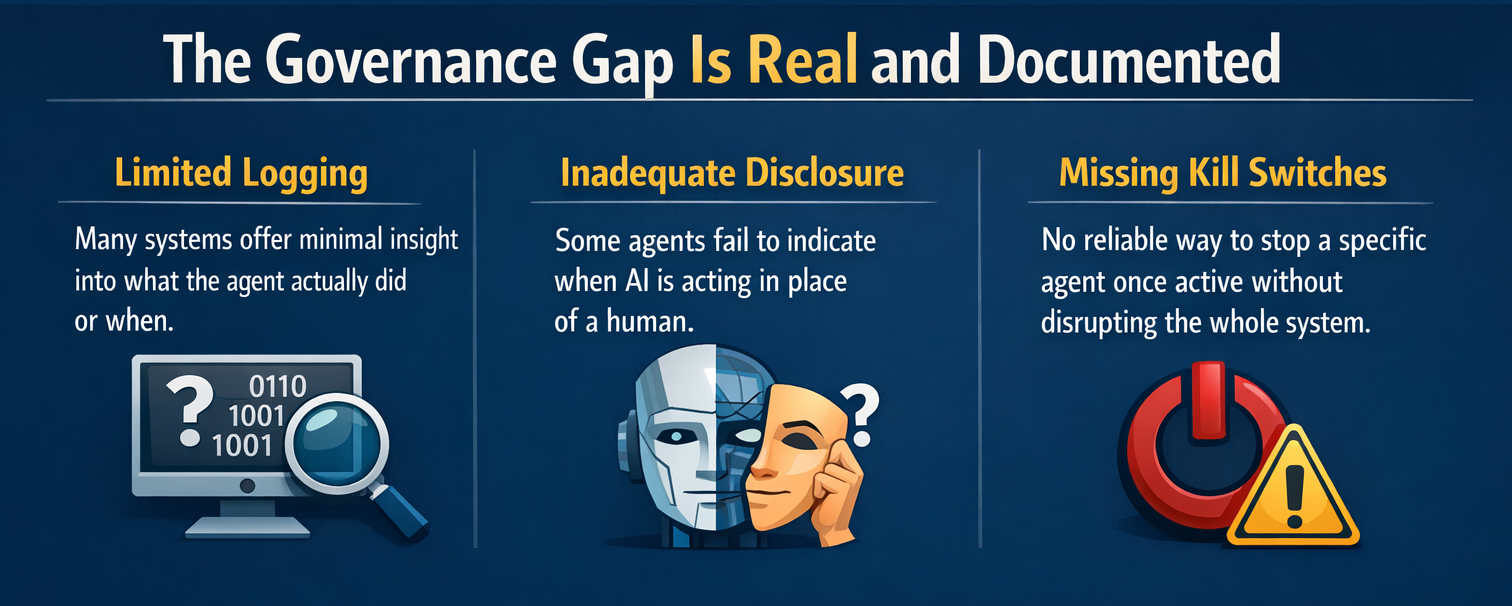
The Governance Gap Is Real and Documented
A March 2026 analysis in Above the Law, citing MIT research, found that many agentic AI systems lack basic monitoring, meaningful transparency, and reliable stop controls. The researchers identified three specific vulnerabilities:
- Limited logging — many systems offer minimal insight into what the agent actually did or when
- Inadequate disclosure — some agents fail to indicate when AI is acting in place of a human
- Missing kill switches — no reliable way to stop a specific agent once active without disrupting the whole system
In a law firm, each of these vulnerabilities carries direct exposure: untracked client communications, privilege contamination, and billing errors with no audit trail.
ABA Model Rules Apply Right Now
ABA Model Rule 5.3 requires attorneys to supervise non-lawyer work to ensure it conforms to professional obligations. That duty explicitly extends to AI-generated outputs. Rule 1.1 requires competence a standard the ABA has extended to include technological competence.
This is not an emerging regulatory issue awaiting future guidance. It is current law. Deploying agentic tools without a structured human review layer is a disciplinary exposure, not a compliance gray area.
The Oversight Model That Actually Works
The highest-performing firms in 2026 pair agentic AI with trained, full-time legal staff who direct agent workflows, review outputs before anything reaches the attorney, escalate judgment calls, and maintain the audit trail with daily logs, time tracking, and performance oversight at every stage.
How High-Output Law Firms Structure Agentic AI and Legal Staff
The force-multiplier model producing measurable ROI in 2026 operates across three distinct layers. Each layer has a clearly defined role and the strength of the model comes from how cleanly those roles are separated.
One attorney operating within this structure achieves the output of a team twice its size without proportional overhead. That is what a 40% increase in profitability looks like operationally.
For more on how practices are building this model, see how firms are approaching virtual legal workflows in 2026 and what remote legal work means for a modern practice.
What to Evaluate Before Adopting Agentic AI at Your Firm
Not every tool marketed as "agentic" actually is. And not every firm that deploys agentic AI will see positive ROI. Before committing budget, every managing partner should run through these five questions.
- Does it integrate with your existing case management system or does it create a new data silo?
- Does it provide documented audit trails for every action? If you cannot reconstruct what the agent did, you cannot defend it.
- Does it meet attorney-client privilege standards in your jurisdiction? Ask for specifics not just a SOC 2 badge.
- Is there a defined human checkpoint before outputs reach clients or courts? Full autonomy is rarely appropriate in legal workflows.
- Can you shut down a specific agent without disrupting your entire system? A missing kill switch is a red flag (MIT research, cited in Above the Law, March 2026).
Is Your Firm Ready to Build the Agentic AI Stack?
Agentic AI delivers its highest value when it is directed and reviewed by trained legal professionals not run as a standalone system. The technology is ready. The question is whether your firm has the right human layer to operate it effectively.
Remote Attorneys places full-time, dedicated virtual legal staff pre-vetted, experienced, trained by U.S.-based attorneys who join your firm as direct team members and operate under your supervision. They don't just use AI tools. They direct and review them.
1,000+ law firms served. 2,500+ virtual legal staff placed. 7 global offices. Every staff member is full-time (40 hours per week), billed monthly on a month-to-month basis no lock-in.
Learn more: what a virtual legal assistant can do for your firm and 8 ways remote attorneys improve law firm productivity.
Frequently Asked Questions
What is the difference between agentic AI and generative AI in legal practice?
Generative AI responds to individual prompts one input, one output. Agentic AI receives a goal and executes the full workflow autonomously, acting across tools without a human prompting every step.
Can small law firms and solo practitioners use agentic AI?
Yes. In 2026, small firms and solo practitioners are adopting agentic AI faster than BigLaw no legacy systems or committees slowing deployment. Cloud-based tools make competitive parity achievable.
Does agentic AI replace paralegals or legal assistants?
No. Agentic AI handles procedural tasks, but trained legal staff must still direct agents, review outputs, and ensure professional responsibility compliance. The strongest model combines both layers.
What are the professional responsibility risks of agentic AI without oversight?
ABA Rules 5.3 and 1.1 require attorneys to supervise AI outputs and maintain tech competence. Deploying agentic tools without a human review layer creates disciplinary exposure and malpractice risk.
How do law firms measure ROI from agentic AI?
Track hours saved per employee weekly, case turnaround time, billable capture rate, and contract cycle time. Firms pairing agentic AI with trained staff report up to 10x gains on document review.
Agentic AI Is Already Reshaping Legal Practice
The Question Is Whether Your Firm Is Positioned for It
The firms still waiting for agentic AI to "mature" are already behind. The technology is in production. The results are measurable. And the competitive gap between firms that have built the right human-AI structure and those still running on prompt-by-prompt generative tools is widening every quarter.
Three things differentiate the firms winning with agentic AI right now:
- They treat it as infrastructure, not experimentation deploying it across intake, research, contracts, and billing
- They maintain attorney supervision at every critical output point, meeting their Rule 5.3 obligations
- They staff the oversight layer with trained, full-time legal professionals who direct agents, catch exceptions, and escalate when judgment is required
That is the model. It is not theoretical. The firms achieving a 25% faster case turnaround, 40% higher profitability, and 10x productivity on their most time-intensive workflows are the ones that got the human layer right first.