
.webp)
The legal industry, long defined by in-person practice and brick-and-mortar offices, has undergone a structural transformation. Remote legal services, once viewed as a contingency solution during the pandemic, have now become a permanent and increasingly strategic component of the U.S. legal market.
Today, licensed attorneys routinely deliver legal services virtually, supported by secure technology, evolving regulatory guidance, and shifting client expectations. What began as an operational necessity has matured into a competitive advantage for firms seeking efficiency, flexibility, and broader access to legal talent.
This report synthesizes regulatory authority, workforce data, client-behavior trends, and operational metrics to provide a comprehensive, evidence-based overview of remote legal services in the United States as we move through 2026.
Key Takeaways
- A majority of legal professionals report remote or hybrid work options and see measurable productivity benefits from flexible arrangements.
- Over half of law firms plan to maintain or expand remote work policies, signaling structural and lasting adoption.
- Remote consultations now account for a significant portion of legal services delivered, with a notable rise compared to pre-2020 levels.
- Clients increasingly prefer hybrid or remote legal interactions over in-person-only service models.
- AI tools and virtual proceedings are reshaping how remote legal work is performed and delivered at every level of the profession.
1. What Are Remote Legal Services?
Remote legal services consist of legal and law-related work performed by an attorney outside the traditional office using digital tools such as secure video conferencing, encrypted document platforms, cloud-based case management, and remote communication systems.
Remote delivery changes the method of work, not the legal or ethical standards. Work remains subject to the same professional rules governing confidentiality, competence, and client communication, regardless of where the attorney is physically located.
Core Characteristics
Understanding what qualifies as remote legal service delivery is the foundation for building a compliant and effective virtual practice.
- Work delivered digitally from a location outside the traditional office
- Client interactions conducted via secure, platform-based remote communication tools
- All work fully compliant with applicable jurisdictional licensing and ethical obligations
By focusing on delivery mechanisms rather than physical location, remote legal services can encompass everything from legal research and document drafting to client consultations and full litigation support, provided that ethical and licensing standards are maintained throughout.
2. The Market Shift Toward Remote Practice
Remote legal services have crossed the threshold from pandemic workaround to standard operating model. Understanding where the market stands today is essential for any firm planning its next phase of growth.
Remote Work Prevalence in Legal Services
The numbers confirm what practitioners are already experiencing on the ground: remote and hybrid work is no longer the exception. It is the new operational standard for U.S. law firms.
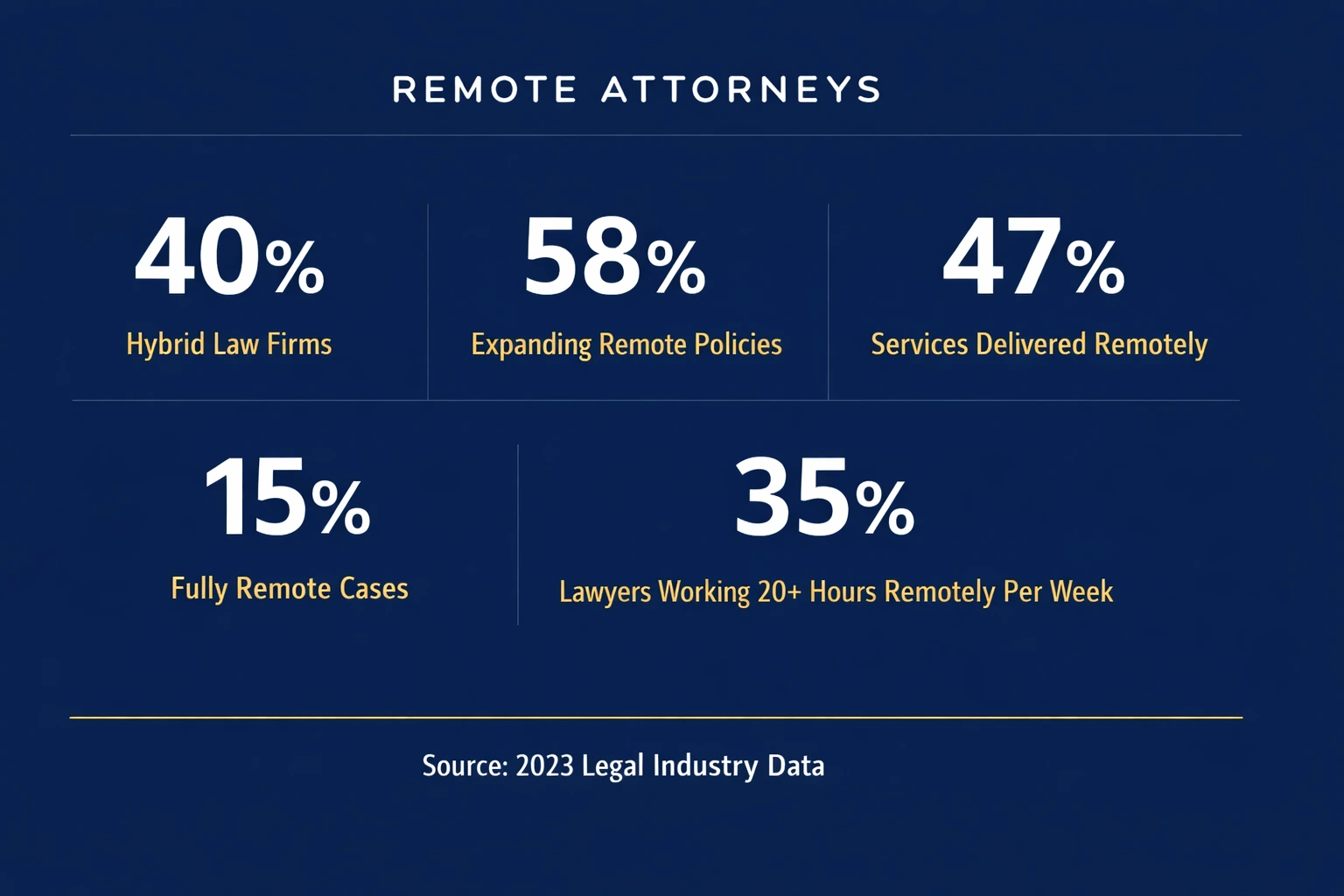
Data shows remote and hybrid arrangements are now firmly embedded in the legal profession, not a temporary outlier:
- 40% of law firms adopted hybrid work models as of 2023.
- 58% of legal firms plan to maintain or expand remote work policies going forward.
- 35% of lawyers report spending over 20 hours per week working remotely.
- 47% of legal services were delivered remotely in 2023, a notable increase over prior years.
- 15% of legal cases were managed fully remotely in 2023, up from just 5% in 2020.
These numbers confirm that remote work is more than a temporary adaptation. It represents a structural market shift embraced by both clients and practitioners alike.
3. Why Legal Professionals Embrace Remote Work
The shift to remote work was not forced on attorneys and then reluctantly accepted. For many legal professionals, remote legal work has become a preferred way of working, with real and documented benefits across productivity, satisfaction, and client service.
Productivity and Satisfaction
Beyond convenience, remote work is delivering measurable professional benefits, from higher output to stronger client relationships and improved attorney wellbeing.
Remote and hybrid work models carry notable perceived benefits across the legal workforce:
- 65% of legal professionals say remote work has increased their productivity.
- 70% believe remote work improves work-life balance.
- 52% report improved overall job satisfaction due to flexible arrangements.
- 62% believe remote work improves client communication.
These sentiments show that remote legal work is not merely tolerated. It is genuinely valued for both its personal and professional advantages.
Talent Attraction and Retention
In a competitive hiring market, remote and hybrid flexibility has become one of the most powerful recruiting tools available to law firms of all sizes.
- 60% of legal professionals cite remote work as a key factor in attracting new talent.
- 78% of legal practices favor a hybrid model as a tool for improving employee satisfaction.
Remote and hybrid options have become a meaningful competitive differentiator in recruiting and retaining attorneys, reflecting broader workforce expectations that have permanently shifted across industries since 2020.

4. Client Demand and Preferences
The conversation about remote legal services is not only happening inside law firms. Clients are driving it too, and their preferences are reshaping how and where legal work gets done.
Remote interactions are now a clear priority not only for attorneys but for legal consumers themselves:
- 55% of legal clients prefer hybrid or remote consultations over in-person-only arrangements.
- 41% of law firms report increased client engagement as a direct result of remote service offerings.
- 50% of legal professionals believe remote work increases accessibility for clients with mobility limitations.
These shifts in client expectations suggest remote legal services are not merely a convenience. They are fundamentally reshaping how legal services are delivered and perceived across the market.
Historical context matters here as well. Consumer surveys once showed only 23% of clients open to remote legal interactions before the pandemic. That figure climbed sharply within just a few years, reflecting a permanent realignment in expectations rather than a temporary accommodation.
5. Remote Work and Professional Rules
Remote legal practice does not exist outside the rules of professional conduct. Knowing where the ethical boundaries sit is a non-negotiable part of any sustainable remote practice.
Licensing and Unauthorized Practice of Law (UPL) Attorneys practicing remotely across state lines must understand two key federal guideposts and how their own state applies them.
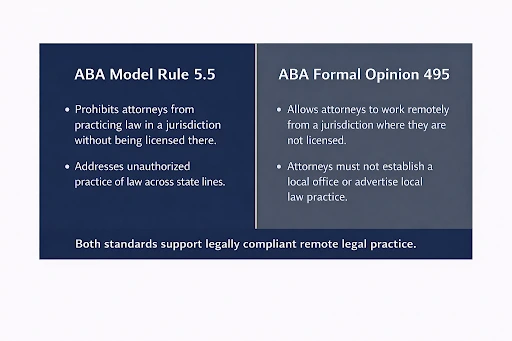
Two key guideposts govern remote practice at the federal level:
ABA Model Rule 5.5 prohibits practice in unlicensed states but does not ban remote work, provided the attorney does not imply local licensure.
ABA Formal Opinion 495 confirms that remote work does not inherently constitute unauthorized practice, so long as jurisdictional boundaries are respected.
6. Economics and Operational Impacts
Remote practice is not just a workforce preference. It is delivering real financial and operational value to firms willing to invest in the right infrastructure and management practices.
Remote legal services change how firms think about workflow, cost, and value delivery.
Cost Savings and Efficiency
Reduced overhead and smarter staffing models are allowing firms to redirect budget toward technology, talent, and higher-value client service rather than real estate and fixed operating costs.
- 80% of law firms reported cost savings as a direct result of remote work policies.
- 43% of law firms now provide remote work stipends or home office reimbursements for their attorneys.
Reduced office footprint and flexible staffing allow firms to reallocate budget toward technology investment, talent acquisition, and enhanced client service delivery, all areas with a far stronger return than fixed real estate overhead.
Work Patterns
The data shows attorneys are not simply working from home occasionally. Remote work has become a core, recurring element of the weekly workflow for a large portion of the profession.
- 37% of legal professionals work remotely at least three days per week.
Extended remote availability helps firms scale workloads without proportional increases in office space or on-site support infrastructure, creating a more agile and cost-efficient operational model.
7. Cybersecurity in Remote Legal Environments
Cybersecurity is no longer just an IT issue for law firms. It is an ethical obligation, a client expectation, and increasingly a precondition for doing business in a remote-capable practice.
Remote legal work depends entirely on secure access to digital systems. Core obligations include client confidentiality protections under ABA Model Rule 1.6, encrypted communication channels, cloud document management, and multi-factor authentication across all access points.
The exposure is real and growing. According to the ABA's 2023 Legal Technology Survey, nearly 30% of law firms reported experiencing a security breach. For professional services firms, the average cost of a data breach now stands at $5.08 million, a figure that has risen more than 10% year over year.
Approximately 24% of law firms have also reported data privacy issues specifically linked to remote work environments, underscoring that distributed work and cybersecurity risk are directly connected, not separate concerns.
Key Threats Facing Remote Legal Teams
Understanding the most common attack vectors is the first step toward building effective defenses for a distributed legal workforce.
- Phishing and business email compromise targeting attorneys and support staff
- Ransomware locking access to client case files and billing systems
- Unsecured home networks and personal devices used for client-sensitive work
- Insider threats from former employees who retain system access after departure
Cybersecurity Best Practices for Remote Law Firms
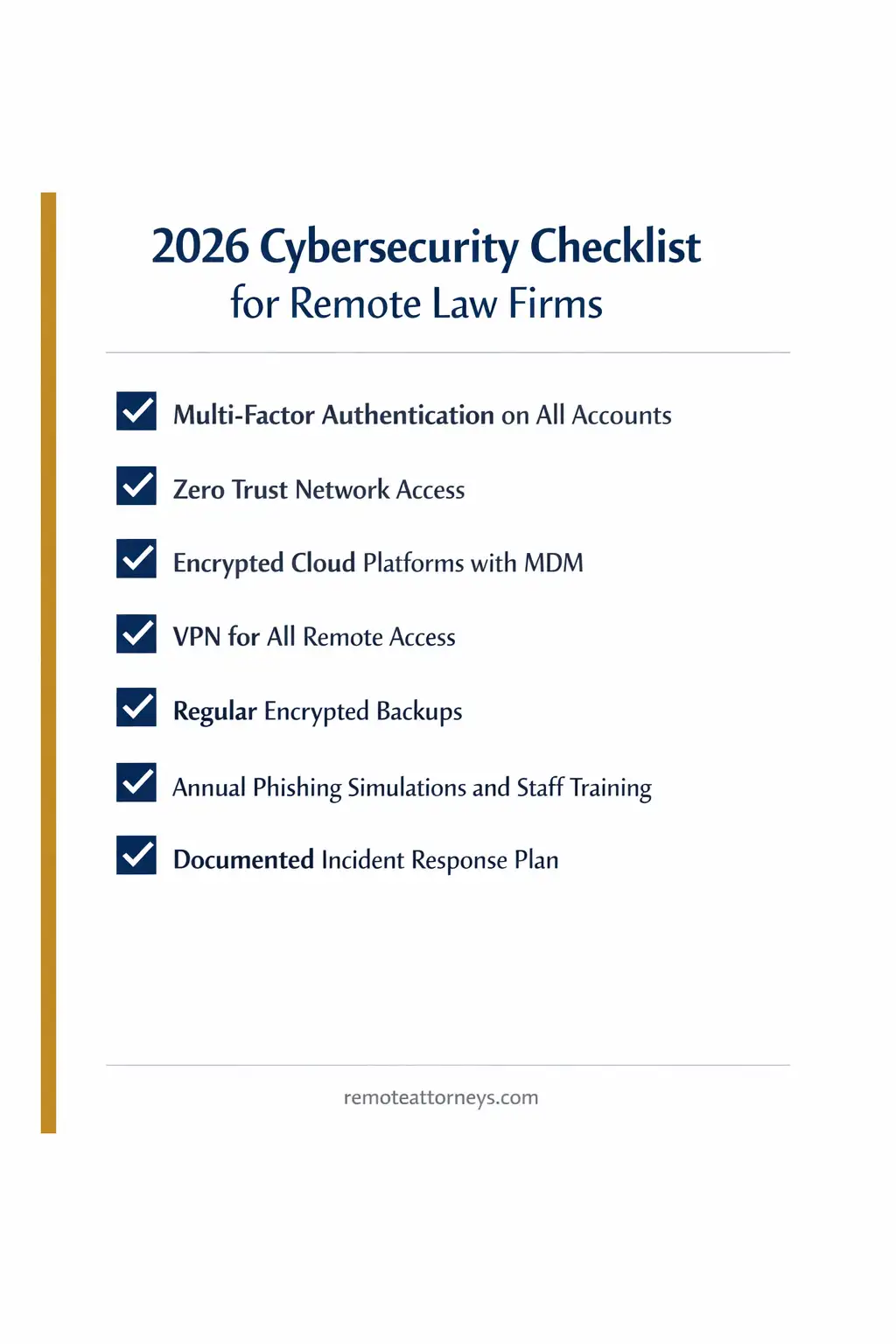
Leading firms are moving beyond basic compliance to build layered, proactive security frameworks that are documented, regularly tested, and enforced across the full firm, including remote staff.
- Multi-factor authentication on all email, VPN, and admin accounts without exception
- Zero Trust Network Access: verify every user and device before granting system access
- Encrypted cloud platforms with mobile device management for all remote work
- VPN required for all remote access to firm systems and client data
- Regular encrypted backups tested for restorability on a defined schedule
- Annual phishing simulations and cyber hygiene training for all attorneys and staff
- A documented incident response plan covering detection, containment, notification, and recovery
Beyond technical controls, 37% of legal clients in 2025 expressed willingness to pay a premium for law firms with demonstrably strong cybersecurity practices, according to the Integris 2025 Law Firm Cybersecurity Report.
For remote-capable law firms, cybersecurity is no longer only a risk management function. It is a visible competitive differentiator.
8. AI and Legal Technology Powering Remote Practice
Artificial intelligence has moved from novelty to necessity in the remote legal services landscape. In 2026, AI is not replacing attorneys. It is making them faster, sharper, and better equipped to serve clients from any location.
The integration of AI into remote legal workflows represents the most significant productivity shift the profession has seen in a generation. Tasks that once required hours of manual effort, including document review, legal research, contract analysis, and client intake, can now be completed in a fraction of the time using purpose-built legal AI platforms.
According to Thomson Reuters’ 2025 Generative AI in Professional Services Report, the share of organizations actively using generative AI nearly doubled in a single year. And 95% of legal professionals believe AI will become central to their workflows within five years.
Real-World Adoption at Scale
Major firms are not just piloting AI. They are operationalizing it at scale, with measurable and documented results for remote and hybrid teams across practice areas.
The adoption curve is steep and accelerating. Macfarlanes launched an AI pilot with Harvey for 70 attorneys in 2023. By 2025, 80% of the firm used it daily. Orrick, Herrington and Sutcliffe deploys CoCounsel for first-pass research and contract review, freeing attorneys for higher-value strategic work.
For remote teams specifically, AI eliminates the collaboration bottlenecks that once required physical proximity. A junior associate no longer needs to sit beside a senior partner to receive structured feedback on a first draft.
When evaluating legal AI tools, firms should prioritize vendors with explicit data non-retention policies, matter-specific isolation, and legal-specific model training, rather than general-purpose consumer AI tools repurposed for legal workflows.
9. Remote Court Proceedings and Litigation Support
Remote legal services now extend well beyond consultations and back-office work. Virtual depositions, remote mediations, and e-filing have become standard litigation tools, and their use is projected to grow further through 2026.
One of the most significant but underreported dimensions of remote legal services is the expansion of virtual proceedings. Remote practice is no longer confined to attorneys working from a home office. It now encompasses core litigation support activities that once required full physical presence from all parties.
According to the 2026 U.S. Legal Support Litigation Trends Survey, 37% of legal professionals expect the use of remote court reporting and depositions to increase in 2026, and 36% anticipate growth in virtual mediations, arbitrations, and trials. This signals that the litigation support sector is firmly committed to virtual-first infrastructure.
Virtual Depositions and Remote Court Reporting
Remote depositions have moved from emergency accommodation to standard litigation practice, offering cost savings, scheduling flexibility, and wider geographic access to witnesses across time zones.
Virtual depositions have become a standard tool for litigation teams, offering flexibility in scheduling witnesses across time zones and eliminating significant travel costs. Remote court reporting platforms now deliver real-time transcription, secure exhibit sharing, and synchronized video, all accessible from any location without sacrificing the accuracy or evidentiary integrity of in-person proceedings.
Virtual Mediations and Arbitrations
ADR providers have made virtual proceedings a core service offering, supported by technology platforms that match or exceed the functional experience of traditional in-person dispute resolution.
Major ADR providers including JAMS and the American Arbitration Association now offer fully virtual and hybrid mediation and arbitration services as standard offerings, not supplemental ones. A 2026 ADR Industry Survey found that nearly half of legal professionals use ADR services at least once per month, with virtually all respondents expecting their usage to remain constant or increase.
For firms delivering remote legal services, integrating virtual ADR capabilities into their practice is no longer optional. Clients increasingly expect seamless dispute resolution that does not require travel or extended scheduling delays.
E-Filing and Digital Court Access
The shift to electronic filing has accelerated court access and reduced administrative burden for remote legal teams, though it requires attorneys to stay current on jurisdiction-specific requirements and platform updates.
According to the LawPay 2025 Legal Industry Report, 76% of legal organizations have adopted cloud-based remote working technologies, with e-filing among the most universally implemented digital tools in the profession. Remote litigation teams should ensure their practice management platforms integrate directly with court e-filing systems to eliminate manual re-entry of case data and reduce the risk of costly filing errors.
10. Remote Legal Professionals Beyond Attorneys
The remote legal workforce extends well beyond partners and associates. Paralegals, legal assistants, and support staff now operate in distributed environments that require their own technology standards, access controls, and supervision protocols.
Remote work is far from an attorney-only phenomenon within the legal profession:
- 82% of paralegals and legal assistants work remotely in some capacity.
- 32% are fully remote, while 28.5% work remotely one to two days per week.
Remote paralegal and legal assistant roles significantly augment firm capacity, particularly for research, document drafting, and administrative support. These professionals also represent a key consideration in firm cybersecurity policy.
Non-attorney staff frequently handle sensitive client data, and role-based permissions, secure portal access, and encrypted communication tools must be built into the remote work infrastructure for support staff just as they are for licensed attorneys.
11. Challenges and Limitations
Remote legal services offer significant advantages, but they also surface real operational and human challenges that firm leaders must address proactively, before those challenges become performance or compliance issues.
Communication and Collaboration
Distributed teams require intentional communication infrastructure. The informal hallway conversations and spontaneous mentoring of traditional office culture do not translate to remote environments without deliberate design and consistent management effort.
About 45% of legal teams report communication and collaboration challenges as a direct result of remote work arrangements. Firms addressing this effectively are implementing structured check-ins, asynchronous documentation standards, and clear protocols for client-related communications across all digital platforms.
Mentorship and Junior Attorney Development
One of the most actively debated challenges in remote legal practice is how to replicate the experiential learning that has traditionally occurred through physical proximity to senior attorneys and real-time case observation.
AI tools are beginning to fill part of this gap, offering junior attorneys structured feedback on draft documents, simulated research exercises, and real-time guidance. However, technology is a supplement, not a substitute, for deliberate mentorship programs. Forward-thinking firms are implementing cohort-based virtual training, structured video-based shadowing, and documented competency frameworks that make professional development measurable regardless of physical location.
Workload and Isolation
The blurring of home and work boundaries creates real wellbeing risks, particularly for attorneys already navigating the high-pressure demands of client-facing legal work and billable hour targets.
Roughly 30% of remote legal staff report increased anxiety or feelings of isolation as a result of working remotely. Proactive firms are addressing this through structured social touchpoints, mental health support resources, and intentional culture-building that does not rely solely on in-office proximity to maintain team cohesion and professional identity.
Security Across Distributed Environments
Every remote connection is a potential entry point into firm systems. Firms that treat cybersecurity as a compliance checkbox rather than an ongoing operational discipline leave client data and professional reputation at significant risk.
Security remains a documented concern for 23% of legal firms operating in remote environments. Balancing technical protection with the flexibility remote work requires is an ongoing management discipline, not a one-time configuration exercise. Firms that invest consistently in security infrastructure will be better positioned both operationally and reputationally as client scrutiny of data practices continues to intensify.
12. Future Outlook
Remote legal services are not a passing trend. They are a permanent structural feature of the U.S. legal market, and the firms that thrive will be those that treat remote practice as a strategic capability rather than a logistical accommodation.
Remote legal services are not a fad. They are a strategic reality that will only deepen in sophistication and scope through the remainder of this decade.
Trends to Watch in 2026 and Beyond
The next phase of remote legal practice will be defined by deeper AI integration, clearer regulatory frameworks, and a profession that has learned to build strong firm cultures without requiring everyone to be in the same building.
- AI and automation will deepen, not just augment, remote legal workflows. Legal operations leaders in 2026 are shifting from AI experimentation to long-term optimization, moving routine tasks to machines so attorneys can focus on strategy, client relationships, and complex problem-solving.
- Hybrid models will remain dominant, but the definition of office will continue to evolve. Mobile-first legal tools are emerging that give attorneys full functionality in courtrooms, at depositions, and while traveling, not just at a desk.
- Regulatory reform around multi-jurisdictional practice is accelerating. States including Utah and Arizona are leading with skills-based bar admission pathways and alternative business structure licensing, and other states are expected to follow.
- Client expectations around accessibility, transparency, and digital-first service will continue to rise, placing pressure on firms to deliver seamless virtual experiences as a baseline standard, not a premium offering.
- Cybersecurity will become a visible client-facing differentiator. Firms that can credibly demonstrate enterprise-grade data protection will command greater client trust and, increasingly, premium billing rates from sophisticated clients who closely evaluate data practices before engagement.
The legal profession is rebalancing thoughtfully. Many firms are re-emphasizing office presence for culture-building and mentorship, while simultaneously maintaining flexible remote norms to retain and attract top talent.
The firms best positioned for 2026 and beyond are those that have stopped treating remote work as a policy question and started treating it as a core practice management discipline, one that requires the right infrastructure, clear protocols, and sustained leadership investment to execute well.
Firms scaling toward that model are increasingly turning to contract attorney support to manage workload spikes without committing to full-time hires
This article is intended for informational purposes only and does not constitute legal advice. Attorneys should consult the applicable rules of professional conduct in their jurisdiction before making any changes to their practice structure or remote work arrangements.



.webp)