

Most attorneys spend less than three hours a day on billable work. The rest goes to scheduling, emails, intake calls, and document tasks that keep the firm running but never show up on an invoice.
A virtual law assistant changes that math. By handling the administrative and research work remotely, they give attorneys back the hours that directly translate to revenue. This guide covers what a virtual law assistant does, which tasks to delegate first, and what to look for when you hire.
Key Takeaways
- Virtual law assistants are full-time remote professionals handling admin, intake, scheduling, and legal research
- Lawyers average only 2.9 billable hours daily; delegating routine tasks helps recover valuable time
- Remote staffing platforms provide pre-vetted candidates faster than traditional hiring methods
What Is a Virtual Law Assistant?
A virtual law assistant is a remote professional who handles administrative, legal support, and client communication tasks for a law firm under attorney supervision.
Unlike an in-house hire, a virtual law assistant works off-site. The firm pays no office rent, no equipment costs, and no benefits. The assistant integrates into existing workflows using the software and communication tools the firm already uses.
This is different from a general virtual assistant. A virtual law assistant has experience in legal workflows, understands legal terminology, and can work directly with case management platforms like Clio, MyCase, and PracticePanther without a long learning curve.
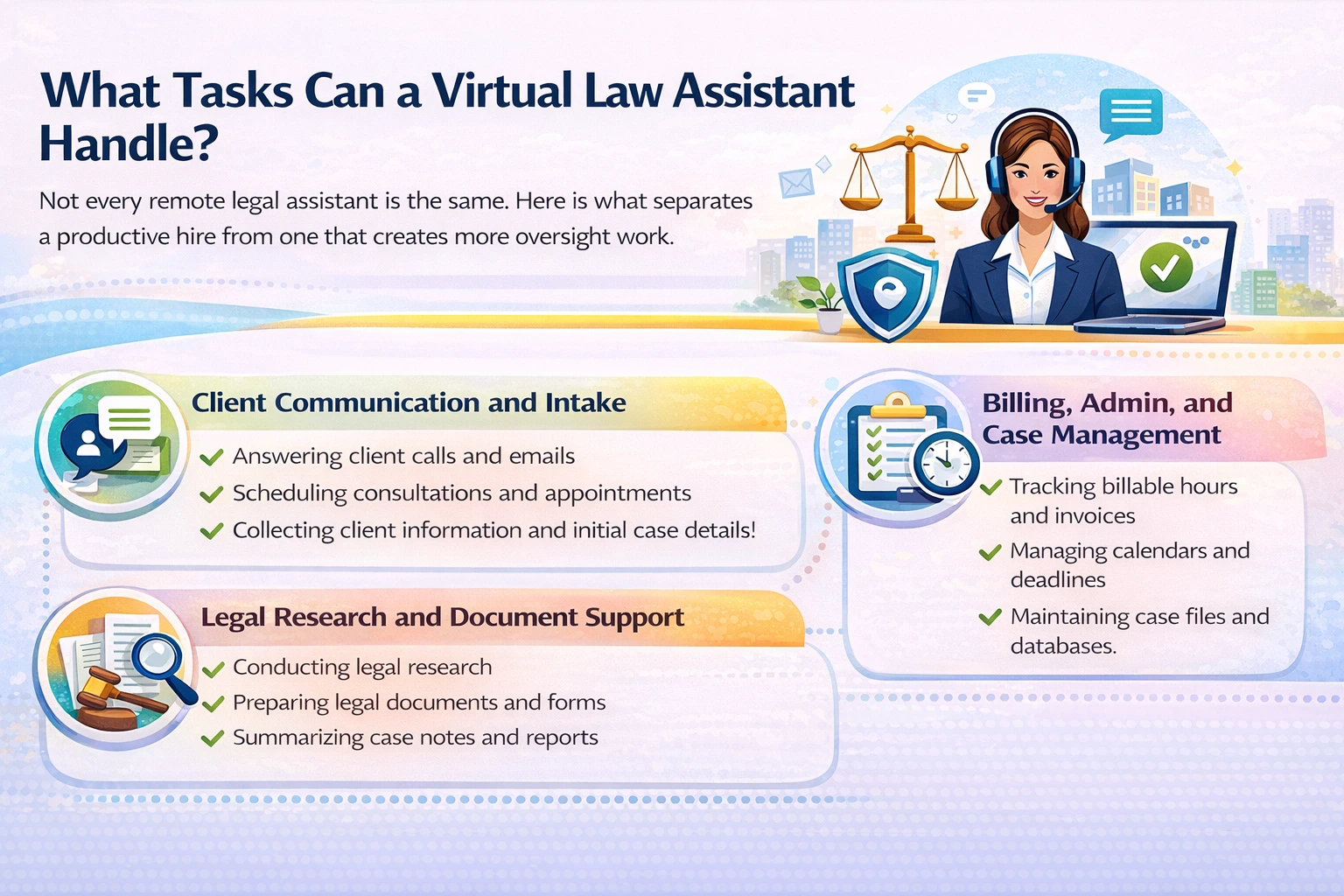
What Tasks Can a Virtual Law Assistant Handle?
According to the Clio Legal Trends Report, attorneys average only 2.9 billable hours per day. Administrative work fills the rest. A virtual law assistant takes those tasks off the attorney's plate.
Client Communication and Intake
- Answering inbound calls and qualifying new leads
- Managing email inboxes and drafting client responses
- Scheduling consultations, court dates, and follow-up calls
- Sending case status updates so attorneys are not fielding routine check-ins
Response time matters here. A study cited by the American Bar Association found that 42% of potential clients expect a response within 30 minutes. Most firms take over three hours. A dedicated virtual law assistant on intake closes that gap.
Legal Research and Document Support
- Researching statutes, case law, and legal precedents
- Drafting demand letters, contracts, and legal memos from attorney templates
- Preparing discovery documents, pleadings, and case summaries
- Organizing and maintaining digital case files
Attorneys still review and approve every document. The assistant handles the first draft and the research, which is where the time savings come from.
Billing, Admin, and Case Management
- Tracking billable hours and generating invoices
- Managing attorney calendars and court deadline reminders
- Entering data and maintaining records in case management software
- Transcribing calls and preparing notes from meetings
These are the tasks that attorneys often handle themselves because they feel too sensitive to delegate. They are also the tasks that consistently push billable work out of the day.
How a Virtual Law Assistant Directly Increases Firm Revenue
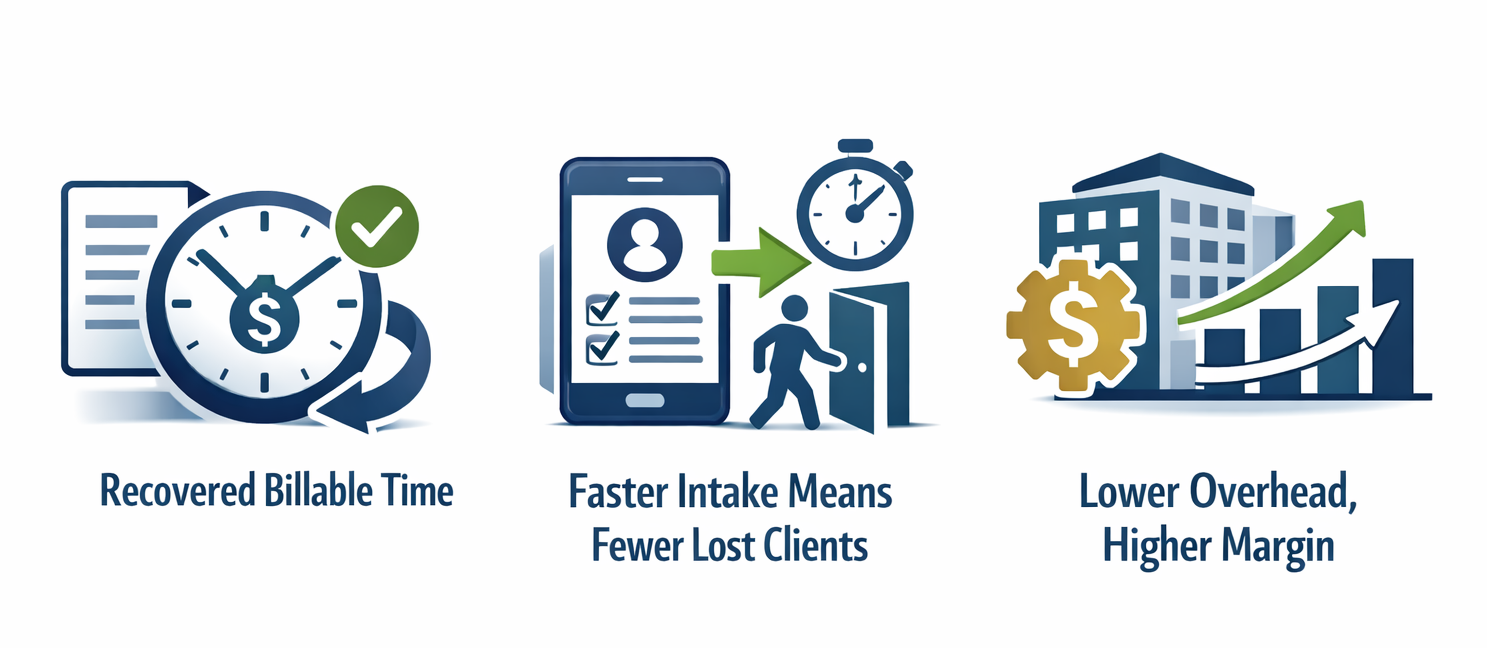
The revenue impact works through three channels: recovered billable time, faster client response, and lower overhead.
Recovered Billable Time
Industry analysis estimates that attorneys who delegate routine tasks recover an average of 12 billable hours per week per attorney. At even $200 per billable hour, that is $2,400 per week per attorney in recaptured revenue.
The math is straightforward. If administrative tasks are consuming six to eight hours daily across your team, the first question is not whether you can afford a virtual law assistant. It is how much it is costing you not to have one.
Faster Intake Means Fewer Lost Clients
Firms lose clients at the intake stage more often than during representation. When a potential client calls and gets voicemail, they call the next firm on the list. A virtual law assistant handling intake in real time keeps those leads from walking.
Remote Attorneys has placed virtual law assistants with over 1,000 law firms. Firms consistently report that dedicated intake support is one of the first places they see a measurable difference in client acquisition.
Lower Overhead, Higher Margin
A full-time in-house legal assistant in most U.S. markets costs between $4,000 and $6,000 per month when salary, benefits, payroll taxes, and overhead are included.
Remote Attorneys places virtual law assistants starting at $17 per hour, billed monthly on a month-to-month basis. There are no long-term contracts and no overhead costs beyond the monthly rate.
Virtual Law Assistant vs. In-House Legal Staff
The cost difference is significant. So is the flexibility. Here is a direct comparison:
The month-to-month billing structure matters for growing firms. A firm that adds a practice area or takes on a high-volume case load can scale support up without committing to a permanent hire.
Firms that hire through a dedicated remote legal staffing platform also skip the recruiting process entirely. Candidates are already screened for legal experience, software skills, and communication ability before the firm ever sees a profile.
The Role of a Legal Recruiter in Remote Legal Hiring
A legal recruiter does more than post a job listing. When you hire remote legal staff through a staffing platform, the recruiter handles credential verification, experience assessment, reference checks, and background screening.
This matters because a virtual law assistant works with sensitive client information from day one. The vetting process is not optional. Firms that skip it in favor of hiring off general freelance platforms typically spend weeks correcting onboarding problems.
Remote Attorneys functions as a legal recruiter by pre-screening every candidate against U.S. law firm standards. Staff are trained by U.S.-based attorneys and matched to the firm's specific practice area. By the time a firm meets a candidate, the screening work is done.
What to Look for When Hiring a Virtual Law Assistant
Not every remote legal assistant is the same. Here is what separates a productive hire from one that creates more oversight work.
- Legal-specific experience. General virtual assistants and virtual law assistants are different roles. Look for candidates who have worked directly with law firms and understand legal workflows, not just administrative tasks.
- Software fluency. The assistant should be able to work in Clio, MyCase, PracticePanther, or whichever platform the firm uses. Confirm this during the vetting process rather than after onboarding.
- Communication skills. The assistant will be a client's first point of contact. Their written and verbal communication reflects on the firm. Ask for examples from previous legal roles.
- Confidentiality protocols. The assistant needs to understand attorney-client privilege and data security practices. This is non-negotiable in a remote legal environment.
- A clear onboarding process. Document your intake workflow, billing process, and communication preferences before the assistant starts. Firms that invest time in onboarding see faster results.
The fastest path to a productive hire is working with a platform that has already done this vetting. Remote Attorneys provides a full management platform with time tracking, performance monitoring, and dedicated account support so firms can delegate without losing visibility.
How Remote Attorneys Places Virtual Law Assistants
This is the one section where we will be direct about how RemoteAttorneys.com works, because it is relevant to how you hire.
Remote Attorneys has placed virtual law assistants and remote legal staff with over 1,000 law firms across the U.S. Staff are full-time, dedicated, pre-vetted, and trained. They are not freelancers cycling between multiple clients.
Pricing starts at $17 per hour, billed monthly on a month-to-month basis. Firms working with Remote Attorneys report an average of $55,000 in annual savings and a 90% improvement in operational efficiency.
Start Recovering Billable Hours This Week
The math on virtual law assistants is not complicated. Attorneys are losing billable hours every day to tasks a trained remote professional can handle. The question is which tasks to delegate first and how to find someone who will not require weeks of oversight before they are productive.
The fastest path is working with a platform that has already done the vetting, training, and onboarding groundwork.
Read more on the legal statistics shaping how law firms hire in 2026, or explore practice-area-specific remote legal support to see which roles fit your firm.
Frequently Asked Questions
What does a virtual law assistant do?
A virtual law assistant handles intake calls, email management, scheduling, legal research, document drafting, and billing tasks remotely under attorney supervision. They free up attorney time for billable legal work.
How is a virtual law assistant different from a paralegal?
Paralegals typically hold credentials and assist with substantive legal work including court filings. A virtual law assistant focuses on administrative and operational support, complementing rather than replacing paralegal work.
Is it safe to share client information with a remote legal assistant?
Yes, when the assistant is hired through a vetted legal staffing platform. Remote Attorneys staff sign comprehensive confidentiality agreements, use encrypted communication channels, and follow U.S. attorney-client confidentiality standards.
How much does a virtual law assistant cost?
Remote Attorneys places virtual law assistants starting at $17 per hour, billed monthly. This is significantly less than the $4,000 to $6,000 per month cost of a full-time in-house hire when salary and benefits are included.
Can a virtual law assistant work with my existing case management software?
Most experienced virtual law assistants are trained on Clio, MyCase, and PracticePanther. Confirm software compatibility during the vetting process. Remote Attorneys matches candidates to your existing tech stack.