
.webp)
Most founders and operators only think about legal headcount once something breaks. A contract gets stuck in review for three weeks. Outside counsel bills hit six figures for work a full-time hire could handle. A new state law requires compliance nobody on the team can interpret.
At that point, the question isn't "do we need a legal team." It's "how big should it be, and how should it be structured." This guide walks through current benchmarks, what actually drives legal team size, how departments are structured, and when it makes sense to grow.
Key Takeaways
- There's no single "right" headcount. Team size scales with revenue, industry regulation, and company stage, not a fixed formula.
- Most legal departments stay lean. Companies under $1 billion in revenue employ a median of just 4 legal team members.
- Structure matters as much as size. Functional, client-focused, and hybrid models each solve different coordination problems.
- Flexible support closes gaps fast. Contract attorneys and paralegals let lean teams absorb workload spikes without a full-time hire.
What Is a Legal Team?
A legal team is the group inside a company responsible for contracts, compliance, risk management, and disputes. It's the internal function that protects the business before problems reach a courtroom.
People often use "legal team" and "legal department" interchangeably. Both describe the same internal function, distinct from outside law firms hired for specialized or overflow work.
A typical legal team includes:
- General Counsel (GC): the senior legal leader, often reporting to the CEO or board
- In-house attorneys: handle contracts, employment law, litigation, and regulatory matters
- Paralegals and legal assistants: manage documentation, filings, and research
- Legal operations staff: run budgeting, vendor management, and legal technology
The mix of these roles shifts as a company grows. That's where benchmarks become useful.
How Big Should Your Legal Team Be?
It depends on revenue, industry, and growth stage. Benchmarking data gives you a starting point instead of a guess.
The 2024 ACC Law Department Management Benchmarking Report surveyed 421 legal departments across 32 countries. It found that legal team size scales sharply with company revenue.
A few patterns stand out from this data:
- Small and mid-size companies run lean legal functions by default.
- Headcount climbs in steps as revenue crosses certain thresholds, not on a smooth curve.
- On average, legal departments assign 14% of their lawyers to litigation and 7% to intellectual property work. This is per the same ACC benchmarking survey.
If your team looks small compared to these numbers, that's normal. Most companies rely on a mix of in-house staff and outside support rather than hiring for every function.
What Drives Legal Team Size (Beyond Revenue)
Revenue explains part of the picture. Several other factors shape how big a legal team needs to be.
- Industry regulation. Fintech, healthcare, and life sciences companies typically need legal support earlier and in greater depth than less regulated industries.
- Product and IP complexity. SaaS and hardware companies often require dedicated support for patents, licensing, and data agreements.
- Global footprint. Expanding into new countries adds local compliance, data privacy, and employment law requirements.
- Outside counsel spend. When overflow and specialist work sent to law firms starts costing more than a hire would, that's a signal to bring the work in-house.
- Legal operations and automation. Contract review software and workflow tools let a small in-house team support a much larger business. See our guide to virtual legal operations workflows for more detail.
Corporate Legal Department Structure
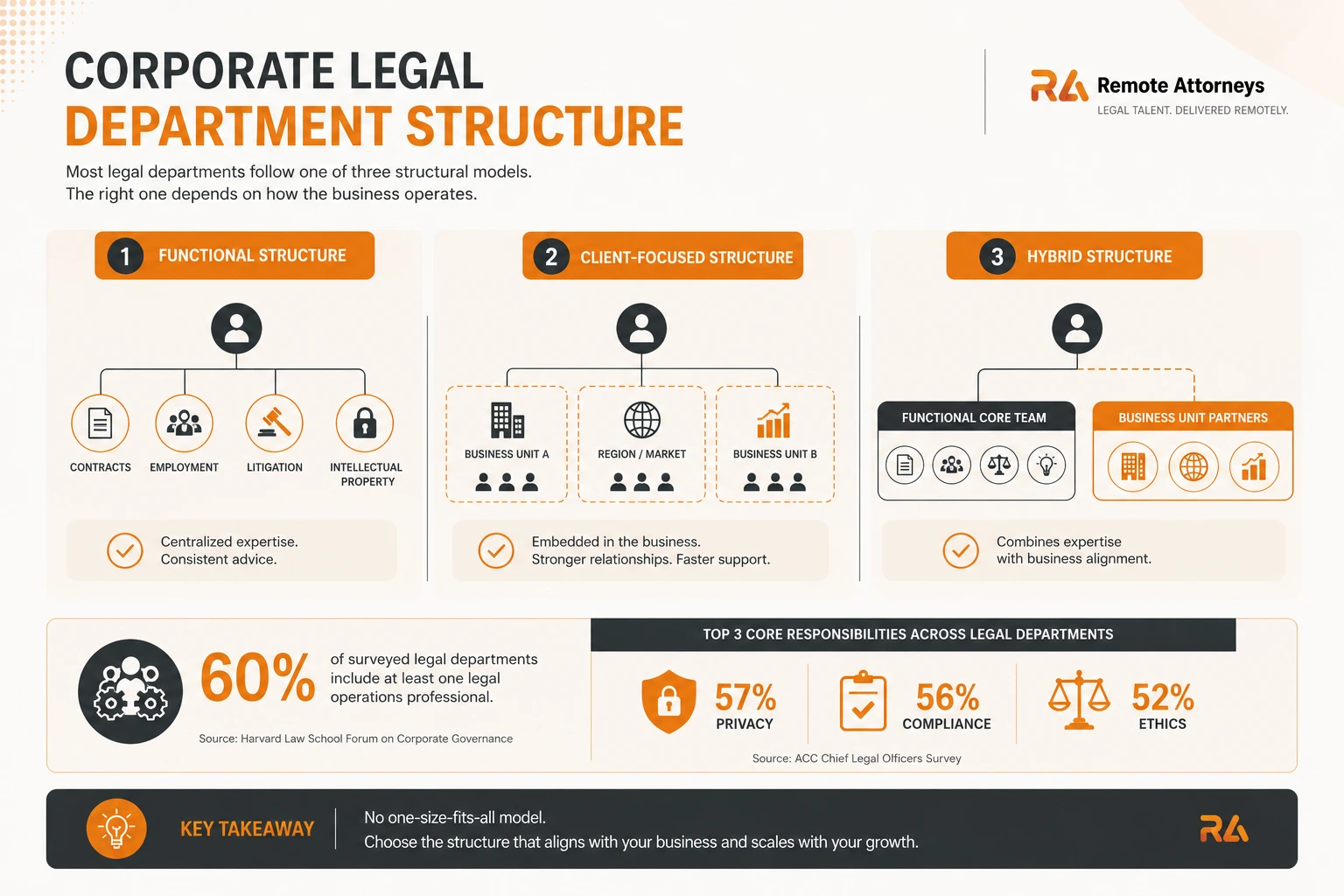
Most legal departments follow one of three structural models. The right one depends on how the business operates, not just how many people are on the team.
Functional Structure
Lawyers specialize by practice area such as contracts, employment, litigation, or intellectual property. This centralized model promotes consistent advice and is easier to manage as a small team.
Client-Focused Structure
Attorneys are embedded directly into business units or regions. This builds stronger relationships with internal stakeholders and speeds up day-to-day support, but it requires a larger team to staff properly.
Hybrid Structure
Most growing companies land here. A core functional team handles specialized work. Certain attorneys are also assigned to high-priority business units.
Legal operations has become part of that mix too. About 60% of surveyed legal departments include at least one legal operations professional, according to the Harvard Law School Forum on Corporate Governance. This role helps run intake, vendor management, and process regardless of which structure a department uses.
Most departments cover a similar core set of responsibilities regardless of structure. Privacy (57%), compliance (56%), and ethics (52%) are the three most common functions, according to the same ACC benchmarking survey cited above.
What the Best Legal Teams Do Differently
Company size alone doesn't determine legal team quality. The strongest legal functions share a few habits regardless of headcount.
- They measure workload with data, not just a sense of being busy. Contract turnaround time, matter volume, and outside spend tell a clearer story than gut feeling.
- They mix staffing models. Full-time hires cover core, ongoing work. Outside counsel and contract talent absorb spikes and specialized matters.
- They invest in legal operations early, even at small headcounts, to keep repetitive work from consuming attorney time.
- They tie hiring requests to business outcomes like deal velocity or reduced legal risk, not just team fatigue.
Flexible staffing fits into this strategy too. Bringing on a contract paralegal or remote attorney to handle overflow work lets a small team keep pace with growth. It also skips the full-time salary and benefits cost.
For more on how this works in practice, see remote paralegal roles built to scale legal teams.
When to Grow Your Legal Team
A few clear signals suggest it's time to expand, rather than push the existing team harder.
- Outside counsel spend is consistently high relative to what an in-house hire would cost.
- The current team is working at capacity and turnaround times are slipping.
- New regulatory requirements demand ongoing, specialized attention.
- The company is entering new markets or launching complex new products.
- Bringing work in-house would reduce total legal spend over time.
Building the Business Case
When asking leadership to approve legal headcount, use specific numbers. Contract turnaround time, outside counsel spend, and deal volume make a stronger case than describing a heavy workload.
Working with a remote attorney can bridge the gap while a full-time hire is being evaluated. This gives leadership real data before committing to a permanent role.
If you want help figuring out what your team needs, you can book a consultation to talk through your options.
Building a Virtual Legal Team
Hiring additional full-time legal staff isn't the only way to grow your legal department. Many businesses build virtual legal teams by combining their in-house counsel with experienced remote attorneys, paralegals, and legal support professionals. This approach provides the flexibility to increase legal capacity while avoiding the long-term costs and delays associated with traditional hiring.
At Remote Attorneys, we help businesses scale their legal teams with vetted remote attorneys who integrate seamlessly into existing workflows. Whether you need support for contract drafting, compliance, employment law, due diligence, litigation support, or day-to-day legal operations, our professionals work as an extension of your in-house team, providing the expertise you need without adding permanent headcount.
A virtual legal team can support:
- Contract drafting, review, and negotiation
- Compliance monitoring and regulatory research
- Employment law documentation and policy updates
- Due diligence and corporate transactions
- Litigation support and document management
- Legal operations, matter intake, and workflow coordination
If your legal team is growing but you're not ready to hire another full-time employee, working with Remote Attorneys gives you access to experienced legal professionals who can provide flexible support as your business evolves.
FAQs
How many lawyers should your company have in-house?
There's no fixed number that fits every business. Companies under $1 billion in revenue employ a median of 4 legal staff, scaling sharply as revenue and complexity grow.
Do major corporations typically have full-time counsel in-house for litigation?
Most companies keep in-house litigation staffing lean and send active cases to outside firms, since litigation work is often unpredictable, specialized, and expensive to staff permanently.
What percentage of a legal team should be lawyers versus support staff?
It varies by company size. Smaller legal teams skew heavily toward lawyers, while larger departments add more paralegals and legal operations professionals as they scale.
When should a startup hire its first in-house lawyer?
Many startups hire once outside counsel fees start approaching the cost of a full-time salary, which commonly happens somewhere between 50 and 100 employees.
Is a bigger legal team always better?
Not necessarily. Capacity built through automation, outside counsel, and flexible staffing often matters more for a growing company than raw in-house headcount alone.
Right-Sizing Your Legal Team as You Grow
Legal team size isn't just a headcount number. It's a mix of in-house staff, outside counsel, legal operations, and flexible support that matches how fast the business is growing.
Most companies don't need a large department. They need the right structure, clear signals for when to add support, and a way to flex up fast when workload spikes.
A platform built to manage a growing legal team makes that mix easier to run. That could mean adding a contract attorney for three months, or tracking outside counsel spend against a hiring decision.