
.webp)
Starting a solo law practice means running a law firm where you are the attorney, the business owner, and the decision-maker all at once. Most solo practitioners who struggle in year one are not missing legal skills, they are missing a business plan, the right tools, and a realistic picture of what running a practice actually costs.
Key Takeaways
- Startup costs for a solo law practice range from $3,500 to $50,000 depending on your office setup and tech choices.
- According to the Embroker 2025 Solo Law Firm Statistics Report, 50% of solo practitioners increased spending on legal software in 2024.
- Solo attorneys average $288 per hour in billing rates, compared to $345 for larger firm attorneys.
- 84% of solo and small firm attorneys view work-life balance as a measure of success, yet most struggle to achieve it without the right systems in place.
What Is a Solo Law Practice?
A solo law practice is a law firm owned and operated by a single licensed attorney. That attorney handles all client work, manages the business, and carries full professional responsibility for every matter.
Solo practitioners make up nearly 49% of all private practice lawyers in the United States. In some states like New York, that number reaches 81%. Despite that scale, most law schools spend little time teaching attorneys how to actually run a business.
A solo practice is not simply a smaller version of a big firm. It is an independent business that requires the attorney to wear multiple roles at the same time.
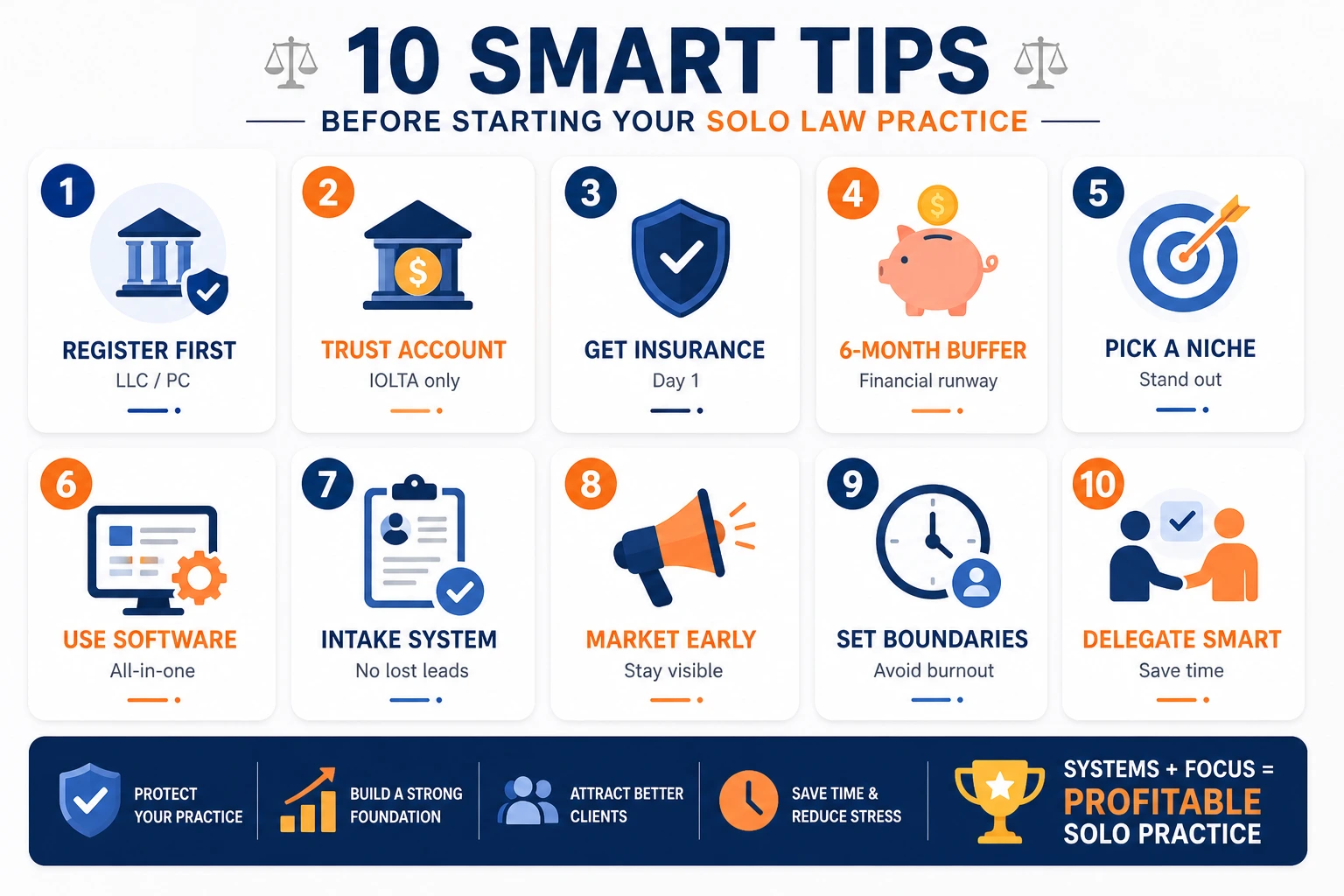
Tip 1: Register Your Business Before Taking Any Clients
Choose your business entity before your first client ever signs a retainer. Most solo attorneys form an LLC or professional corporation for liability protection and tax flexibility.
Your structure affects personal asset protection, how you pay self-employment taxes, and what business deductions you can claim. A CPA who works with law firms can help you make the right call for your state and practice area.
Skipping this step creates personal liability exposure before you even open your doors.
Tip 2: Open a Dedicated Trust Account Immediately
Client funds must be held in a trust account that is completely separate from your business operating account. Commingling client and firm funds is an ethics violation that can result in disbarment.
Follow these steps to set it up correctly:
- Open an IOLTA (Interest on Lawyers' Trust Accounts) account at a state-approved financial institution.
- Use legal billing and accounting software with built-in trust tracking.
- Reconcile the trust account every single month.
- Never use trust funds to cover firm operating expenses, even temporarily.
Review your state bar's Rules of Professional Conduct before your first client retainer is collected.
Tip 3: Get Malpractice Insurance Before Day One
Professional liability insurance is not optional for a solo practitioner. The average malpractice premium for solo attorneys runs approximately $2,300 per year, according to the Embroker 2025 Solo Law Firm Statistics Report.
Without coverage, one claim can erase years of earnings and expose personal assets. Rates vary by practice area. Litigation and real estate typically cost more than transactional work.
Do not take on a paying client until your policy is active and confirmed in writing.
Tip 4: Build a Six-Month Financial Runway First
Income for a solo practitioner is irregular, especially in the first 12 to 18 months. The feast-or-famine cycle is real: one month brings five new clients, the next month brings none.
According to the Above the Law 2024 Solo and Small Firm Compensation Survey, 28% of solo practitioners earn less than $100,000 per year. Having a six-month personal financial cushion before you launch removes desperation from client selection.
Save aggressively before going solo. Taking bad clients out of financial pressure leads to bad outcomes for everyone.
Tip 5: Pick a Niche Practice Area From the Start
Generalist practices struggle to stand out in local search results and referral networks. Attorneys who focus on one or two practice areas build reputation faster and attract better-fit clients.
Choose your niche based on:
- Prior firm experience and case types you know well
- Local market demand and competition
- Your personal interest in the subject matter
- Practice areas with consistent referral pipelines
Niche positioning makes your marketing dollar work harder and your client intake faster.
Tip 6: Choose the Right Practice Management Software Early
The best law practice management software for solo practitioners handles case management, time tracking, billing, trust accounting, and client communication in one place. Setting this up from day one prevents administrative chaos later.
According to the PracticePanther 2024 Small and Mid-Sized Law Firm Report, solo practitioners using practice management software billed significantly more hours per year than those managing manually. The time saved on administrative tasks alone often covers the software cost within the first month.
Solo attorneys who skip practice management software spend more time on non-billable admin work. That directly reduces take-home income.
Tip 7: Set Up Your Client Intake Process Before You Need It
A missing intake process is one of the most common early mistakes solo practitioners make. Without a defined system, leads fall through the cracks and potential clients never convert.
A basic intake process should include:
- An online contact form or scheduling link on your website
- A conflict check procedure before any substantive consultation
- A written engagement letter signed before work begins
- A clear fee agreement with payment terms defined upfront
Your legal document preparation workflow should be ready before clients start calling. Templates save time and protect you from scope creep.
Tip 8: Market Your Practice Before You Have Cases to Fill
Most solo practitioners stop marketing when they get busy. That guarantees a famine period six to eight weeks later. Consistent visibility is what keeps the pipeline moving.
Marketing activities that actually produce results for solo practitioners:
- Referral networks: Other attorneys, CPAs, financial advisors, and real estate agents in your area
- Google Business Profile: Free and consistently drives local search traffic
- Practice area content: Blog posts and FAQs that answer questions your clients are already typing
- Bar association involvement: Local and practice-specific groups where referral relationships form
Marketing does not stop when your calendar is full. That is exactly when the next client cycle is being built.
Tip 9: Protect Your Time With Clear Boundaries
84% of solo and small firm attorneys say work-life balance matters to them, according to the 2023 Thomson Reuters State of U.S. Small Law Firms Report. Most say they struggle to achieve it.
When your home is your office and your phone is your receptionist, the workday never ends on its own. You have to define it.
Practical ways to protect your time:
- Set defined office hours and communicate them to clients upfront
- Use an auto-responder for after-hours emails
- Block non-client time on your calendar the same way you block court dates
- Build real vacation coverage through per diem attorneys or contract legal support before you need it
Burnout is the most common reason solo practices fail in years two and three, not lack of clients.
Tip 10: Know When to Delegate and How to Do It
Solo does not mean doing every single task yourself forever. Attorneys who try to handle everything intake calls, document drafting, research, billing, and client communication run out of bandwidth fast.
The right time to delegate is when non-billable tasks consistently take more than 10 to 15 hours per week. That threshold is a signal, not a suggestion.
Options for solo practitioners who need support without a full-time hire:
- Contract attorneys for overflow legal research, document drafting, and case support
- Virtual paralegals for document management and client communication
- Outsourced billing support for invoicing and collections
Delegation is a financial decision. If the cost of help is less than what you could bill in that same time, keeping tasks yourself costs you money.
How Can Remote Legal Support Help Solo Practitioners Grow?
Solo practitioners carry every operational and legal task alone. That works at low volume. As caseload grows, the administrative and research burden grows faster than revenue does.
Remote Attorneys connects solo practitioners with trained contract attorneys and paralegals who work inside your existing workflow. You pay by the hour, with no long-term commitment required. Learn more about how it works and what roles are available for solo practices.
What Are the Pros and Cons of a Solo Law Practice?
Pros:
- Full control over clients, cases, and schedule
- Higher earning potential per case compared to associate salaries
- No firm politics or mandatory billing targets
- Direct client relationships from day one
Cons:
- No guaranteed income or salary floor
- All overhead, insurance, and tech costs fall on you
- Isolation is the top complaint among solo practitioners
- Irregular cash flow in the first 12 to 18 months
Understanding both sides helps you prepare for what is coming rather than being surprised by it. Many attorneys find that the right support systems turn most of the cons into manageable variables.
What It Actually Takes to Run a Solo Law Practice
Starting a solo practice is a business decision as much as a career one. The attorneys who succeed long-term are not necessarily the most experienced lawyers. They are the ones who set up proper systems early, manage cash flow deliberately, and know when to ask for help.
Review the Remote Attorneys blog for more practical guidance on how solo and small firms compete and grow. For attorneys ready to offload research, drafting, or document work, explore the legal research and writing service as a starting point.
Solo practice is hard. With the right foundation, it is also one of the most financially and professionally rewarding paths in law.
FAQs
How much does it cost to start a solo law practice?
Starting costs range from $3,500 for a minimal home-based setup to $50,000 with a full office. Budget at least $10,000 and save six months of personal living expenses before launching.
What is the best law practice management software for solo practitioners?
Clio, MyCase, and PracticePanther are the top-rated options for solo attorneys. Each handles billing, case management, and trust accounting. Pricing starts at $39 per user per month.
Can a solo practitioner hire help without a full-time employee?
Yes. Contract attorneys, virtual paralegals, and remote legal support services let solo practitioners get help by the hour with no long-term employment commitment or payroll overhead.
What practice areas work best for a solo law practice?
Family law, estate planning, criminal defense, immigration, and real estate law generate consistent referral volume for solo practitioners. Niche focus builds reputation faster than a general practice approach.
Do solo attorneys need malpractice insurance?
Yes. Professional liability insurance is required or strongly recommended in every state. The average annual premium for solo attorneys is approximately $2,300, varying by practice area and claims history.