Many law firms treat bilingual support as a phone problem — something solved with an answering service or a Spanish-speaking receptionist. In reality, the challenge extends beyond the first call.
According to the U.S. Census Bureau’s 2024 American Community Survey, 44.9 million people in the United States speak Spanish at home — nearly 1 in 7 Americans. For law firms, that represents a large and growing group of potential clients.
In major metros like Los Angeles, Miami, Houston, and New York, Spanish-speaking communities make up a significant share of the legal services market. Firms that cannot communicate effectively in Spanish often lose opportunities before a consultation even begins.
The real question for law firms is not whether bilingual support matters it’s where it belongs in the client journey.
In practice, bilingual capability operates in two layers:
- Front-end coverage — what happens when a Spanish-speaking prospect first contacts your firm
- Back-end capacity — what happens after the client signs and the case begins
A lawyer answering service handles the first layer. Bilingual legal support handles the second. Confusing the two is one of the most common — and costly — operational mistakes growing firms make.
Key Takeaways
- A bilingual answering service handles inbound calls and initial intake — it does not replace legal workflow support.
- A bilingual virtual receptionist screens and qualifies leads but cannot carry substantive legal work.
- Law firms serving multilingual markets need both a front-end answering layer and back-end bilingual legal staff.
- Remote bilingual legal professionals handle the work a lawyer answering service was never designed to do.
- Choosing the wrong layer costs firms cases, not just calls.
What a Bilingual Answering Service Actually Does
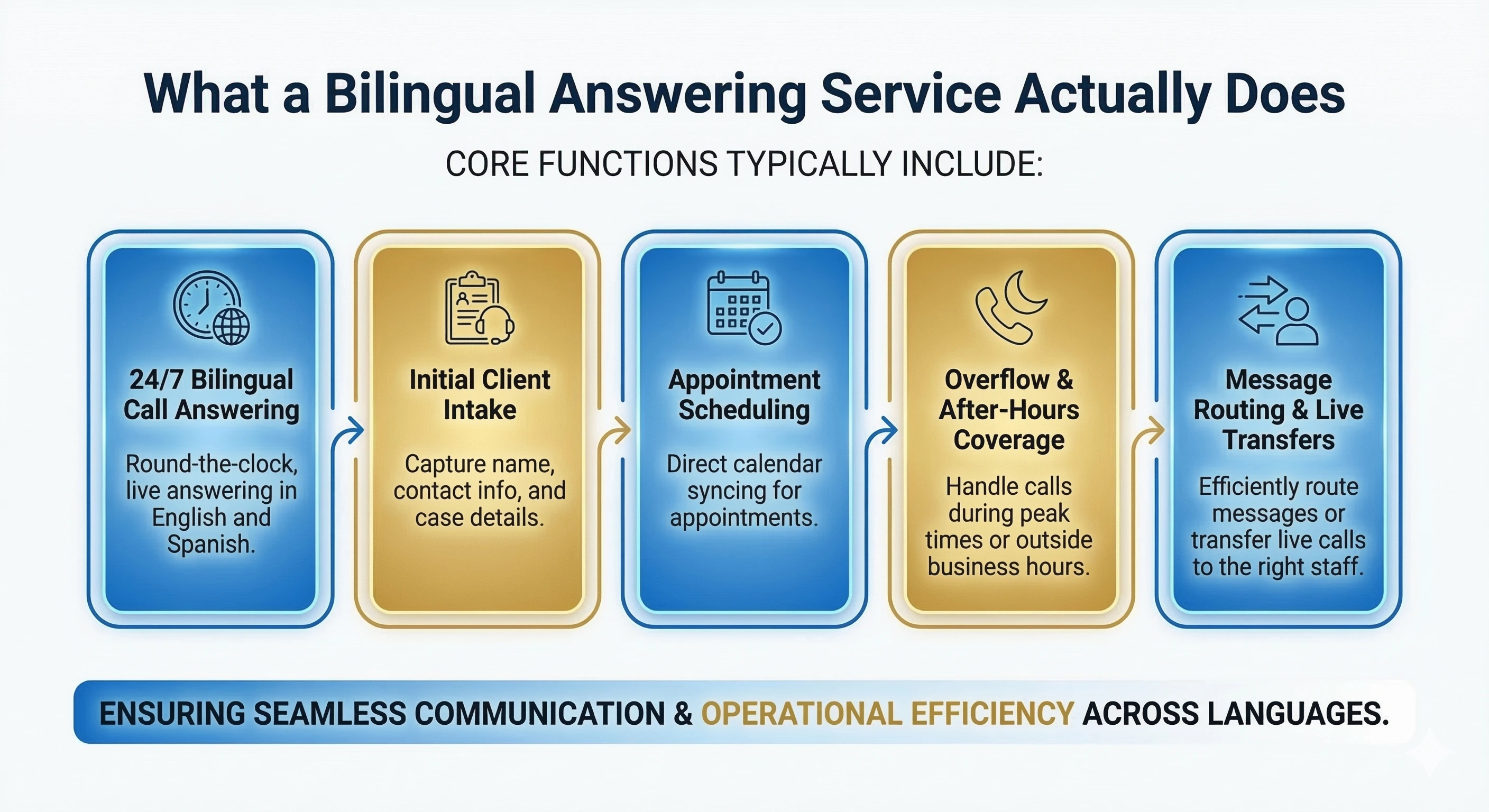
A bilingual answering service is an outsourced call handling solution. It fields inbound calls, gathers initial information, and routes inquiries according to your firm’s protocols in two or more languages.
Core functions typically include:
- 24/7 inbound call answering in English and Spanish
- Initial client intake (name, contact info, case type)
- Appointment scheduling and calendar syncing
- Overflow and after-hours call coverage
- Message routing and live call transfers
The best services are legal-specific. They train agents on legal terminology, follow custom intake scripts, and integrate with case management software like Clio, MyCase, or PracticePanther.
What they cannot do is equally important to understand. A bilingual answering service cannot draft documents, conduct legal research, manage deadlines, correspond with courts, or carry any substantive legal work — in any language.
Where a Bilingual Virtual Receptionist Fits
A bilingual virtual receptionist operates at the intersection of call handling and light legal administration. Unlike a generic call center agent, a bilingual virtual receptionist is trained to follow firm-specific intake protocols, identify case urgency, flag practice-area relevance, and deliver a professional first experience in the client’s language.
They are a strong fit for:
- High-volume inbound call environments in diverse markets
- Firms that need qualified lead screening before attorney time is spent
- After-hours coverage without sacrificing intake quality
They are not a fit for:
- Replacing a paralegal on active case files
- Managing client communications past the first-touch stage
- Providing legal guidance or document assistance in any language
The distinction matters operationally. When a firm invests in a bilingual virtual receptionist and assumes the job is done, the gap shows up mid-case — when a Spanish-speaking client realizes the team handling their file cannot communicate with them effectively.
Side-by-Side: Bilingual Answering Service vs. Bilingual Legal Support
Use this reference to clarify which layer each solution belongs to:
What “Bilingual Legal Support” Actually Means Inside a Law Firm
Bilingual legal support refers to trained legal professionals paralegals, case managers, remote attorneys who work across languages throughout the active life of a case.
This is where the front-end investment pays off or falls apart.
When a Spanish-speaking client is signed after a smooth intake call and then handed to an English-only case team, trust erodes fast. The client doesn’t return calls. Miscommunications multiply. Cases that should close cleanly get complicated.
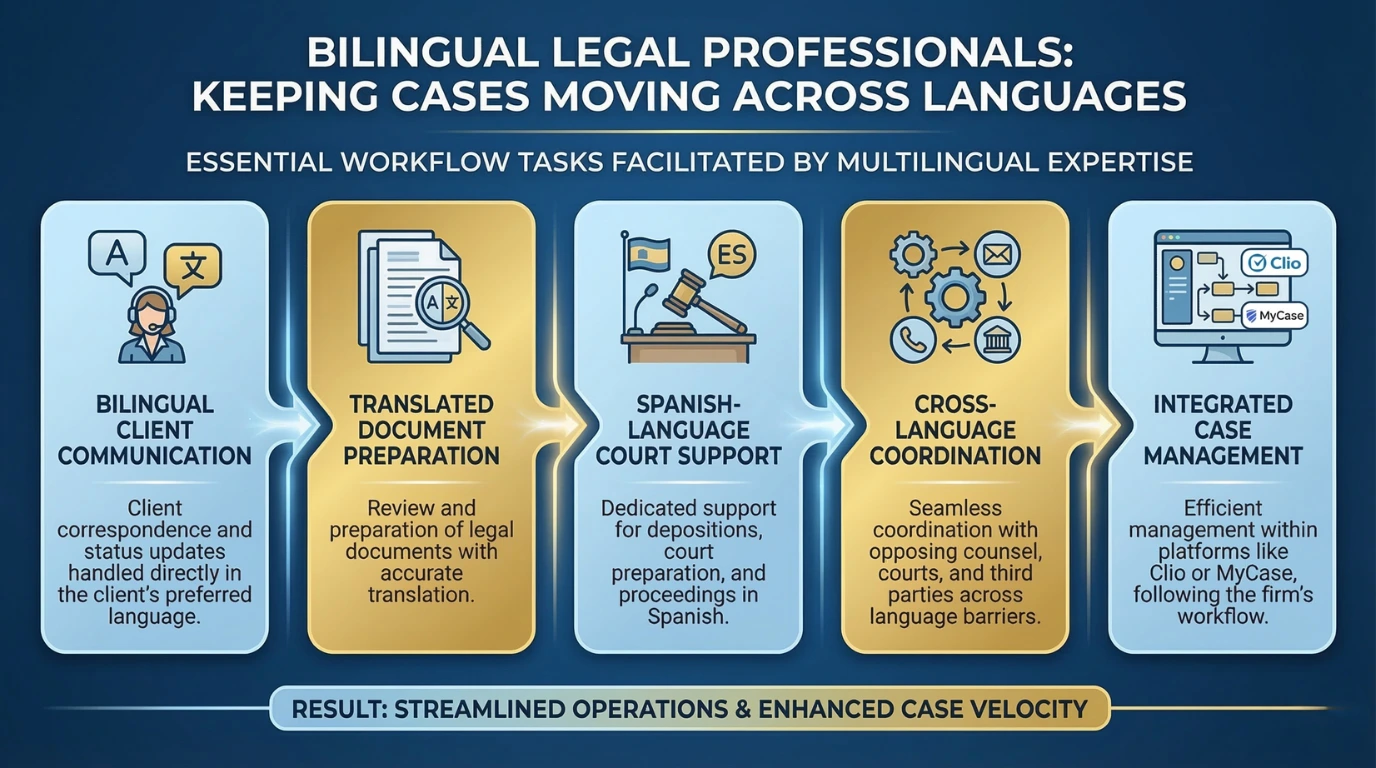
Bilingual legal professionals handle the work that keeps cases moving:
- Client correspondence and status updates in the client’s language
- Translated document review and preparation
- Spanish-language deposition or court prep support
- Coordination with opposing counsel, courts, and third parties across languages
- Case management within platforms like Clio or MyCase — in the firm’s workflow
Practice areas where this matters most: immigration, personal injury, family law, and criminal defense. These are emotionally high-stakes cases. Clients in these situations don’t just want to be heard on the first call — they need someone fluent in both languages working with them from intake to resolution.
The Legal Services Corporation’s Language Access guidance makes clear that firms serving limited-English-proficiency clients need bilingual staff embedded at the intake level — not just on the phone line. Firms that extend that bilingual capacity into active case support consistently report stronger client retention and fewer mid-case communication breakdowns.
The Real Cost of Relying on a Lawyer Answering Service Alone
A lawyer answering service is a coverage tool. It solves the problem of missed calls. It does not solve the problem of a client who speaks Spanish working with a case team that doesn’t.
Here is where firms lose ground:
- A Spanish-speaking prospect calls. The bilingual answering service handles it well. The client feels confident and schedules a consultation.
- The consultation goes well because the attorney has basic Spanish fluency or uses a translator.
- The client signs. Case work begins. The paralegal, case manager, and support staff are English-only.
- Client communications slow down. Deadlines get missed because the client doesn’t understand instructions.
- The client leaves a negative review, refers no one, or abandons the case mid-process.
The answer service did its job. The firm lost the case anyway.
The Harvard Business Review found that 72.4% of consumers are more likely to purchase a product or service when information is provided in their native language. In legal services, where trust is the product, that figure translates directly to retainer conversion and client retention.
The front-end and back-end of bilingual capability must be connected. An excellent lawyer answering service feeding into an English-only case pipeline is not a bilingual law firm. It is a firm that makes a good first impression and a poor second one.
One, the Other, or Both: A Practical Decision Guide
Not every firm needs the same solution. Use this decision framework to align your bilingual investment with your actual caseload profile:
The most common mistake is treating these as either/or. For any firm actively growing its Spanish-speaking client base, the answer is both — with each layer clearly defined.
What to Look for in Bilingual Legal Support That a Call Center Cannot Provide
When evaluating remote bilingual legal staff — as distinct from a bilingual call center or answering service — the criteria shift significantly.
Look for:
- Legal domain training in both languages, not just conversational fluency. A paralegal who speaks Spanish socially is not the same as one trained in legal terminology in both languages.
- Jurisdiction-specific vocabulary. Terms like “demandado” and “acusado” carry different weight in legal contexts. Mistranslation at this level creates case risk.
- Workflow integration. Remote bilingual legal professionals should operate inside your case management software and communicate using your firm’s documented protocols.
- Ethical awareness. Bilingual legal staff working adjacent to attorneys must understand confidentiality obligations, the boundaries of the paralegal role, and applicable bar guidelines in your jurisdiction.
- Scalability. Unlike a fixed bilingual call center staff roster, remote legal professionals can be added on-demand as caseload grows, without the overhead of full-time hires.
The difference between a bilingual answering service agent and a bilingual remote paralegal is the difference between someone who can take a message in Spanish and someone who can advance a case in it.
How Remote Attorneys Closes the Bilingual Legal Support Gap
Remote Attorneys connect law firms with vetted remote legal professionals — including bilingual paralegals, case managers, and attorneys fluent in English and Spanish — trained to work inside U.S. law firm workflows.
This is not an answering service. This is legal-trained talent that works on your cases.
Remote bilingual professionals through Remote Attorneys can:
- Handle full case communication with Spanish-speaking clients from intake through resolution
- Prepare and review legal documents in both languages
- Manage case files in Clio, MyCase, PracticePanther, and other leading platforms
- Support immigration, personal injury, family law, and criminal defense practices
- Work on a flexible, scalable basis — without the cost of a full-time in-house hire
Explore available roles: Remote Paralegal | Contract Attorney | Contract Paralegal
For firms in immigration or family law, see our Immigration Law staffing options and Family Law attorney resources.
Firms that serve bilingual clients deserve a bilingual team not just a bilingual phone line.
Bilingual Coverage Starts at the Phone — But Your Clients Need It to Go Further
A bilingual answering service solves a real problem. So does a bilingual virtual receptionist. Both are worth having. Neither one is the complete picture.
Law firms that want to serve multilingual client populations at a high level need language capability woven into every stage of the client experience — from the first call, through active case work, to resolution.
The front end and the back end must connect. When they do, bilingual capability becomes a competitive advantage that compounds over time: more signed clients, better retention, stronger referrals from a community that values being heard.
When they don’t, the answering service takes a good message and the firm drops it.
Frequently Asked Questions
What is the difference between a bilingual answering service and bilingual legal support?
A bilingual answering service handles calls and initial intake. Bilingual legal support means trained legal professionals — paralegals, case managers — working on cases in two languages.
Can a bilingual virtual receptionist handle legal intake for Spanish-speaking clients?
Yes, for initial screening and scheduling. A bilingual virtual receptionist cannot perform substantive legal work, draft documents, or manage active case files.
What types of law firms benefit most from remote bilingual legal staff?
Immigration, personal injury, family law, and criminal defense firms serving Spanish-speaking clients gain the most from remote bilingual paralegals and case managers.
Is a lawyer answering service enough if my firm serves Spanish-speaking clients?
No. A lawyer answering service covers intake calls. Firms with active bilingual caseloads also need bilingual legal staff to handle case work past the first call.
How do I find qualified bilingual legal professionals for my remote law firm team?
Platforms like RemoteAttorneys.com vet and place remote bilingual paralegals and attorneys trained to work inside U.S. law firm workflows and case management systems.