

Many law firms publish blogs, articles, and legal resources, but content alone does not generate new cases. Without a clear strategy, even well-written content can attract readers without creating meaningful opportunities for client acquisition.
Effective content marketing connects valuable information with a structured path to conversion. This guide explores how law firms can develop content that supports visibility, builds trust, and helps turn interested readers into qualified consultations.
Key Takeaways
- 92.4% of legal consumers research their legal issue online before contacting an attorney, making organic content your most consistent lead source.
- Content without a CTA sends warm prospects to your competitors. Every article needs a clear next step.
- One strong practice area content cluster outperforms thirty disconnected blog posts.
- Virtual law firms can target statewide audiences through content, reaching far more potential clients than geographically limited firms.
What Content Marketing Actually Means for Law Firms
Content marketing is the practice of publishing searchable resources that answer the questions your future clients are already typing into Google.
It is not a press release about your latest verdict. It is not a blog that explains statutes in dense legal language. It is a resource written for a person who is scared and confused and needs to know if they have a case.
According to the Martindale-Avvo State of the Legal Consumer 2026 report, 92.4% of legal consumers research their legal issue online before ever contacting an attorney. Your content is not optional. It is the first impression your firm makes.
The 2025 Clio Legal Trends Report on marketing ROI also confirms that SEO and high-quality content consistently deliver the highest long-term return of any digital channel for law firms.
Why Traffic Without Strategy Fails
A blog that ranks on page one but has no CTA and no path to a consultation is not generating leads. It is generating readers. Those are two very different things.
Here is what happens on most law firm sites: a potential client searches "what to do after a slip and fall in Florida," reads your article, gets their answer, and leaves. You gave them no reason to contact you.
The 2024 Clio Legal Trends Report Secret Shopper Study found that 48% of law firms were essentially unreachable by phone, and only 33% responded to email inquiries at all. A potential client who finds you through content and tries to reach out has a coin-flip chance of hearing back. Content builds the first layer of trust. Your intake process closes the deal.
How to Build a Strategy That Brings in Cases
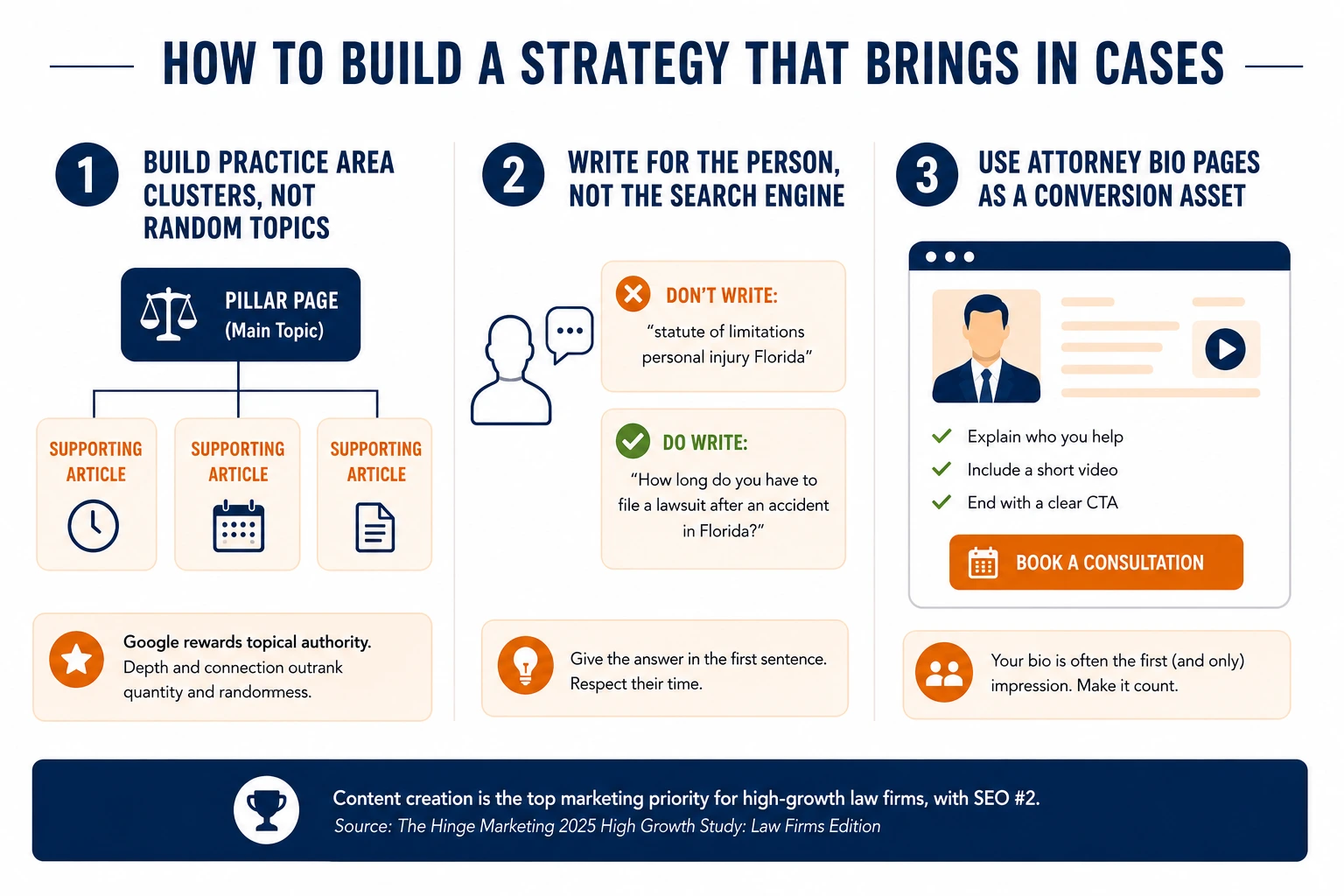
Build Practice Area Clusters, Not Random Blog Topics
A content cluster is a group of related articles all connecting back to one authoritative page on a specific topic.
A personal injury firm in Florida would build a pillar page on "Florida Car Accident Claims" and surround it with supporting articles on immediate steps after an accident, settlement timelines, and comparative fault rules.
Google rewards topical authority. A firm publishing ten well-connected articles on workers' compensation will outrank a firm with one hundred scattered posts across unrelated topics. The Hinge Marketing 2025 High Growth Study: Law Firms Edition found that content creation ranks as the top marketing priority among high-growth law firms, with SEO ranking second. Both outranked paid ads and social media.
Write for the Person, Not the Search Engine
Clients search in plain English. Meet them there.
Instead of writing about "statute of limitations personal injury Florida," write "How long do you have to file a lawsuit after an accident in Florida?" Give the answer in the first sentence. If someone has to read three paragraphs before understanding whether the content is relevant, they leave.
Use Attorney Bio Pages as a Conversion Asset
Bio pages consistently rank among the highest-trafficked pages on law firm websites, yet most firms treat them as a credentials list.
A potential client reading your bio is deciding whether to trust you enough to call. A bio that explains the types of clients you help, includes a short video, and ends with a direct link to book a consultation does that job. For virtual and remote attorneys, the bio is often the only impression a potential client has before deciding whether to reach out.
The Content Formats That Convert
Practice Area Articles and FAQ Posts
Target questions potential clients are actively searching:
- "What to do after a car accident" (informational, high volume)
- "Can I be fired for filing a workers' comp claim?" (specific, high intent)
- "How to file for divorce in Florida without a lawyer" (transactional intent)
Every article ends with a CTA. Not a link to another article. A prompt to take action.
Downloadable Guides and Lead Magnets
A downloadable resource, given in exchange for a name and phone number, captures leads who are not ready to call yet. Examples that work:
- "Florida Injury Claim Checklist: What to Do Before Your First Attorney Meeting"
- "Step-by-Step Divorce Process in Florida"
- "Workers' Compensation Rights Guide for Florida Employees"
These are not long PDFs. They are one-to-two-page practical tools that answer one specific question and position your firm as the logical next call.
Short-Form Video
Video builds trust faster than any written format. A 60-to-90-second clip of an attorney explaining one legal concept does more for credibility than a 2,000-word article.
The format does not need to be polished. A well-lit recording from a home office works. Platforms to prioritize: YouTube for search, Instagram Reels for reach, and LinkedIn for business and employment law audiences.
How Law Firm Content Marketing Generates Leads
Content generates leads when it gives readers a clear reason to take the next step. This is where most law firm content strategies fall apart.
Place CTAs Where Readers Are Already Engaged
Embed a CTA after the first major problem is introduced, again in the middle, and at the end. Keep each one short:
- "Not sure if you have a case? Book a free consultation."
- "Download our Florida injury checklist before your first attorney meeting."
- "Talk to a contract attorney today. No commitment."
Optimize Your Contact Forms for Qualification
Most law firm contact forms collect a name and phone number. That is not enough for your intake team to prepare for a call.
Add two qualifying questions based on your practice area:
- Personal injury: When did the accident happen? Have you received medical treatment?
- Family law: Do you have children under 18? Are you and your spouse in agreement on filing?
Qualified leads convert at higher rates. Trained legal research and intake support staff can handle initial screening so your attorneys stay focused on billable work.
Email newsletters keep your firm in front of past clients and referral sources. One email per month linking to your latest resource is enough to stay top of mind.
LinkedIn is the right channel for business law, employment law, and estate planning audiences. Share practice insights rather than promotional announcements.
Google Business Profile posts keep your GBP active and can surface in local and map pack results, yet most firms never use them.
If a top-ranking blog is not generating calls, the problem is almost always the CTA, the offer, or the landing page, not the content itself. Google Search Console and Google Analytics 4 are free and cover the baseline. Pair them with call tracking software to connect organic content to offline conversions.
According to the 2025 Clio Legal Trends Report highlights, firms using client-facing tools alongside consistent content saw 51% more leads and 52% higher revenue than those that did not. SEO and content marketing also deliver the highest sustained ROI of any digital channel for law firms, with results that compound over time rather than stopping when a budget runs out. Measurement is what separates content that drives cases from content that just drives traffic.
How Remote Attorneys Helps Law Firms Execute and Convert
Content strategy only delivers results when someone is there to follow through on the leads it generates.
Most small and mid-sized law firms run lean. When a lead comes in from a blog post at 8 PM, no one screens it. When a contact form is submitted, it sits until someone has bandwidth. That gap between content and conversion is where cases are lost.
Remote Attorneys connects law firms with trained remote legal professionals who handle the work that supports your pipeline: intake screening, document review and preparation, and client follow-up. All attorneys and paralegals on the platform are trained by U.S. attorneys and integrate directly into your existing workflow.
For firms running content-driven growth, this means leads get followed up quickly, intake forms are processed without delays, and contract paralegals handle the administrative work that would otherwise fall on your attorneys.
Content brings the lead to the door. See how the Remote Attorneys platform works and find out how remote legal support fits into your firm's growth plan.
Frequently Asked Questions
How long does content marketing take to generate leads for a law firm? Most law firms see measurable organic traffic growth between 3 and 6 months. Consistent publishing within a focused practice area speeds up results significantly.
What content type converts best for law firms? FAQ-style articles targeting specific questions like "Can I sue my employer for wrongful termination" drive the most qualified traffic by matching active search intent directly.
Do law firms need to blog every week to see results? No. Two well-structured posts per month consistently outperform eight thin posts. Quality and publishing consistency matter more than frequency.
Is blogging still relevant with AI search becoming more common? Yes, and arguably more so. AI-generated search summaries pull directly from authoritative, well-structured pages. A strong blog increases your chances of appearing in those summaries.
What makes content marketing different for virtual law firms? Virtual firms can target clients statewide rather than locally. Publishing statewide content reaches a much larger pool of potential clients than a geographically limited firm.
The Difference Between Content That Ranks and Content That Converts
Content marketing is not about publishing more. It is about publishing with a purpose.
Every piece of content should answer a real question, speak to a specific client situation, and point toward one clear action. When those three things work together, a blog post stops being a traffic source and starts being a case source.
The firms seeing consistent results from content are the ones that treat it as a system: focused topics, structured CTAs, and a follow-up process that captures leads before they move on. That system takes time to build, but once it is running, it generates cases without requiring the same spend a paid ad campaign does.
Start with one practice area. Build the cluster. Add a lead magnet. Measure what converts. Then repeat. That is the entire strategy.