

An attorney billable hours chart converts minutes worked into standardized decimal units that firms use for invoicing. It solves a simple problem: clients understand hours and dollars, not raw minutes. Most lawyers only bill a fraction of the time they actually work each day, according to the American Bar Association's Litigation News, which reported that the average lawyer bills roughly 1,693 hours a year, well below common 2,000-plus hour targets.
A chart alone will not close that gap. Consistent, real-time logging does. Below is the chart, the math behind it, and the habits that turn tracked time into paid time.
Key Takeaways
- A billable hours chart converts minutes into decimal units (0.1 to 1.0) so time entries match invoice line items.
- Most firms bill in 6-minute, 10-minute, or 15-minute increments, with 6-minute increments being the most common.
- Billable hour targets typically fall between 1,700 and 2,300 hours a year, but most attorneys bill fewer.
- Delayed or vague time entries, not a missing chart, are the leading cause of lost billable hours.
What Is an Attorney Billable Hours Chart?
An attorney billable hours chart is a reference table that turns minutes spent on a task into a decimal fraction of an hour. Instead of writing "22 minutes" on an invoice, an attorney logs "0.4 hours." Clients see clean, comparable line items, and firms multiply that decimal by the hourly rate to calculate the charge. The terms "billable hours chart," "billing chart," and "attorney billing chart" all describe the same tool.
Why Law Firms Use Time Increments Instead of Exact Minutes
Billing by the exact minute is difficult to track by hand and hard for clients to audit. Billing in large blocks, like half-hour chunks, risks overcharging for short tasks. Increments solve both problems by keeping entries consistent and proportional. Firms generally choose from three standards:
- 6-minute increments (1/10 hour): the most widely used, especially in litigation and general practice.
- 10-minute increments (1/6 hour): common in flat-fee-adjacent or hybrid billing models.
- 15-minute increments (1/4 hour): used by some firms, though it can round up short tasks more aggressively.
How to Calculate Billable Hours
- Log the exact start and end time of the task.
- Find the minutes worked on the chart.
- Convert that range to its decimal increment.
- Multiply the decimal by the hourly rate.
Example: a research task takes 3 hours and 42 minutes. That is 3.0 for the full hours plus 0.7 for the 42 minutes, for a total of 3.7 billable hours. At $250 an hour, that task bills at $925. Round to the nearest increment your chart uses, rather than always rounding up, to keep invoices defensible.
How Many Billable Hours Should an Attorney Have?
Firms typically set billable hour targets between 1,700 and 2,300 hours a year, according to Yale Law School's Career Development Office. In practice, most attorneys fall short of the higher end of that range. Part of the gap comes from utilization: industry estimates put the average lawyer's billable rate at only 30 to 40 percent of total hours worked.
The rest goes to administrative tasks, business development, and internal work that never reaches an invoice. Expectations also shift by practice type and firm size. Large corporate firms often set higher targets than solo practices or public interest organizations, which may not track billable hours at all. This is also reflected in billing rates.
According to the Thomson Reuters Institute's 2025 Report on the State of the Legal Market, law firm billing rates grew at their fastest pace since the 2008 financial crisis, which raises the cost of every hour left untracked.
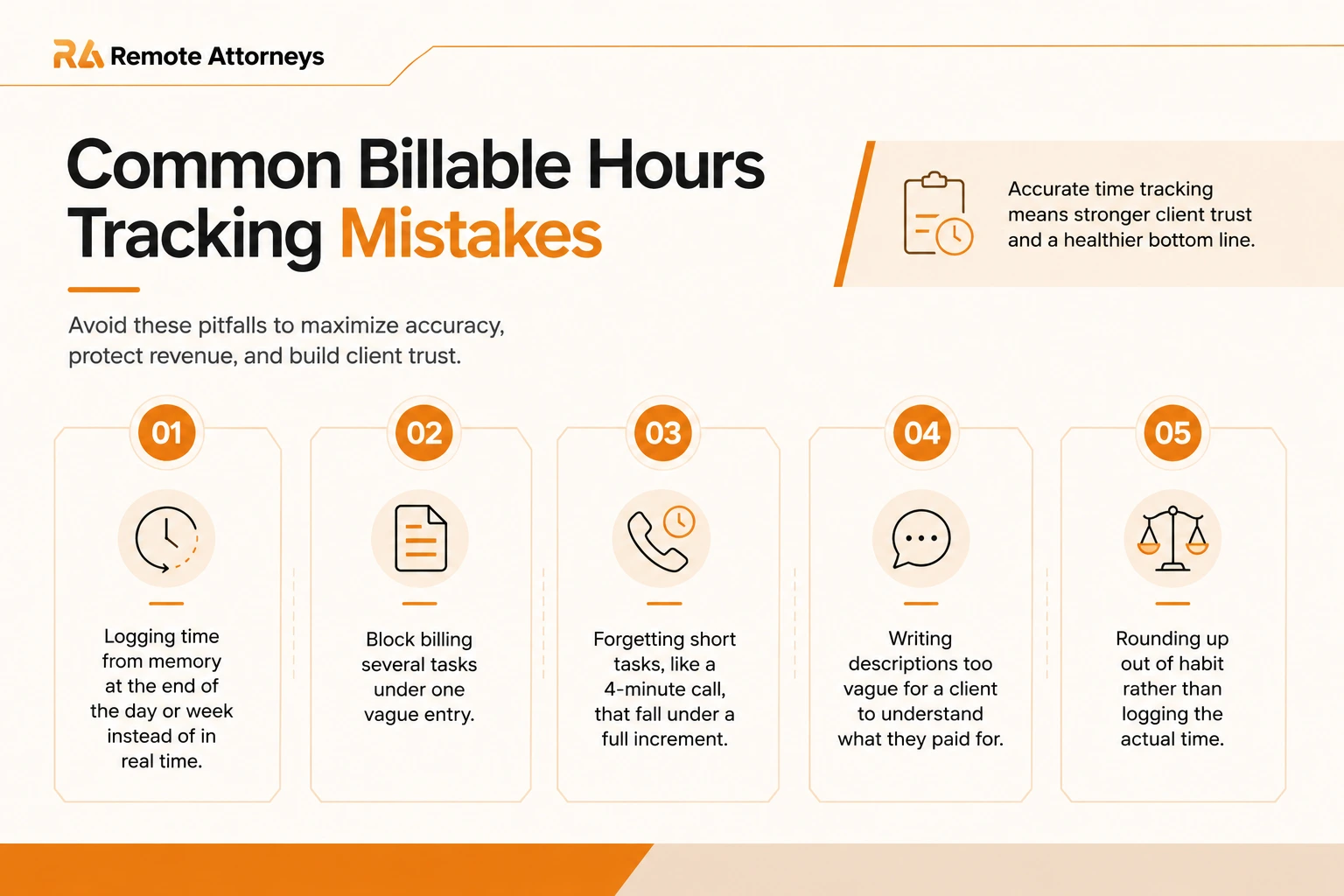
Common Billable Hours Tracking Mistakes
- Logging time from memory at the end of the day or week instead of in real time.
- Block billing several tasks under one vague entry.
- Forgetting short tasks, like a 4-minute call, that fall under a full increment.
- Writing descriptions too vague for a client to understand what they paid for.
- Rounding up out of habit rather than logging the actual time.
Billable Hours Best Practices
- Track time as the task happens, not from memory later.
- List each task separately instead of grouping them into one block.
- Use specific, client-readable descriptions for every entry.
- Set clear billing policies and rates with clients before work begins.
- Review time entries weekly to catch missing or vague logs early.
Alternative Billing Models
Not every matter fits an hourly chart. Flat fees work well for predictable matters like uncontested divorces or simple contracts. Contingency fees, common in personal injury cases, tie payment to case outcome instead of hours worked. Retainers give clients a set scope for a fixed monthly fee. Many firms blend models, using a flat fee with hourly billing for work that falls outside the agreed scope.
How to Track Billable Hours Without Losing Time to the Process
The real bottleneck usually is not the chart. Legal time-tracking and practice management software can automate parts of the process, such as running timers and mobile capture, but someone still has to enter, review, and reconcile that data. Many firms solve this by delegating repetitive legal tasks to remote support staff who log entries the same day, directly from call notes, calendars, and task lists.
A virtual freelance paralegal can handle time entry, invoice prep, and case file organization, so nothing gets lost by Friday. For firms that need licensed legal work handled remotely, virtual freelance lawyers can take on drafting and research tasks directly, freeing up in-house attorneys for higher-value billable work. Book a free consultation to see how the onboarding process works and whether remote support fits your firm.
Frequently Asked Questions
What is a billable hours chart?
It is a reference table that converts minutes worked into decimal billing increments, usually tenths of an hour, so time entries stay consistent and invoices are easy for clients to read.
How do lawyers bill in 6-minute increments?
Each 6-minute block equals 0.1 hour. A task's total minutes round to the nearest listed increment on the chart, then that decimal gets multiplied by the hourly rate to set the charge.
What is the difference between billable and non-billable hours?
Billable hours cover client-related work you can invoice directly. Non-billable hours cover admin, training, and marketing tasks that support the firm but can't be charged to any client.
Do all lawyers use the billable hour system?
No. Many attorneys use flat fees, contingency fees, or retainers instead. The choice usually depends on practice area, case type, and what clients expect to pay upfront.
Do billable hour expectations vary by practice area or firm size?
Yes. Large corporate firms often require more billable hours than solo practices, small firms, or public interest organizations, which may set lower or no targets at all.
Track Every Billable Hour With Confidence
A billable hours chart fixes the math. It will not fix inconsistent logging on its own. Firms that pair a clear increment chart with same-day time entry, itemized descriptions, and reliable staffing data recover more of the revenue they already earned. Start with the chart above, apply the best practices, and consider where delegating time-consuming administrative work could free up hours for the work that actually bills.