

Law firms weighing remote legal support usually land on the same fork: nearshore or offshore. Nearshore means hiring legal staff in a nearby country and time zone. Offshore means hiring in a distant country where labor costs are lowest.
Neither model is universally better. The right choice depends on how time sensitive your work is, how much attorney supervision a task needs, and what you can spend per hour. This guide breaks down the real differences so you can match the model to the task instead of guessing.
Key Takeaways
- Nearshore staff (Mexico, Colombia, Costa Rica) overlap 6 to 9 hours with U.S. business hours, making real time collaboration easy.
- Offshore staff (Philippines, India) cost less per hour but usually work with a 10 to 13 hour time gap.
- Attorneys must supervise any nonlawyer assistant under ABA Model Rule 5.3, regardless of where that person is located.
- Nearshore fits live case work and deadline driven tasks. Offshore fits repetitive, well scoped work like document review.
What Is Nearshore vs Offshore Legal Staffing?
Nearshore legal staffing means hiring paralegals, legal assistants, or attorneys in a country close to yours. For U.S. firms, that usually means Mexico, Colombia, Costa Rica, or Argentina. The appeal is shared or near shared business hours.
Offshore legal staffing means hiring in a distant country, most often the Philippines or India. The pitch is cost. Offshore rates run lower, and the talent pool for repetitive tasks is large. The tradeoff is a wide time zone gap that turns daily collaboration into a next-day relay.
Key Differences That Actually Matter
Time zone overlap.
A nearshore paralegal in Bogotá can join a 10am status call on your schedule. An offshore team in Manila is often asleep during your morning and awake during your evening, so questions wait until the next business day.
Cost per role.
Offshore is the cheaper option on paper. Nearshore costs more per hour but often costs less overall once you factor in fewer delays and less rework.
Language and communication.
English proficiency is strong in both regions at the professional level, but nuance matters more in legal work than in general customer support. Misread instructions on a filing deadline are expensive.
Compliance and supervision.
Every attorney remains responsible for the work product of any nonlawyer assistant, whether that person sits in Bogotá, Manila, or the office next door. The median paralegal salary in the U.S. is $61,010 a year, which is exactly why firms look nearshore and offshore in the first place. Lower cost never removes the supervision duty.
Data security and infrastructure.
Confidentiality agreements matter less without technical controls behind them. Look for encrypted file sharing, access logging, and clear data policies regardless of location. Geography alone says nothing about how well a provider protects client files.
Cultural fit and talent depth.
Nearshore regions share closer cultural and legal-system familiarity with U.S. practice, which shortens onboarding. Offshore markets often have deeper benches for narrow specialties. Travel is easier nearshore too, since flights to Mexico City or San José beat flights to Manila or Mumbai.
Which Legal Tasks Fit Each Model
Better suited to nearshore:
- Live client intake and screening calls
- Paralegal support tied to active litigation deadlines
- Same-day deposition summary turnaround
- Tasks that need frequent attorney check-ins
Better suited to offshore:
- Bulk document review with clear instructions
- Data entry and case file organization
- Transcription and non-urgent legal research
- Overnight processing of routine intake forms
For more on what a virtual paralegal can take off your plate, see our complete guide to virtual paralegal services.
The hourly rate is only part of the picture. Offshore providers made up more than 77% of the global legal process outsourcing market. But a cheaper hour that takes three extra days to complete is not actually cheaper. According to Clio's benchmark data, lawyers already capture only 3.0 billable hours in an average 8-hour workday, so added friction anywhere works against the firm's own numbers.
Nearshore Outsourcing Beyond Legal Staffing
The same nearshore vs offshore logic applies outside legal work. Nearshore outsourcing offers closer time zones and easier collaboration for a higher rate, the same tradeoff seen in nearshore software development or nearshore software development services for case management and e-discovery tools. If your firm outsources legal tech alongside legal staff, apply this same framework to both.
How to Choose Between Nearshore and Offshore
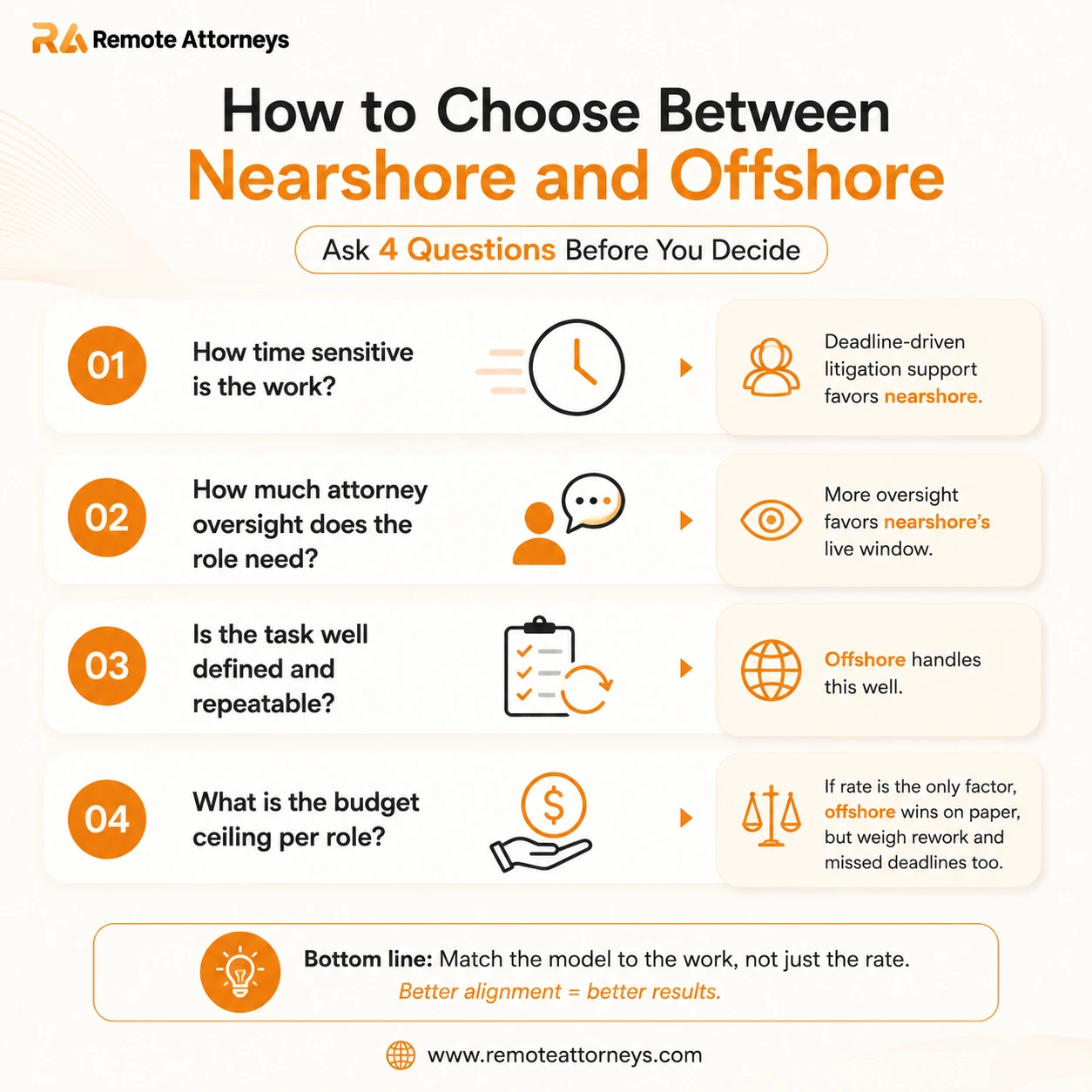
Ask four questions before deciding:
- How time sensitive is the work? Deadline-driven litigation support favors nearshore.
- How much attorney oversight does the role need? More oversight favors nearshore's live window.
- Is the task well defined and repeatable? Offshore handles this well.
- What is the budget ceiling per role? If rate is the only factor, offshore wins on paper, but weigh rework and missed deadlines too.
Most firms end up using both models for different roles rather than picking one exclusively. A firm might keep intake and litigation support nearshore while sending bulk document review offshore.
Why Firms Choose Remote Attorneys for Nearshore and Offshore Staffing
Comparing models is only half the decision. The other half is finding a provider that manages these tradeoffs for you. Remote Attorneys' legal staffing agency matches firms with pre-vetted talent across both models, trained on U.S. confidentiality standards and supervised in line with ABA Rule 5.3.
Need live case support? Our virtual paralegals and freelance attorneys integrate into your workflow within days. Need research or drafting instead? Our legal research and writing team handles that at scale, at a fraction of in-house cost.
FAQs
Is nearshore or offshore legal staffing cheaper? Offshore rates run lower, often $10 to $18 an hour, versus $18 to $28 nearshore. Nearshore frequently costs less overall once you count delays, rework, and missed deadlines.
Can offshore staff work on privileged legal documents? Yes, as long as the firm has signed confidentiality agreements and active attorney supervision under ABA Rule 5.3. Location alone never removes that supervision duty.
What is the time zone gap between nearshore and offshore staffing? Nearshore staff overlap roughly 6 to 9 hours with U.S. business hours. Offshore staff often overlap only 0 to 3 hours, which causes next-day handoffs on urgent tasks.
Do nearshore or offshore paralegals need attorney supervision? Yes. ABA Model Rule 5.3 requires an attorney to supervise every nonlawyer assistant's work, regardless of whether that person works nearshore, offshore, or in your office.
Which is better for a law firm, nearshore or offshore staffing? Nearshore suits time sensitive case work that needs live collaboration and quick check-ins. Offshore fits repetitive, well defined tasks where the lowest hourly rate matters most.
Nearshore vs Offshore Legal Staffing: The Bottom Line
Neither model wins outright. Nearshore earns its rate with real time collaboration and easier supervision. Offshore earns its rate with volume on repeatable work. The smartest firms match each task to the model built for it, and keep attorney oversight in place no matter where the work happens.