

Legal teams handle thousands of pages during discovery, and a single misplaced page can slow down an entire case. Bates numbering solves that problem by giving every page a unique, sequential identifier. Whether you are drafting an ESI protocol or training a new paralegal, a consistent numbering system keeps every document traceable from intake to trial.
This guide covers what Bates numbering is, how to Bates stamp documents, and the mistakes that trip up even experienced legal teams.
Key Takeaways
- Bates numbering assigns a unique, sequential number to every page in a legal document set, making pages easy to locate and cite.
- Consistent formatting, leading zeros, and clear prefixes prevent duplicate or missing Bates numbers during high-volume review.
- Tools like Adobe Acrobat and eDiscovery platforms automate Bates stamping, but a manual quality check is still necessary.
- Firms handling large caseloads often pair Bates numbering with outsourced document support to stay on schedule.
What Is Bates Numbering?
Bates numbering is a method of assigning a unique, sequential number to each page within a set of legal documents. The number usually sits in the bottom corner of the page, similar to a page number.
It can be a simple sequence like "0001" and "0002," or an alphanumeric code such as "SMITH_0001" that includes a case or party prefix. This practice is also called Bates stamping, a name that comes from its origin as a physical rubber stamp.
Law firms rely on Bates numbering during discovery, depositions, and trial preparation. Once a page carries a Bates number, anyone on the case, from a paralegal to a judge, can locate it in seconds.
A Brief History of the Bates Stamp
Inventor Edwin G. Bates patented an automatic numbering machine in the late 1800s. The original Bates numbering machine stamped a number onto a page, then advanced automatically to the next number with each press.
This turned a manual, error-prone task into a repeatable process for office workers. Physical stamps have mostly given way to digital tools, but the core idea, one unique number per page, has not changed in over a century.
Why Bates Numbering Still Matters in Document Management
Bates numbering keeps every page traceable across a case, no matter how many hands the file passes through. This matters more now than ever, since data volumes in litigation keep climbing every year.
The global eDiscovery market is projected to grow to roughly $20.74 billion in 2026, according to Fortune Business Insights. More electronic evidence means more pages to track, and more room for confusion without a consistent numbering system.
A clear Bates number also creates a shared reference point. Opposing counsel, the court, and your own team can all point to the exact same page without pulling up a full document or explaining a paragraph number.
This matters most during depositions and trial, when time spent searching for a page is time lost building your argument. Firms managing heavy caseloads often turn to outsourcing legal back-office work to keep numbering and document handling consistent across large productions.
Bates Numbering Best Practices
Good Bates numbering habits prevent confusion later in a case. Many standard ESI protocols require parties to agree on formatting rules in advance, as outlined by The Sedona Conference. Keep these practices in mind:
- Use one unique number per page. Never let two documents share the same Bates number.
- Keep numbers sequential. Skipping or reordering numbers breaks the chain of custody.
- Add leading zeros. This keeps digit counts consistent so systems sort pages correctly.
- Stay consistent in formatting. Same font, same placement, on every page.
- Batch number related documents. Group emails, attachments, or exhibits to save review time.
- Include native files. Original Word or PDF files still need their own Bates number.
- Run quality checks. Spot-check number ranges after each production to catch overlaps early.
Firms that fold Bates numbering into a broader intake process often rely on structured legal document preparation services to keep formatting consistent from the start.
How to Bates Stamp Documents
There are a few common ways to apply Bates numbers, depending on your document volume and available tools.
Bates Stamping a PDF in Adobe Acrobat
Adobe Acrobat's Bates numbering tool is the most common way to stamp a smaller batch of PDFs. Here is the basic process:
- Open the PDF in Adobe Acrobat.
- Go to Tools, then select Edit PDF.
- Choose More, then Bates Numbering, then Add.
- Set your prefix, number of digits, and starting number.
- Choose where the number should appear on the page.
- Apply the numbering across the full document set.
Bates Numbering in an eDiscovery Platform
Most eDiscovery platforms apply Bates numbers automatically during upload, review, or export. This removes manual stamping and reduces the risk of duplicate numbers across large productions. Teams can then search or pull documents by Bates range once numbering is complete.
Common Bates Numbering Mistakes to Avoid
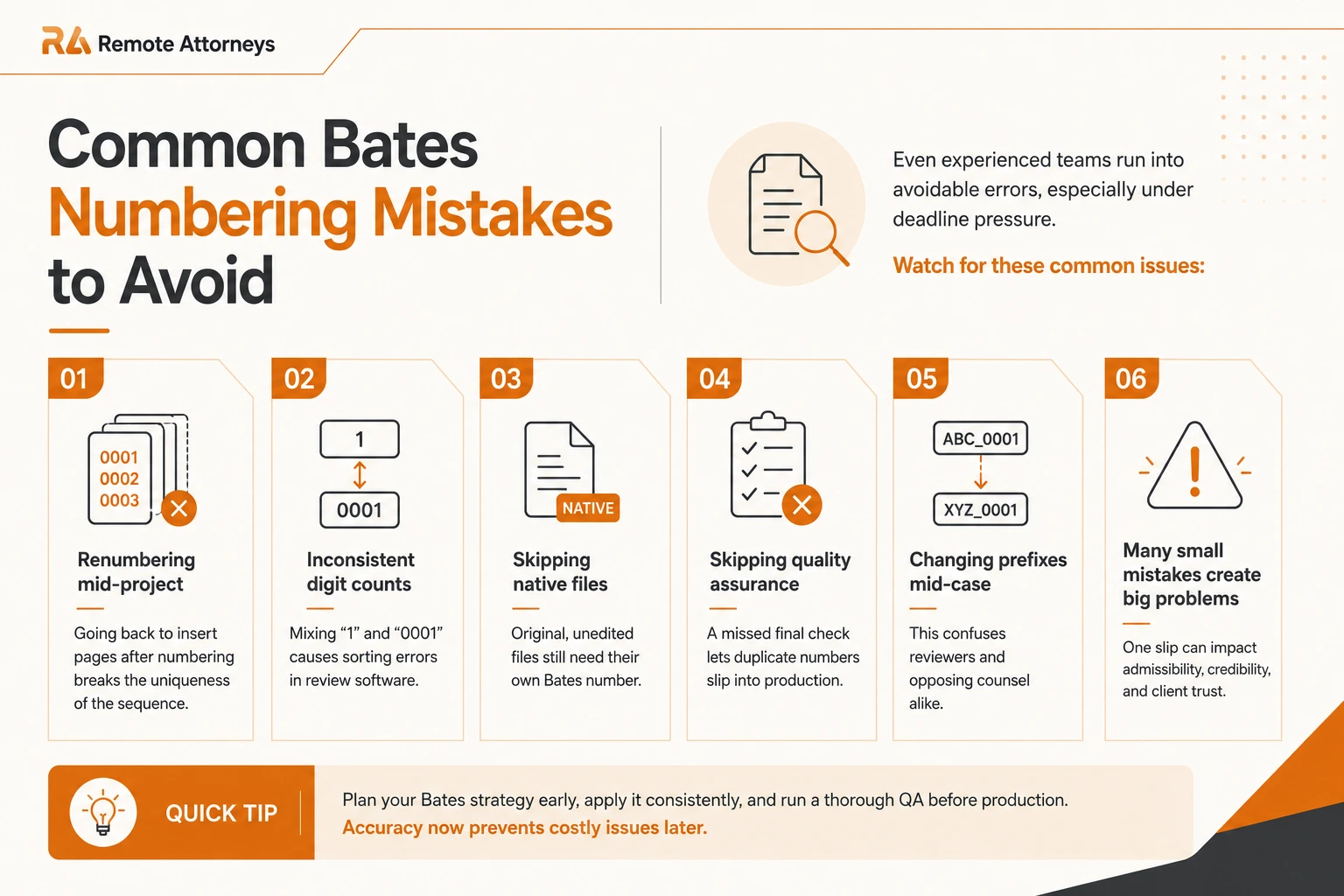
Even experienced teams run into avoidable errors, especially under deadline pressure. Watch for these common issues:
- Renumbering mid-project. Going back to insert pages after numbering breaks the uniqueness of the sequence.
- Inconsistent digit counts. Mixing "1" and "0001" causes sorting errors in review software.
- Skipping native files. Original, unedited files still need their own Bates number.
- Skipping quality assurance. A missed final check lets duplicate numbers slip into production.
- Changing prefixes mid-case. This confuses reviewers and opposing counsel alike.
Many firms assign this task to a virtual paralegal who can dedicate focused time to catching these errors before a document set goes out.
Who Handles Bates Numbering at a Law Firm?
Paralegals and legal assistants typically own Bates numbering day to day. In firms with heavy litigation caseloads, this task competes with drafting, filing, and client communication, so it often gets pushed to the last minute.
That crunch is where Remote Attorneys fits in. Our paralegal staffing agency connects your firm with trained legal professionals who handle Bates numbering, indexing, and document prep as part of their daily workload, not as an afterthought before production.
You keep your in-house team focused on strategy and client work, while a dedicated remote paralegal or document review specialist handles the formatting, quality checks, and audits that keep a large document set defensible. Firms typically onboard support within days, with month-to-month flexibility so staffing scales up or down with caseload. Explore our full range of remote legal support services to see how it fits your next production.
Frequently Asked Questions
What is Bates numbering in a PDF?
In a PDF, Bates numbering stamps a unique sequential number onto each page, usually in a corner, so reviewers can locate, cite, and reference an exact page quickly during a case.
What is a Bates stamp legal?
A Bates stamp is the unique identifier placed on a legal document page, allowing attorneys, courts, and opposing counsel to reference an exact page consistently.
What is a Bates number?
A Bates number is the sequential code, often paired with a case prefix, assigned to a single page so it can be tracked, searched, and cited throughout a case or trial.
What is a Bates stamp example?
A typical Bates stamp example looks like "SMITH_000123," combining a case prefix with a zero-padded sequential number for fast identification and easy retrieval.
How do you Bates stamp legal documents?
Most teams Bates stamp legal documents using Adobe Acrobat or an eDiscovery platform, which apply prefixes and sequential numbers automatically across a batch.
Building a Bates Numbering Process That Actually Scales
Bates numbering looks simple on the surface, but consistency is what makes it useful. A clear format, disciplined quality checks, and the right tool for your document volume will keep any case organized from intake through trial.
The firms that manage this well usually treat Bates numbering as a standard step in every matter, not an afterthought handled the night before production. If your team is buried in document prep during a high-volume matter, Remote Attorneys can connect you with document review and paralegal support built to keep pace with your caseload.