

Family law is one of the most competitive practice areas to market. Potential clients are not just comparing credentials. They are searching for someone they can trust during one of the hardest moments of their lives, and they are making that decision online.
Family law digital marketing has shifted. Clients now research attorneys through search engines, read reviews, watch videos, and check social profiles before they ever call. Firms that show up consistently across those channels win the case before the first consultation.
Whether you run a solo practice or manage a mid-size firm, this guide walks through 12 practical marketing strategies for attorneys that work in 2026 and beyond. From local SEO and Google ads to content, reviews, and referral networks, each strategy is built around one goal: getting more of the right clients through your door.
Key Takeaways
- Most family law clients search online before contacting any attorney, making digital visibility non-negotiable.
- Local SEO and Google Business Profile optimization are the highest-ROI starting points for most firms.
- Trust signals like reviews, video content, and educational blogs convert more visitors than promotional ads alone.
- Tracking results monthly is how you stop wasting budget and double down on what works.
What Is Family Law Marketing?
Family law marketing covers everything a firm does to get in front of people dealing with divorce, child custody, adoption, domestic violence, and related matters, and to convince them to call your firm instead of a competitor's.
It differs from general legal marketing in one important way: your clients are not shopping for a commodity. They are going through one of the hardest periods of their lives. That means marketing for attorneys in this space has to lead with empathy, clarity, and trust rather than hard sells or legal jargon.
Done right, family law marketing builds a pipeline of qualified leads who already trust you before they ever pick up the phone.
Why Referrals Alone Are Not Enough
Referrals still matter. A recommendation from a trusted friend carries real weight. But referrals are unpredictable, slow to scale, and entirely outside your control.
The majority of people searching for a family law attorney start online. They search, read, compare, and decide, often before they contact anyone. Firms that are not visible during that process simply do not exist to those potential clients.
Digital marketing for family law firms fills the gap that referrals leave. It keeps your firm in front of the right people, at the right moment, consistently.
12 Family Law Marketing Strategies to Get Clients
1. Build a Website That Converts Visitors into Consultations
Your website is either working for you 24/7 or sending visitors to a competitor. Most law firm websites fall into the second category because they were built to impress rather than to convert.
A high-performing family law website needs three things: fast load speed, mobile-friendly design, and a clear call to action above the fold. Visitors should know within five seconds that your firm handles their situation and how to reach you.
Quick check: Run your site through Google PageSpeed Insights. A score below 70 is actively costing you clients.
2. Claim and Optimize Your Google Business Profile
This is the single fastest move most family law firms can make. A well-optimized Google Business Profile puts your firm directly in front of people searching for attorneys in your area, often before they ever reach your website.
Fill out every field: firm name, address, phone number, practice areas, hours, and photos. Post updates regularly. Respond to every review, good or bad. Ignored negative reviews signal to potential clients that your firm is not responsive.
If you have claimed your profile but have not updated it in months, start here before anything else.
3. Prioritize Local SEO
Local searches drive a significant share of family law leads. People searching "divorce attorney near me" or "child custody lawyer in [city]" are ready to hire. You need to be in the results they see.
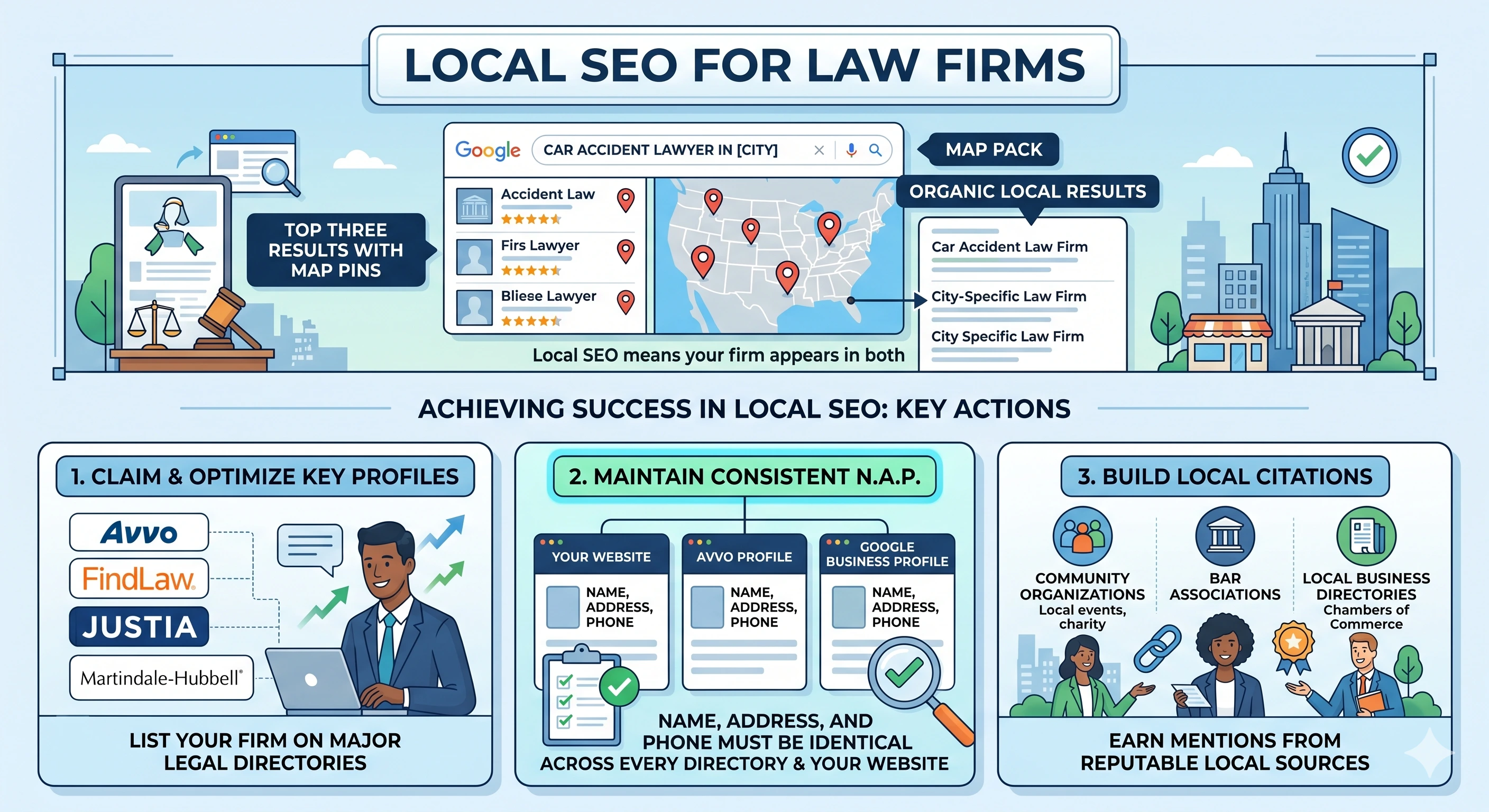
Local SEO means your firm appears in the Map Pack, the top three results with a map pin, and in organic results for city-specific searches. Key actions:
- List your firm on Avvo, FindLaw, Justia, and Martindale-Hubbell.
- Keep your Name, Address, and Phone (NAP) identical across every directory and your website.
- Earn local citations from community organizations, bar associations, and local business directories.
Quick check: Search your top keyword plus your city right now. If you are not in the top three map results, that is your gap.
4. Publish Content That Answers Real Questions
Content marketing does two things for family law firms: it brings people searching for answers to your website, and it shows those visitors you understand their situation before they ever talk to you.
The best content skips legal terminology and writes the way a worried parent or someone facing divorce actually thinks. Topics that work well include:
- "What to Expect During a Divorce in [State]"
- "How Is Child Custody Decided?"
- "5 Things to Know Before Filing for Legal Separation"
Publishing consistently, even once a month, builds authority over time. Search engines reward sites that regularly add helpful, relevant content. Readers do too.
5. Use Google Local Services Ads for Immediate Visibility
Google Local Services Ads (LSAs) appear above standard paid ads and above organic results. They come with a "Google Screened" badge, which signals credibility before a potential client clicks anything.
Unlike pay-per-click ads where you pay for every visitor, LSAs charge you per lead. You pay when someone actually contacts your firm, not just when they see your listing.
LSAs work especially well for firms that need leads quickly while longer-term strategies like SEO build in the background.
6. Run Targeted Google PPC Campaigns
Pay-per-click advertising targets people who are actively searching for an attorney right now. These are high-intent leads, people who know they need help and are looking for someone to call.
Legal keywords can be competitive and costly in major markets. The way to control costs is to:
- Target tightly focused geographic areas rather than broad regions.
- Focus on long-tail keywords like "emergency child custody lawyer [city]" rather than generic terms.
- Send every ad to a dedicated landing page, not your homepage, with one clear call to action.
Track cost per lead, not just clicks. That number tells you whether the campaign is actually working.
7. Build a Systematic Review Generation Process
Potential clients read reviews before they call. Family law prospects go further than most: they read comments looking for words like "compassionate," "responsive," and "respectful." They are not just counting stars. They are looking for proof that you understand what they are going through.
The best time to ask for a review is two to three weeks after a case closes, when the outcome is fresh but the emotional intensity has settled. Make it easy by sending a direct link to your Google Business Profile review page.
Respond to every review publicly. For negative ones, acknowledge the concern without disclosing any confidential information and offer to discuss the matter privately.
8. Use Social Media to Stay Visible and Build Trust
Social media for family law firms is not about going viral. It is about being findable and familiar when someone who needs you looks you up.
According to the American Bar Association, 35% of law firms that use social media have been retained by a client as a result. That is a strong indicator of how social platforms can support real business growth for family law firms.
Platform quick guide:
Post content that helps: answers to common questions, short process explainers, and client testimonials where your jurisdiction permits. Avoid broadcasting achievements. Clients are looking for a guide, not a trophy case.
9. Invest in Short-Form Video Content
A two-minute video of an attorney explaining what to expect at a custody hearing builds more trust than three paragraphs of text. People watching that video see your face, hear your tone, and decide whether they trust you before ever speaking to you.
You do not need a production crew. A well-lit, clearly spoken video recorded on your phone can outperform expensive produced content. What matters is that it is helpful and genuine.
Upload to YouTube first, then repurpose clips to Instagram Reels, Facebook, and your website FAQ pages. Good starting topics:
- "What Happens at a First Divorce Consultation?"
- "3 Common Mistakes in Child Custody Cases"
- "How Long Does a Divorce Actually Take in [State]?"
10. Get Listed on Legal Directories
Legal directories like Avvo, FindLaw, Justia, and Martindale-Hubbell are where people look when they want a vetted attorney. A complete profile with reviews, practice areas, and a photo increases the chance someone contacts you.
You do not need to be on every platform. Prioritize directories that show up in search results for your geographic area and practice area. Free listings should always be claimed and completed. Paid ones are worth evaluating based on the leads they actually send.
Quick check: Search your name on Avvo right now. If your profile is unclaimed or incomplete, that is a gap you can fix in 20 minutes.
11. Build a Referral Network That Goes Beyond Past Clients
Referrals from past clients matter, but you can grow this channel intentionally. Therapists, financial advisors, mediators, CPAs, and school counselors all regularly work with people going through family legal issues.
Building these relationships takes time but pays consistently. Start with a few connections in complementary fields, stay in touch, and offer to send referrals their way too. A quarterly email with a useful legal update keeps your name in front of your referral network without being intrusive.
Family law clients referred by a trusted professional convert at a much higher rate than cold search leads. They arrive already warmed up.
12. Track What Is Working Every Month
If you do not know which channel is sending clients to your firm, you are managing your marketing budget by gut feeling. That is an expensive way to operate.
Set up Google Analytics 4 and Google Search Console on your website. Connect your Google Business Profile to track how people find and contact you. For paid ads, watch cost per lead, not just impressions or clicks.
Thirty minutes reviewing these numbers each month is enough to catch what is working and stop spending on what is not.
How to Prioritize These Strategies by Budget
No firm needs all 12 strategies running at once. Start with the channels that give you the most return relative to your budget, then expand from there.
The firms that grow consistently pick three or four of these well and build from a solid foundation rather than spreading thin across every channel at once.
Common Family Law Marketing Mistakes to Avoid
Even well-intentioned marketing efforts can stall when these mistakes are in play:
- Running ads without a dedicated landing page, paying for clicks that go nowhere
- Not having a system to collect reviews, leaving the most powerful trust signal untapped
- Writing content for search engines instead of real people, heavy on keywords and light on clarity
- Starting strong for two months and then going quiet, inconsistency kills momentum
- Not tracking where leads come from, you cannot improve what you do not measure
When More Clients Means You Need More Capacity
Growing your client base is only half the equation. The other half is having the capacity to serve those clients without burning out your existing team.
Many family law firms find that after improving their marketing, attorneys are stretched too thin handling intake, research, and document drafting that increased caseloads bring. One option worth exploring is working with remote legal professionals who can handle support tasks directly within your workflow.
Remote Attorneys connects family law firms with vetted legal staff, including freelance lawyers and paralegals, who integrate into your existing processes. Firms use this model to handle more cases without adding full-time overhead.
If you are curious how other family law practices have approached this, this post on why family lawyers are delegating to remote attorneys is a good starting point.
Frequently Asked Questions
How much should a family law firm budget for marketing? Most small to mid-size family law firms allocate 5 to 10% of gross revenue. Start with the highest-ROI basics like Google Business Profile and reviews before expanding into paid ads.
What is the fastest way to get new family law clients? Google Local Services Ads and a fully optimized Google Business Profile with strong reviews produce results fastest. These channels reach people already searching for an attorney right now.
Do family law firms need a marketing agency? Not at the start. Many core tactics like GBP optimization and review requests can be done in-house. As the firm grows, a legal-focused agency can save time and improve results on paid campaigns.
What makes family law marketing different from other legal marketing? Your clients are often in crisis. Marketing that feels cold or promotional repels them. Empathetic, clear, client-first messaging converts far better than hard-sell tactics in this practice area.
How long does it take for SEO to generate leads for a family law firm? Most family law firms see measurable organic traffic growth within three to six months of consistent SEO work. Paid ads like LSAs can generate leads within days of launching.
Start Turning Your Marketing Into a Client Pipeline
Good family law marketing is not about doing everything at once. It is about showing up consistently where your future clients are looking, speaking to what they actually need, and making it easy for them to choose you.
Start with your Google Business Profile, get your review system in place, and build from there. The firms that grow steadily are the ones that treat marketing as a system, not a one-time project.
And when those new clients start coming in, make sure your team has the capacity to serve them well.