

Subpoena work looks simple on paper. Draft it, serve it, track the response, move on. In practice, it is one of the most consistent sources of untracked cost in active litigation.
At associate billing rates between $300 and $450 per hour, the administrative side of a single subpoena can cost your firm $900 to $2,100 before any legal judgment is applied. Most firms absorb that quietly, case after case.
This post breaks down the real cost of subpoena bottlenecks, how flat fee and hourly billing each apply, and what a more efficient workflow looks like for litigation teams managing high volume.
Key Takeaways
- U.S. subpoena volumes reached nearly 500,000 in 2025, a 51% jump from pre-pandemic levels, according to Wolters Kluwer data.
- Routine subpoena tasks billed at hourly rates of $300 to $450 per hour can cost $900 to $2,100+ per subpoena before any legal strategy is applied.
- Flat fee billing works best for defined, repeatable subpoena tasks. Hourly billing fits better when scope is genuinely unpredictable.
- Remote litigation support can handle end-to-end subpoena workflows, often at a fraction of in-house costs, without long-term overhead.
What Is a Subpoena?
A subpoena is a legally binding court order compelling a person to testify or produce documents at a specified time and place. Failure to comply can result in civil or criminal contempt of court, including fines or imprisonment in serious cases.
Courts, government agencies, and attorneys can issue subpoenas. They must be formally served, and the scope of the request must be relevant to the case without being excessively broad or seeking legally protected information.
Key Procedural Facts
- Service: Subpoenas must be formally served in person by someone at least 18 years old who is not a party to the case. Federal cases often involve a U.S. Marshal.
- Scope: Requests must be relevant to the case and cannot seek privileged information or be unreasonably broad.
- Challenging a Subpoena: Recipients can file a motion to quash or modify a subpoena if it is overly broad, seeks protected information, or creates undue burden.
- Compliance Consequences: Ignoring a subpoena can lead to immediate contempt charges, fines, or in extreme cases, imprisonment. (Cornell Law)
What to Do If Your Client Receives One
- Do not ignore it. Contempt charges can follow immediately.
- Read it carefully. Note the response deadline, the type of subpoena, and the specific materials requested.
- Preserve related documents immediately.
- Review with counsel to determine whether the subpoena is valid or whether grounds exist to challenge it.
Why Subpoenas Create a Workflow Bottleneck
U.S. subpoena volumes hit nearly 500,000 in 2025, a 51% increase from pre-pandemic levels. Insurance-related subpoenas alone rose 65% between 2019 and 2025. These numbers are still climbing.
For litigation teams, the volume problem compounds quickly. Each subpoena touches multiple people: an attorney reviews it, a paralegal drafts or processes it, someone tracks the response deadline, and someone follows up when the other side is slow to comply.
In a high-volume practice handling personal injury, workers' compensation, or multi-party matters, a single case can generate dozens of subpoenas. That is dozens of manual touch points, each billing at hourly rates.
Flat Fee vs. Hourly Billing for Subpoena Work
Whether flat fee or hourly billing makes more sense depends on one factor: how predictable the work actually is.
Firms are billing 34% more cases on a flat fee basis compared to 2016, signaling a clear shift in how litigation teams are thinking about routine work. Clients want cost certainty. Billing disputes slow cash flow. And hourly billing on predictable tasks penalizes efficiency rather than rewarding it.
When Hourly Billing Makes Sense
- Complex subpoenas requiring privilege review or legal assessment
- Federal cases with evolving scope under FRCP Rule 45
- Subpoenas tied to contested depositions or third-party disputes
- Cases where scope cannot be defined in advance
When Flat Fee Billing Makes Sense
- High-volume, routine subpoena duces tecum processing
- Drafting and serving standard subpoenas ad testificandum for deposition prep
- SDT (Subpoena Duces Tecum) tracking and compliance follow-up
- Firms with recurring case types such as personal injury, workers' compensation, or medical malpractice
For most litigation teams, the practical answer is a hybrid model. Flat fees for defined, repeatable subpoena tasks. Hourly billing for anything requiring attorney judgment on scope, privilege, or challenge strategy.
Phased flat fees work well here. Firms can assign a fixed price per litigation stage, giving clients predictability without forcing the firm to absorb unpredictable complexity. This is a structure that experienced litigation attorneys increasingly recommend for managing client relationships without sacrificing profitability.
Our team at Remote Attorneys works with firms to set up transparent legal billing structures and litigation support workflows that fit the specific volume and pace of their practice.
The Hidden Cost Your Billing Model Is Not Capturing
The real cost of subpoena bottlenecks is not just the hours billed. It is the senior attorney time pulled away from work that actually moves cases forward.
When associates or partners spend time on subpoena logistics, that time is not going toward strategy, client communication, or trial preparation. Hourly billing on routine subpoena work masks this inefficiency. The client pays, but the firm loses productive capacity.
According to a 2022 Wolters Kluwer survey, 81% of legal departments planned to increase their use of legal outsourcing. The primary driver was reclaiming capacity, not just cutting costs.
There is also a compliance dimension that is easy to overlook. Responding to a Rule 45 subpoena takes time and money. In federal litigation, the general rule is that the party responding to the subpoena pays the costs associated with compliance. A court may shift those costs only when they are "significant" under FRCP Rule 45(d)(2)(B)(ii). One documented case resulted in a $9,100 fee award for 28 hours of attorney work on document review and privilege log production alone.
When those hours sit inside your firm untracked, unpriced, and absorbed as overhead, the financial picture becomes difficult to manage.
How Remote Litigation Support Helps Teams Manage Subpoena Volume
Remote litigation support attorneys handle the end-to-end subpoena workflow without requiring full-time overhead. They draft, serve, track, and follow up on subpoenas, and can flag compliance issues within 24 to 36 hours.
Firms handling personal injury, workers' compensation, or multi-party litigation remove a significant daily bottleneck by delegating this work to experienced remote professionals. The billing model matters here too. Remote legal support is often available on flat fee or defined-scope arrangements, which gives firms the cost predictability they lose with hourly billing on routine tasks.
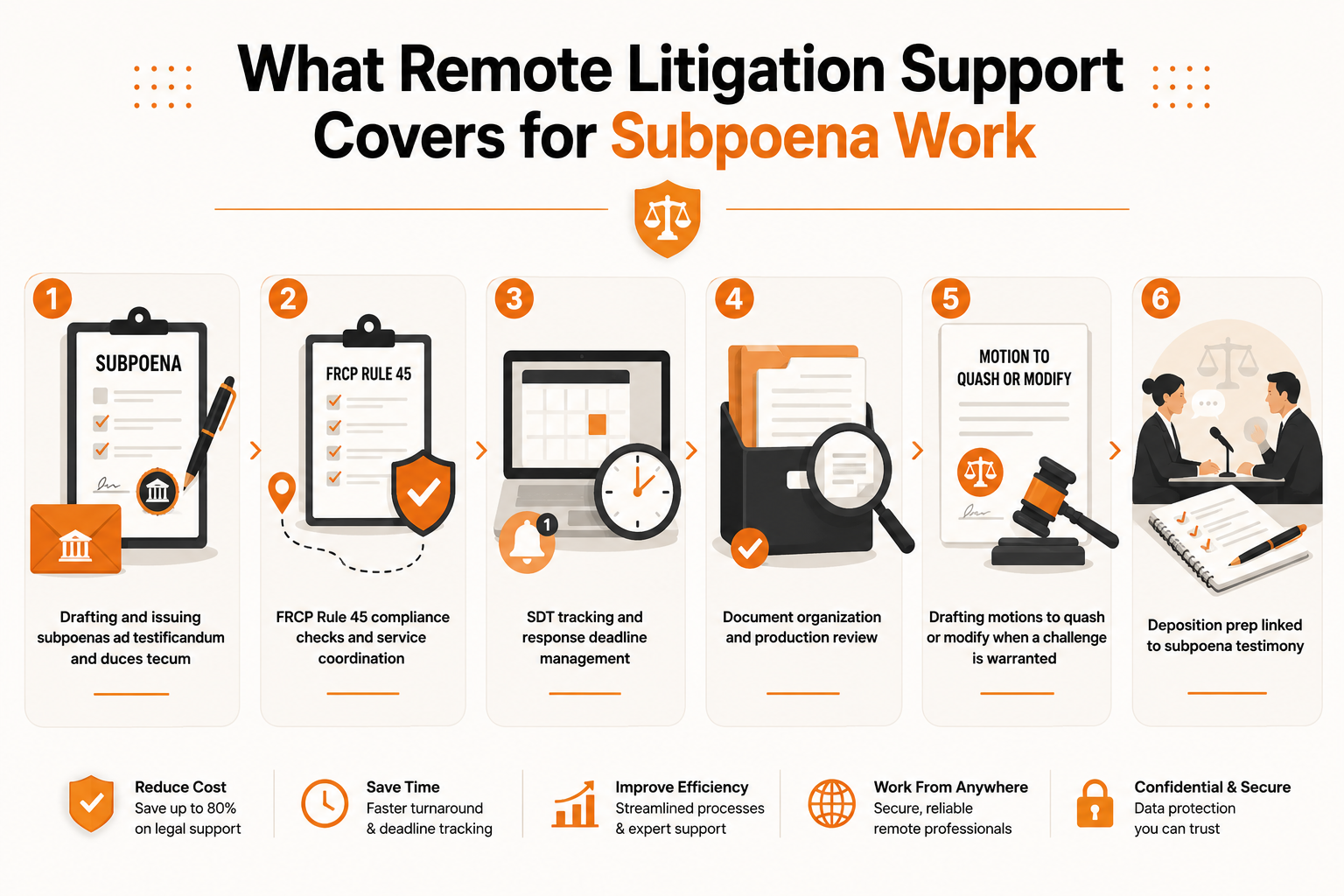
What Remote Litigation Support Covers for Subpoena Work
- Drafting and issuing subpoenas ad testificandum and duces tecum
- FRCP Rule 45 compliance checks and service coordination
- SDT tracking and response deadline management
- Document organization and production review
- Drafting motions to quash or modify when a challenge is warranted
- Deposition prep linked to subpoena testimony
Firms that have moved subpoena management to remote support consistently report fewer missed deadlines and more senior attorney time available for case strategy.
Learn how remote attorneys improve law firm productivity across litigation workflows, including subpoena management, document review, and deposition prep.
If you are evaluating whether to bring on in-house staff or work with a remote team, the comparison between hiring in-house versus a remote attorney goes beyond hourly rates. It includes onboarding time, overhead, and the ability to scale quickly when case volume spikes.
What Law Firm Managers Should Ask Before Changing Their Billing Model
Before adjusting how your firm bills for subpoena work, run these four questions past your litigation team.
- How repeatable is this task? If your firm handles the same type of subpoena across multiple cases, flat fee pricing is almost always more efficient.
- Who is doing the work? Associate or paralegal-level work billed at high hourly rates is where firms most often lose client trust and create invoice disputes.
- What does your client expect? Clients in commercial and personal injury litigation increasingly expect billing predictability. Flat fee phases reduce disputes and improve retention.
- Can you scope it? If you can define the deliverable, such as "draft and serve subpoena duces tecum for deposition," you can price it as a flat fee.
Firms that answer yes to most of these questions are good candidates for hybrid billing structures. Those with highly complex or jurisdiction-specific subpoena work may find that hourly billing remains more appropriate for certain tasks.
Frequently Asked Questions
What is a subpoena in litigation?
A subpoena is a court-issued legal order requiring a person to testify (subpoena ad testificandum) or produce documents (subpoena duces tecum). Non-compliance can result in contempt of court charges, fines, or imprisonment.
What happens if a subpoena is ignored?
Ignoring a subpoena can lead to an immediate contempt of court finding. Penalties range from financial sanctions to imprisonment in the most serious cases. Recipients should never disregard a subpoena without first consulting an attorney.
What is a motion to quash a subpoena?
A motion to quash is a formal legal request asking the court to cancel or limit a subpoena. It is typically filed when the request is overly broad, seeks privileged information, or imposes unreasonable burden on the recipient.
Is flat fee billing better than hourly for routine litigation tasks?
For predictable, repeatable work like standard subpoena drafting and compliance tracking, flat fee billing is more transparent and often more profitable for the firm. Hourly billing stays appropriate where scope cannot be defined upfront.
Can subpoena management be outsourced to remote attorneys?
Yes. Remote litigation support professionals regularly handle subpoena drafting, service coordination, SDT tracking, and document review. Many work on flat fee or defined-scope arrangements that reduce cost and free up in-house capacity.
Take Control of Your Litigation Workflow
Subpoena bottlenecks are not an unavoidable part of litigation. They are workflow gaps with a direct cost, and that cost compounds across every active case on your docket.
If your team is spending senior attorney hours on routine subpoena tasks, the billing model is worth reviewing. So is the question of who is doing the work.
Remote Attorneys works with litigation teams across the country on flat fee and defined-scope support. Book a free consultation to see how it applies to your current caseload.
You can also explore the Remote Attorneys to see how time tracking, task management, and billing oversight work together when you bring on remote