

An express contract is a legally binding agreement where every term is stated outright, either in writing or verbally, at the time the deal is made. Both sides know exactly what they agreed to, what they owe each other, and what happens if someone doesn't deliver.
For law firms working with remote attorneys or outsourced legal support, this is the contract type you will use every time. Getting those terms right before work begins is far less costly than trying to resolve a dispute after.
This guide covers what an express contract is, how it compares to other contract types, and what law firms must include when outsourcing legal work.
Key Takeaways
- An express contract requires a clear offer, acceptance, consideration, and mutual intent to be bound.
- It can be oral or written, but written is the only safe format for legal outsourcing arrangements.
- Express contracts are easier to enforce than implied contracts because the evidence is already on the page.
- Law firms that skip key clauses like scope of work, IP ownership, or governing law create disputes that cost more to fix than to prevent.
What Is an Express Contract in Business Law?
An express contract is an agreement where both parties state their terms clearly and agree to be bound by them. Nothing is assumed. Nothing is inferred from behavior. The terms are said out loud or put in writing, and both parties understand those terms create legal obligations.
Cornell Law School's Legal Information Institute defines it as a contract formed by language, oral or written, that clearly demonstrates the parties' intent to be bound.
In business law, express contracts show up in nearly every transaction: employment agreements, vendor deals, service retainers, software licenses, and real estate leases. They are the default contract form because courts can enforce them without guessing what either side intended.
For law firms specifically, every contract drafting and review engagement, remote attorney agreement, or outsourced paralegal arrangement should be an express contract in writing.
An implied-in-fact contract arises from the parties' behavior. If a freelance attorney has been reviewing documents for six months without a written agreement, a court may find an implied contract exists based on that history. That may or may not reflect what either side actually intended.
An implied-in-law contract is different again. Courts sometimes impose one to prevent unjust enrichment, even when no real agreement existed. Neither type gives a law firm the clarity or protection that a written express contract provides.
When outsourcing legal work, relying on implied agreements creates risk around scope, pay, deliverables, and confidentiality.
The 4 Required Elements of a Valid Express Contract
For an express contract to hold up, it must contain four elements. If any one of them is missing, the contract may be unenforceable.
1. Offer
One party proposes specific terms: what they will do, by when, and what they want in return. An offer is the foundation of the agreement.
2. Acceptance
The other party agrees to those exact terms. Any change to the offer creates a counter-offer, not acceptance. The agreement is not formed until both sides are aligned on the same terms.
3. Consideration
Each side exchanges something of value. In legal outsourcing, that is typically work performed in exchange for payment. Consideration does not have to be money. It can be a promise to act or refrain from acting.
4. Mutual Intent (Meeting of the Minds)
Both parties understand they are entering a binding agreement. No confusion, no misrepresentation, no pressure. If one party signed without understanding what they were agreeing to, the contract may be void.
Two additional requirements also apply. The parties must have legal capacity (adults of sound mind), and the contract's subject matter must be lawful. A contract to perform illegal services is unenforceable regardless of how clearly it is written.

What Are the 4 Types of Contracts?
Understanding where express contracts fit among the four main contract types helps law firm managers make better decisions when structuring legal support arrangements.
1. Express Contract All terms are stated openly, verbally or in writing. This is the most common contract type in business and the one courts prefer.
2. Implied Contract Terms are inferred from behavior or circumstances, not stated. Valid but harder to enforce. Appropriate for informal, low-stakes interactions.
3. Unilateral Contract One party makes a promise in exchange for the other party's performance, not a promise in return. A reward offer is a classic example.
4. Bilateral Contract Both parties exchange promises. Most business contracts and legal outsourcing agreements fall into this category. Both sides commit to specific obligations.
Most legal outsourcing agreements are bilateral express contracts. The firm promises payment. The remote attorney or LPO provider promises delivery. Both sides are bound by written terms.
Express Contract Examples in Legal Outsourcing
These are four real-world scenarios that law firm managers encounter when outsourcing legal work.
Remote Attorney Services Agreement A law firm signs a written agreement with a remote attorney to handle contract review 20 hours per week at a flat hourly rate. The agreement covers scope, billing cycle, confidentiality obligations, and termination notice.
Legal Research Retainer A solo practitioner retains a freelance attorney for per-project research memos. The express contract specifies turnaround time, citation format, revision policy, and flat-fee pricing per project.
Outsourced Intake and Document Drafting A mid-size firm outsources initial client intake and document drafting. The written contract defines which matter types are in scope, quality standards, and the process for returning work.
High-Volume Contract Review with an LPO Provider A corporate legal department brings on an LPO firm for large-scale document review. The agreement covers SLA benchmarks, data security protocols, IP ownership, and escalation procedures for disputed calls.
Verbal express contracts are technically valid. According to the American Bar Association, oral agreements can satisfy basic contract requirements. In legal outsourcing, however, oral agreements create avoidable exposure around confidentiality, scope, and deliverables.
Implied Authority and Express Contracts: What Law Firms Miss
Even when a contract is express, agents acting on behalf of the firm may have implied authority to make commitments that bind the firm, even if those commitments were never written down.
Implied authority is the authority that naturally follows from a person's role. A remote attorney who has been authorized to correspond with clients may have implied authority to make representations on the firm's behalf, even if the express contract says nothing about it.
For law firm managers, this matters in two ways.
First, it means the written contract must define the scope of authority explicitly. If a remote attorney is not authorized to negotiate on the firm's behalf, say so in the agreement.
Second, it means you cannot rely on job title or past behavior to set the limits of what someone can do. Those limits must be written into the contract.
This is one of the most overlooked clauses in legal outsourcing agreements, and one of the most commonly disputed.
Read more about structuring these arrangements in our guide to outsourced legal back-office work.
Common Drafting Mistakes Law Firms Make
These four gaps appear repeatedly in outsourcing agreements and create the most disputes.
Vague scope of work "Legal support as needed" is not a deliverable. Define the task type, volume, format, and expected turnaround. If it is not written, it will be interpreted differently by both sides.
Missing IP and work-product clause Who owns the research memo? Who owns the drafted brief? If the contract is silent, ownership is disputed. According to the USPTO, work-for-hire assignments must be explicit to transfer ownership in written works. State it outright.
No termination or notice clause Firms assume they can end an outsourcing arrangement at will. Without an express term for notice or wind-down, both parties are exposed to claims for abrupt termination.
Skipping governing law Remote and cross-state arrangements need a clause specifying which state's law governs the contract. This matters especially when using attorneys trained under a different jurisdiction's framework
How to Write a Strong Express Contract for Legal Outsourcing
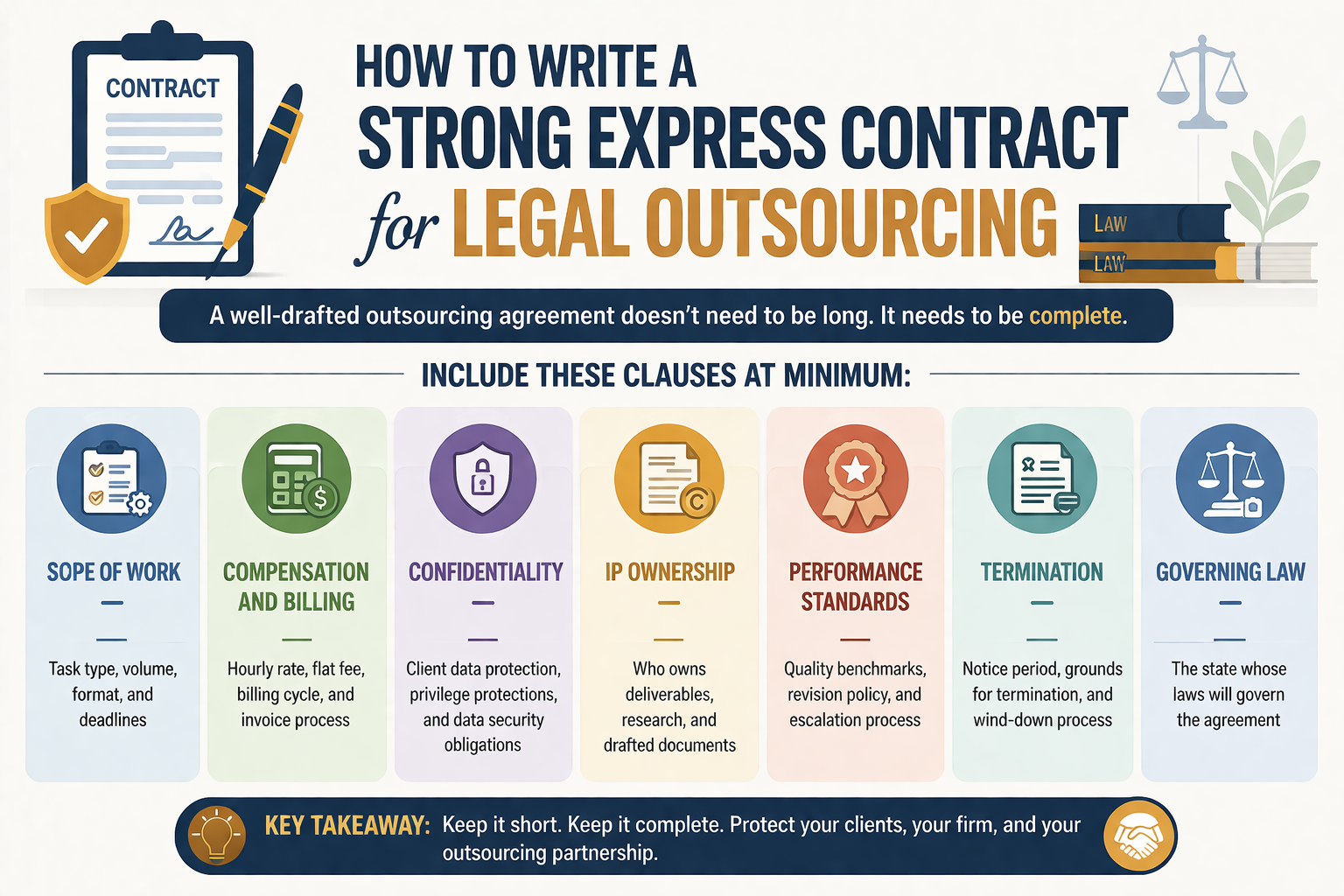
A well-drafted outsourcing agreement does not need to be long. It needs to be complete.
Include these clauses at minimum:
- Scope of work: Task type, volume, format, and deadlines
- Compensation and billing: Hourly rate, flat fee, billing cycle, and invoice process
- Confidentiality: Client data protection, privilege protections, and data security obligations
- IP ownership: Who owns deliverables, research, and drafted documents
- Performance standards: Quality benchmarks, revision policy, and escalation process
- Termination: Notice period, grounds for termination, and wind-down process
- Governing law: The state whose laws will govern the agreement
ABA Formal Opinion 00-420, listed in the ABA Ethics Opinions Index, addresses fee arrangements for outsourced legal work. It confirms that firms may bill outsourced legal services at market rates, provided the total fee remains reasonable under Model Rule 1.5(a). A written express contract makes it possible to document and defend that fee structure.
How Remote Attorneys Can Help You Structure Compliant Outsourcing Agreements
Remote Attorneys works with law firms to place vetted, trained legal professionals into defined roles with clear written agreements from day one.
Every engagement starts with a written scope. Every attorney is trained by U.S.-based legal professionals. Every arrangement is documented so the firm retains control.
Frequently Asked Questions
Can an express contract be oral and still be legally binding?
Yes. An oral express contract is valid if the essential elements (offer, acceptance, consideration, and mutual intent) are present. However, verbal agreements are harder to prove and riskier for legal outsourcing. Written contracts are always the better choice.
What is the difference between an express contract and an implied contract?
An express contract has stated terms, written or spoken. An implied contract is formed by conduct or circumstances without explicit agreement. Courts enforce both, but express contracts are far easier to litigate because the evidence is on the page.
What happens if two parties have both an express and an implied contract?
Courts generally prioritize the express contract. If an express contract covers a specific situation, an implied agreement on that same issue will not override it. The written terms take precedence over inferred ones.
Does a remote attorney arrangement qualify as an express contract?
It does if both sides state and agree to the terms, whether verbally or in writing. Without written terms, disputes over pay, scope, and IP ownership are common. A written engagement agreement is the proper format for any legal outsourcing arrangement.
What makes an express contract unenforceable?
Common reasons include missing consideration, lack of legal capacity, an illegal subject matter, duress at the time of signing, or a material mistake in the stated terms. Unconscionable clauses can also make a contract unenforceable.
Written Clarity Is a Business Asset
An express contract does one thing well. It removes the guesswork.
When a law firm outsources legal work, every assumption that goes unwritten becomes a potential dispute. Who owns the deliverable? What happens if the scope expands? Which state's law applies if something goes wrong? A written express contract answers all of those questions before work begins.
That is not a legal formality. It is how professional outsourcing arrangements stay professional.
For law firm owners and managers evaluating remote legal support, the contract you sign before day one determines how well the arrangement holds up on day ninety. Clear scope, stated authority, written terms. Those three things protect the firm, the client relationship, and the working arrangement itself.
Get those right, and the rest of the engagement has a solid foundation to stand on.